Cleaner and more standardized profile
Buyers often prefer refined oil when they want a more uniform appearance, a cleaner presentation and a format that fits more easily into controlled manufacturing environments and repeated formulation targets.
Refined walnut oil for neutral, cleaner-profile, standardized and broader formulation use across industrial, foodservice and selected retail channels.
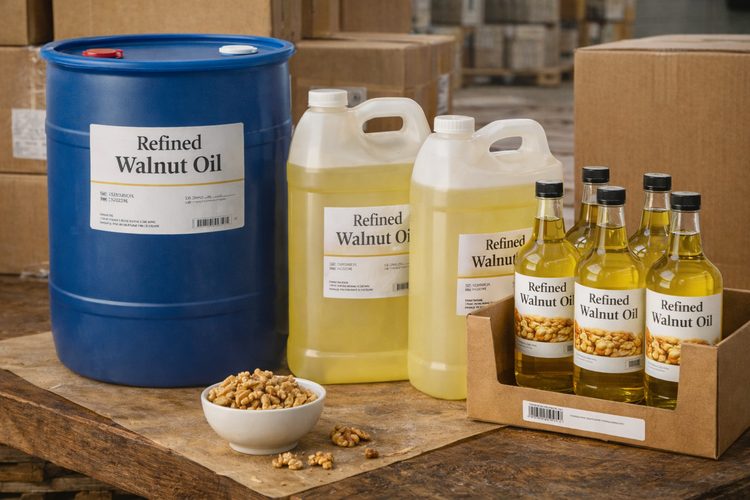
Refined walnut oil is generally selected when buyers need a cleaner, more standardized and more formulation-friendly oil profile than they might expect from less-processed specialty oil routes. In commercial terms, it is often positioned for manufacturers and brands that want the value of walnut-origin oil while reducing variability in flavor intensity, appearance or handling behavior across production and distribution.
Because the oil is commonly used in industrial and blended food systems, buyers typically assess more than origin and basic oil type. They may review clarity, filtration and appearance, packaging compatibility, oxidation-management strategy, storage expectations, destination-market requirements and how the oil will behave in filling, blending, sauce production, dressings, bakery systems or retail bottling. The right specification usually depends on how standardized the buyer needs the finished formulation to be.
Atlas approaches refined walnut oil as part of a broader commercial workflow: define the application, confirm the packaging and distribution model, align the document package and then structure the supply plan around volume, destination and timing. That makes the page relevant to food manufacturers, ingredient buyers, distributors, private label brands, importers and retail oil developers evaluating a refined walnut oil program.
Refined walnut oil is often chosen for a cleaner and more consistent profile, but program success still depends on packaging selection, storage discipline, destination handling and the specific requirements of the finished application.
Refined walnut oil is often chosen when the buyer needs a walnut-derived oil that integrates more easily into broader product systems and commercial workflows.
Buyers often prefer refined oil when they want a more uniform appearance, a cleaner presentation and a format that fits more easily into controlled manufacturing environments and repeated formulation targets.
The category is commonly evaluated for dressings, sauces, baking and industrial systems where a more neutral oil expression and better batch-to-batch consistency can simplify product development and scale-up.
Refined walnut oil can support bulk ingredient supply, foodservice formats and selected retail or private label oil lines, making it commercially relevant to both buyer processors and consumer-facing brands.
The strongest inquiries define the oil in the context of the end use. That allows the buyer and supplier to align on technical expectations, packaging route and commercial feasibility before the project reaches the label, launch or import stage.
| Refined oil definition | Clarify that the project is for refined edible walnut oil and specify whether the intended use is industrial formulation, culinary retail, foodservice, sauce production, dressings, baking or broader ingredient blending. |
|---|---|
| Appearance and clarity | Buyers often define whether the oil must present with a clean, polished and commercially uniform appearance suitable for ingredient handling or finished retail sale. This matters particularly in bottled retail and premium culinary lines. |
| Application fit | State whether the oil will be blended into dressings, used in sauces, filled for retail, applied in baking systems or held as a foodservice ingredient. Different routes can create different expectations around packaging, inventory cycle and quality documentation. |
| Packaging system | Specify whether the requirement is bulk drum or tote, intermediate format, foodservice pack, bottled retail or private label-ready configuration. Container selection affects freight, handling, storage and the commercial presentation of the finished program. |
| Shelf-life strategy | Clarify the target shelf-life at shipment, receipt or shelf, along with expected storage conditions, transit duration and the buyer’s stock-turn model. Shelf-life planning is especially important in export and retail projects. |
| Documents and QA | Common requests include product specification sheet, certificate of analysis, allergen statement, origin declaration, packaging statement, traceability information and any destination-specific documents required for import or customer approval. |
| Commercial program | Share expected trial size, recurring volume, reorder rhythm, destination market, requested Incoterm, target launch or delivery window and whether the program is bulk ingredient, distributor, foodservice, retail or private label oriented. |
Final analytical parameters, packaging details and retail or export presentation requirements should be confirmed in the approved commercial specification for the specific project.
The product can serve both ingredient and consumer-facing channels. The best packaging and logistics route depends on whether the oil will be blended, filled, cooked with, sold directly or moved through foodservice and distribution networks.
Manufacturers may use refined walnut oil in broader product systems where a more standardized oil profile supports formula consistency, easier scale-up and reliable batch behavior.
Refined oil can be evaluated for dressings and vinaigrettes where the buyer wants a cleaner profile and a more stable presentation for consistent finished-product development and repeat production.
In sauce and condiment systems, buyers may focus on how the oil behaves in the overall formulation and whether the refined profile helps align with texture, flavor and commercial positioning targets.
Some buyers look at refined oil where they need a walnut-origin oil that fits more easily into structured baking or culinary systems without requiring the more pronounced character of less-refined alternatives.
Foodservice programs may prefer larger containers that balance premium sourcing with handling convenience, consistent back-of-house performance and manageable inventory rotation.
Selected retail and private label programs may use refined walnut oil where the buyer wants a cleaner shelf presentation, predictable pack appearance and a format that fits a broader consumer audience.
Refined walnut oil packaging is usually discussed in the context of how the oil will be sold or used. Bulk ingredient buyers often prioritize handling efficiency, warehouse practicality and lot control. Foodservice users may focus on pack size and ease of use. Retail or private label buyers may care much more about bottle style, closure choice, carton presentation, label quality and the visual consistency of the finished pack on shelf.
Because refined oil is often selected for its cleaner profile and broader usability, the packaging system should reinforce those strengths. Container choice, fill size, closure, carton build, palletization and label execution can all influence transport performance, warehouse handling, shelf presentation and the perceived quality of the finished program. In premium consumer channels, packaging is not just a protective layer. It is part of the commercial offer.
Although refined oil programs often aim for a cleaner and more standardized commercial profile, storage and handling discipline still play a major role. Transit conditions, warehouse temperature, light exposure, inventory age and post-opening use can all influence how the oil performs by the time it reaches the end user or enters production.
Buyers should think through stock rotation, ambient or controlled storage, pallet stacking, first-in-first-out discipline and how long the oil will remain in inventory before use, filling or sale.
Transit mode, route length and climate exposure can affect the packaging and logistics strategy, especially for export business or longer distribution chains with multiple warehousing points.
Industrial users, foodservice operators and retail consumers create different post-opening conditions. That can influence pack size choice, headspace management and the way the product is positioned commercially.
Refined walnut oil can be relevant to private label and export projects, particularly where the buyer wants a cleaner shelf presentation or broader commercial usability. These projects usually require closer attention to label readiness, packaging component selection, carton marks, barcodes, pallet labels, importer documentation and launch timing than a standard bulk ingredient sale would require.
Private label buyers typically define bottle style, fill size, cap choice, front-label look, back-label content, carton presentation and rollout timing. A more complete brief generally leads to a faster technical and commercial review.
Export projects often need alignment on documentation, destination label format, carton marks, pallet labels, importer expectations and the overall shipment handoff between supplier, forwarder, broker and receiving customer.
Distributors usually focus on reorder rhythm, shelf-life at receipt, storage conditions, pallet efficiency and how well the finished oil program supports downstream commercial movement without unnecessary relabeling or repacking.
Lead time can be influenced by packaging component readiness, artwork approval, production sequencing and the shipment model. Oil projects usually run more smoothly when the buyer shares a realistic launch calendar, not only a price request.
Refined walnut oil is typically priced as a finished commercial system rather than only as a raw edible oil. Packaging and program complexity often shape the real economics.
Pricing may be influenced by oil profile, packaging format, container choice, label scope, carton configuration, pallet build, order size, destination, documentation requirements and the overall complexity of the supply route.
Bulk ingredient supply, foodservice distribution and retail private label runs can each have different MOQ realities depending on packaging customization, project setup and the degree of commercial coordination required.
Lead time may depend as much on packaging readiness, artwork approval and shipment planning as on oil availability. Retail and export programs especially benefit from early packaging and documentation coordination.
A serious refined walnut oil inquiry usually includes enough detail for a genuine commercial review instead of a generic reply. These are the inputs most buyers provide when they want useful feedback.
Use the contact form to share the intended application, packaging format, volume profile, destination and timing. Atlas can review the brief, identify the main technical and commercial checkpoints, and organize the next step for a domestic, export, foodservice or private label oil program.
Refined walnut oil is commonly used in industrial foods, dressings, sauces, baking systems, foodservice and selected retail oil programs where a buyer wants a cleaner, more standardized oil profile.
Atlas can discuss refined walnut oil for domestic and export-oriented business and can review bulk supply, foodservice packs, retail-ready packaging or private label direction where the commercial brief is workable.
Buyers should ideally provide intended application, refined oil expectations, packaging format, annual and per-order volume, destination market, shelf-life strategy, label direction and target timing.
Typical technical review points include appearance, clarity, packaging compatibility, lot consistency, storage plan, oxidation-management approach and the requested quality-document package.
Yes. Depending on the project scope, refined walnut oil may be discussed for industrial ingredient supply, foodservice distribution and selected retail or private label programs.
Price and lead time are commonly shaped by oil profile, packaging format, container choice, label scope, order size, destination, document requirements and shipping structure.
Because packaging affects storage, transport, lot control, shelf presentation and the overall commercial usability of the program. In refined oil projects, the right pack format supports both product integrity and operational efficiency.