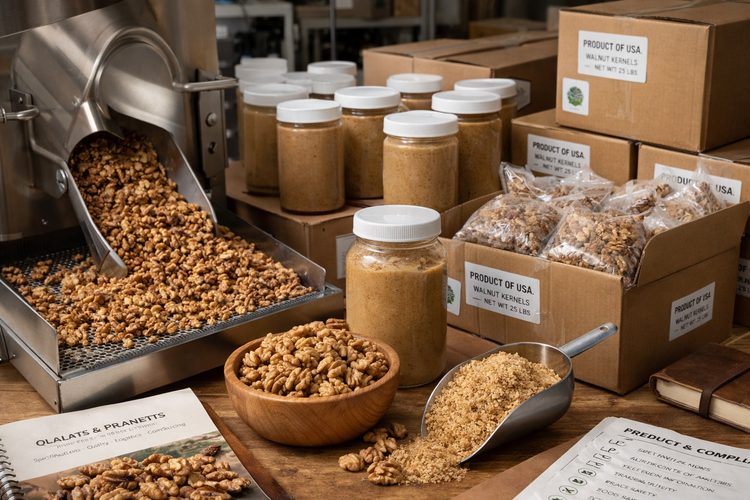
Toll processing for walnuts sits at the intersection of raw material ownership and value-added transformation. In many buyer programs, the buyer either owns the walnut raw material or sources it separately, then uses a processor to convert it into a specific format—roasted kernels, diced cuts, meal, butter or packed retail goods. The commercial value is not only in the transformation itself, but in how precisely the process aligns with the end application.
This is why toll processing is rarely just a “service add-on.” It is a strategic step in product development, cost control and supply chain design. A bakery manufacturer may want custom diced walnuts with controlled particle range. A snack brand may require a specific roast profile for flavor consistency. A private-label customer may need grinding and retail packing under one controlled program. In all these cases, toll processing defines how the walnut performs in the final product.
Understanding the walnut toll processing chain
A typical walnut toll processing program can include multiple steps, depending on the intended output. The core stages usually include receiving raw material, cleaning and inspection, roasting or thermal treatment, size reduction or grinding, blending where required, and final packaging. Not every program uses all steps, but most industrial applications combine at least two or three.
- Receiving and inspection: verifying incoming walnut quality, lot identity and suitability for processing.
- Roasting: dry or oil roasting to develop flavor, reduce moisture and modify texture.
- Cutting or size reduction: producing halves, pieces, diced or granulated formats.
- Grinding: converting walnuts into meal, paste or butter depending on the application.
- Blending: combining walnuts with other ingredients or stabilizing blends where required.
- Packing: bulk, foodservice or retail-ready formats depending on destination.
The key point for buyers is that each stage affects functionality, shelf life, appearance and cost. Toll processing should therefore be specified as part of the product definition, not treated as a generic conversion step.
Roasting: technical and commercial considerations
Roasting is often the first major transformation step in walnut toll processing. It affects flavor development, moisture level, texture and shelf stability. From a technical standpoint, roasting can be adjusted for temperature, time and airflow to create different sensory outcomes.
Dry roasting is commonly used where a clean nut profile is required, while oil roasting may be used in snack applications where seasoning adhesion or specific mouthfeel is desired. The choice is not only technical but commercial. Oil roasting may introduce additional cost and labeling considerations, while dry roasting may require tighter control to achieve consistent flavor.
Buyers should also consider whether roasting is necessary at all. In some bakery or manufacturing applications, raw or pasteurized walnuts are preferred because the final process step (baking or cooking) already develops sufficient flavor.
Grinding and size reduction: from pieces to paste
Grinding and cutting operations define how walnuts behave in formulations. Coarse cuts provide visual identity and texture, while finer cuts and meal formats provide more uniform distribution and flavor integration. At the extreme end, grinding produces walnut butter or paste, which behaves more like a fat-rich ingredient than a particulate inclusion.
Commercially, this means buyers should not treat “ground walnuts” as a single category. There is a wide range between coarse meal and smooth butter, and each requires different equipment, processing time and cost structure.
Typical processed formats include:
- Coarse diced walnuts for bakery and snack use
- Granulated walnuts for cereal and topping blends
- Walnut meal for fillings and specialty baking
- Walnut paste or butter for spreads, sauces and plant-based products
Each of these formats changes not only product functionality but also packaging needs and shelf-life management.
Packing: where processing meets market requirements
Packing is often underestimated in toll processing discussions, but it is where the product becomes commercially usable. A processor may be able to roast and grind walnuts effectively, but if the pack format does not match the customer’s distribution model, the program will not scale efficiently.
Bulk industrial packing is typically used for manufacturers, while smaller formats are used for foodservice or retail. Private label programs may require custom packaging, labeling and documentation aligned with specific markets. Export programs may add further requirements such as language, compliance labeling and shipping configuration.
For buyers, this means pack style should be defined at the same time as processing steps. Changing packaging late in the process can affect lead time, cost and documentation.
Commercial reality: toll processing is most efficient when roasting, grinding and packing are planned together as one program, not as separate decisions.
How this topic shows up in real buying decisions
In real sourcing discussions, toll processing appears when buyers need flexibility. Some customers already have walnut supply and want to convert it into a finished format. Others want a partner to manage both sourcing and processing under one structure. The decision depends on control, cost and operational preference.
For example:
- A bakery brand may supply raw walnuts and request diced and packed output.
- A snack company may require roasting and seasoning before packaging.
- A plant-based food producer may need grinding into butter or paste.
Each scenario changes how the toll processing program is quoted and structured.
What Atlas would ask before quoting
Before discussing toll processing options, Atlas typically asks buyers to clarify:
- Raw material ownership: supplied by customer or sourced through Atlas
- Processing steps required: roasting, cutting, grinding, blending
- Target output format: kernel, diced, meal, butter or packed product
- Pack style: bulk, foodservice, retail or export
- Volume and frequency: trial, batch or ongoing program
- Destination market and compliance requirements
- Timeline and production window
These inputs help determine whether a simple processing service or a fully integrated sourcing and processing program is more appropriate.
Commercial planning points
Toll processing programs often develop in stages. A typical progression includes initial trials, validation runs and then scaled production. This staged approach allows buyers to confirm that the processed walnut meets performance expectations before committing to larger volumes.
From a commercial standpoint, toll processing can affect pricing structure. Costs may be separated into raw material value and processing fees, or combined into a delivered product price. Lead times may also depend on processing capacity and scheduling, especially for specialized formats or private label programs.
Repeatability is critical. The best toll processing programs are those where processing parameters, pack formats and shipment cadence are clearly defined and consistently maintained.
Buyer planning note
Atlas Global Trading Co. uses toll processing discussions to help buyers move from concept to execution. Whether the need is roasting, grinding, packing or a combination of all three, the goal is to align processing with the final application and commercial structure.
If you are evaluating walnut toll processing, share the raw material type, processing steps, output format, packaging, volume and destination through the contact form. That allows Atlas to structure a more precise and practical response based on real program requirements.
Need toll processing support for walnuts?
Turn your processing requirement into a structured quote request with Atlas.
- Define processing steps (roasting, grinding, packing)
- Share output format and volume
- Include destination and timing
Frequently Asked Questions
When does toll processing make sense for walnuts?
Toll processing makes sense when a buyer already has walnut raw material or wants to control sourcing separately while outsourcing transformation steps such as roasting, grinding or packing.
What operations are typically included in walnut toll processing?
Typical operations include roasting, cutting or dicing, grinding into meal or butter, blending and final packaging into bulk or retail formats.
What should buyers define before requesting a toll processing quote?
Buyers should define raw material type, required processing steps, output specification, packaging format, volume, destination and timeline.