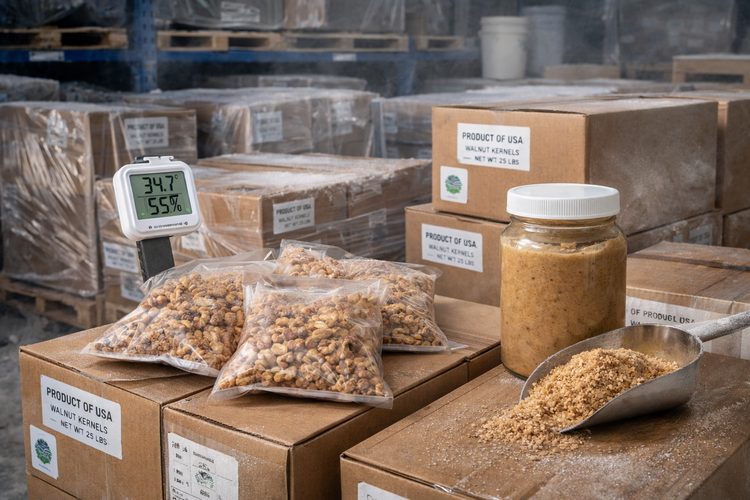
Storage stability is one of the most commercially important topics in walnut trade because walnuts are not a static dry commodity. They are a fat-rich food ingredient whose usable life depends on how the product is processed, packed, stored, shipped and handled after arrival. For buyer buyers, the practical concern is not only whether walnuts are good on the day they ship. The real question is whether the walnuts will still be commercially fit when they are received, warehoused, staged, opened, portioned, run on line and incorporated into the final application.
That is why storage, oxidation and rancidity control should be treated as part of the original walnut specification rather than an afterthought for the warehouse team. A whole kernel program for near-term domestic production has a different storage profile from a diced walnut ingredient crossing multiple logistics steps. Walnut meal for bakery, walnut butter for spreads and walnut oil for specialty food use all behave differently because the amount of exposed surface, available oxygen contact, process history and packaging protection are not the same. Better commercial outcomes usually come from aligning product form, cut exposure, packaging route, expected dwell time and shipment timing before the order is placed.
Why walnuts require careful oxidation control
Walnuts are valued for flavor, texture and premium positioning, but those same product characteristics come with storage sensitivity. Compared with more inert dry ingredients, walnut quality can change more noticeably when exposed to oxygen, heat, light, extended holding time or poor pack integrity. In commercial terms, that means quality loss is not always dramatic at first. It may appear gradually as flatter nut flavor, stale notes, bitterness, less clean aroma, darker appearance, softer texture or reduced customer acceptance. By the time a buyer describes the issue as rancidity, the product may already be commercially compromised.
For industrial buyers, oxidation control is therefore about preserving usable flavor and functional value across the real life of the product. That life includes post-processing time, pre-shipment holding, in-transit time, customs or port dwell where relevant, warehouse storage, internal transfers and the operating schedule of the customer’s production plant. A walnut program that looks acceptable on paper can still perform poorly if the timeline between packout and end use is too long for the chosen format and packaging system.
Buyer takeaway: walnuts should not be evaluated only at ship date. The more useful question is whether the chosen format and packaging will still support the intended application after real-world transit, storage and production handling.
How walnut format changes storage behavior
The storage profile of walnuts changes significantly with format. In-shell walnuts, whole kernels, halves and larger pieces generally present a different oxidation exposure compared with smaller cuts, meal, fine flour, butter or oil. The reason is simple commercial logic: the more the product is reduced, cut or processed, the more surface area becomes exposed and the more tightly storage control usually matters.
For buyers, the main practical hierarchy often looks like this:
- In-shell walnuts: the shell provides an additional physical barrier, so the handling and market logic differ from shelled ingredient programs.
- Whole kernels and large pieces: generally more robust than smaller processed formats when all other factors are equal.
- Diced and chopped walnuts: more cut exposure means more attention to pack integrity, storage time and warehouse conditions.
- Walnut meal and fine flour: smaller particle size usually means tighter control is needed because the product is more exposed and more integrated into the surrounding environment.
- Walnut butter and paste: these formats require their own handling logic because oxidation control, oil behavior and pack system design become more sensitive.
- Walnut oil: highly format-specific and often handled under even more deliberate packaging and shelf-life logic.
This does not mean smaller or more processed formats are commercially problematic. It means they should not be purchased with the same timing and handling assumptions as larger kernel material.
Storage conditions that matter in real buying decisions
In practice, walnut storage performance is shaped by a combination of temperature, oxygen exposure, light exposure, packaging condition, residence time and warehouse discipline. Buyers often focus first on nominal storage temperature, but temperature is only one part of the system. A walnut ingredient packed well and moved quickly may outperform a poorly packed item stored in an otherwise acceptable room. Likewise, a good pack can still lose commercial value if it is repeatedly opened, partially consumed and poorly resealed in plant operation.
From a buyer standpoint, the most relevant storage questions usually include:
- How long will the walnuts be stored before use?
- Will the product move quickly through production, or sit in inventory as a safety stock item?
- Will the original pack be kept intact until use, or opened and rehandled multiple times?
- Is the application domestic with short transit, or export with longer logistics exposure?
- Does the chosen walnut format match the actual inventory turnover of the customer?
Those questions are commercially more useful than treating storage as a generic warehouse instruction.
What rancidity risk looks like in different walnut applications
Not every application reveals oxidation in the same way. In some end uses, a modest flavor shift becomes obvious very quickly. In others, the change may be partly masked at first by sugar, chocolate, seasoning, baked flavors or blended ingredients. That can create a false sense of security. The material may seem commercially usable during early trials yet create inconsistency later in the product life cycle.
Typical application-specific considerations include:
- Bakery: diced walnuts, meal and toppings need to hold acceptable flavor through storage before the bake, and the bakery product itself may have its own shelf-life expectations afterward.
- Confectionery: premium sensory systems often reveal off-notes quickly because the walnut is expected to taste clean and rich, not stale or bitter.
- Granola and cereal: products may sit in distribution longer, so the walnut format and packout discipline become especially relevant.
- Snack mixes: roasted and flavored walnut items need both oxidative stability and pack integrity, especially in consumer-facing channels.
- Sauces, fillings and walnut butter systems: more processed formats may require closer control because the walnut is highly dispersed and flavor changes can affect the whole system.
That is why the same walnut may be commercially suitable in one application and too risky in another. End use changes the storage conversation.
Packaging is one of the main controls, not a secondary detail
Packaging is one of the most important commercial tools for oxidation control because it determines how well the walnut is protected from air, light, moisture fluctuation and distribution stress. Buyers often ask first about walnut grade or cut size, but the packaging structure can be just as important in determining whether the product arrives and performs as expected.
In practical trade terms, walnut pack decisions usually involve tradeoffs between protection, handling efficiency, unit size and end-market needs. Bulk industrial packs may work well for high-turn manufacturing where product is used promptly after opening. More protective or specialized pack systems may be preferred where the product has a longer logistics path, slower turnover or more sensitive format. Retail and export programs often add additional constraints because consumer-facing packaging, labeling and shelf presentation need to work alongside protection.
Commercially, buyers should define not only the walnut itself but also the packaging logic:
- whether the requirement is industrial bulk, foodservice, retail-ready or private label,
- whether the product will be opened all at once or staged across multiple production runs,
- whether the route is domestic or export,
- whether the program needs short-term working stock or longer inventory holding.
A walnut item with the right pack structure and timing can often outperform a nominally similar item packed for a different commercial route.
Cut exposure and why smaller formats need more disciplined planning
One of the most important but often overlooked issues in walnut procurement is cut exposure. As kernels are chopped, diced, milled or ground, more of the internal material becomes exposed. That is often necessary for functionality and application fit, but it also changes how the product should be stored and how quickly it should move through the supply chain.
For example, a bakery buyer choosing diced walnuts for even distribution in cookies or brownies may gain process consistency but also accept a format that usually needs tighter inventory discipline than whole kernels. A buyer using walnut meal for a filling or specialty baking system may gain better flavor integration and finer texture while also moving into a format that should not be held under overly casual storage assumptions. These are not arguments against processed formats. They are arguments for better specification and timing.
Specification tip: when the walnut format becomes smaller or more processed, buyers should usually pay closer attention to dwell time, pack size, shipping route and warehouse turnover. The processing gain should be matched by stronger handling discipline.
How this topic shows up in real buying decisions
In real sourcing discussions, storage and oxidation concerns appear in several ways. Sometimes a buyer is choosing between whole kernels and diced product and needs to understand the shelf-life implications. Sometimes the issue is whether a domestic pack system will still work for export. Sometimes the product is technically correct, but the customer’s inventory rhythm is too slow for the selected format. And sometimes the problem is not the product itself, but the gap between warehouse practice and the original sourcing assumption.
For walnuts, the quote should reflect the real format and route. Whole kernel material is different from diced, meal, extra fine flour, butter or oil. The commercial logic also changes when the material is raw, pasteurized, dry roasted or oil roasted. Roasted and flavored items may carry their own storage implications because flavor integrity, pack barrier performance and retail shelf presentation are all part of the commercial requirement.
For walnut buyers, the usable product menu can include in-shell walnuts, raw walnuts, pasteurized walnuts, dry roasted walnuts, diced walnuts, meal, butter and oil. Which of those makes sense depends not only on the end use, but also on how long the customer intends to hold inventory, what pack system is planned and how much transit or repacking the product will go through before consumption.
Common commercial mistakes in walnut shelf-life planning
Several recurring mistakes tend to reduce performance in walnut programs:
- buying a more processed walnut format without adjusting inventory turnover expectations,
- focusing on price per pound while ignoring logistics time and post-arrival storage reality,
- using large bulk packs for operations that actually consume product slowly after opening,
- treating export routes as if they have the same timing profile as domestic shipments,
- assuming the packaging is only a transport detail instead of a shelf-life protection tool,
- using the same handling logic for kernels, diced cuts, meal and butter.
These issues often create preventable quality loss that is attributed vaguely to “product freshness” when the root cause is actually a mismatch between format, pack type and commercial flow.
What Atlas would ask before quoting
Atlas generally encourages buyers to define intended use, pack style, destination, timeline and quality expectations early. For walnut storage-sensitive programs, that discussion often becomes more specific. Before building a meaningful quote, Atlas would usually want to understand:
- the exact walnut format required: kernels, pieces, diced, meal, butter or oil,
- the intended application and whether the walnut is a visible inclusion, flavor component or base ingredient,
- whether the product is raw, pasteurized, roasted or otherwise further processed,
- the expected inventory turnover and whether the product is for quick production use or extended holding,
- the pack style required: industrial bulk, foodservice, retail-ready, private label or export-oriented,
- the destination market and likely shipment duration,
- the estimated volume pattern: trial, monthly replenishment, seasonal buy or container program,
- any specific shelf-life or quality-hold expectations relevant to the customer’s system.
Those inputs help reduce avoidable back-and-forth and improve comparability across California supply options. More importantly, they help make sure the selected walnut format suits the real storage profile of the program.
Commercial planning points
From a trading standpoint, the strongest walnut programs are built around repeatability and realistic timing. That means the buyer does not simply choose the cheapest usable format, but the format that can be stored, moved and consumed with reasonable quality confidence across the real logistics chain. Clear documentation, agreed packaging, sensible shipment cadence and aligned replenishment timing are all part of oxidation control in a commercial sense.
When relevant, the brief should also mention whether the program is industrial bulk, foodservice, retail-ready, private label or export-oriented. That single clarification often changes packaging, documentation and timing assumptions. A fast-turn domestic bakery account may be able to use one format and pack style efficiently, while an export retail customer may need a different structure to maintain acceptable quality through a longer route.
Commercially, many buyers benefit from planning walnuts in stages: trial quantity, validation run, launch volume and repeat replenishment. That logic is especially useful when moving into smaller-cut or more processed walnut formats. It allows the customer to confirm not only application fit, but also whether the chosen pack and timing assumptions are sustainable in real operation.
Buyer planning note
Atlas Global Trading Co. uses topics like this to move conversations from broad interest to a specification-minded inquiry. For walnut storage-sensitive programs, the most useful first step is to define the real format, the intended application, the expected storage window, the packaging style and the destination. That creates a more practical basis for discussing California supply options than a generic request for walnut pricing.
If you are evaluating walnuts supply for bakery, confectionery, sauces and fillings, snacks, granola, foodservice or export retail, share the format, pack style, estimated volume and destination using the floating contact form. That helps make the next step grounded in a real commercial need rather than a broad category assumption.
Need help sourcing around this walnut storage topic?
Use the contact form to turn this shelf-life and handling topic into a practical quote request for Atlas and its California supply partners.
- State the exact walnut format and application
- Add target monthly or trial volume and timing
- Include destination market and preferred pack style
Frequently Asked Questions
What is the main buyer takeaway from “Storage, Oxidation and Rancidity Control for Walnut Ingredients”?
The main buyer takeaway is that walnut shelf life is influenced by format, cut exposure, packaging choice, storage discipline and shipment timing. Better commercial outcomes come from aligning those factors before supply is booked.
Which walnut formats usually require the closest storage attention?
More processed formats such as diced walnuts, meal, flour, butter and oil generally require closer attention because greater surface exposure can increase sensitivity to oxidation, flavor change and quality loss during storage and transport.
Can this topic be applied to both U.S. and export walnut programs?
Yes. The same storage and oxidation logic applies to domestic and export programs, although packaging, transit time, warehouse handling and documentation expectations may vary by destination.