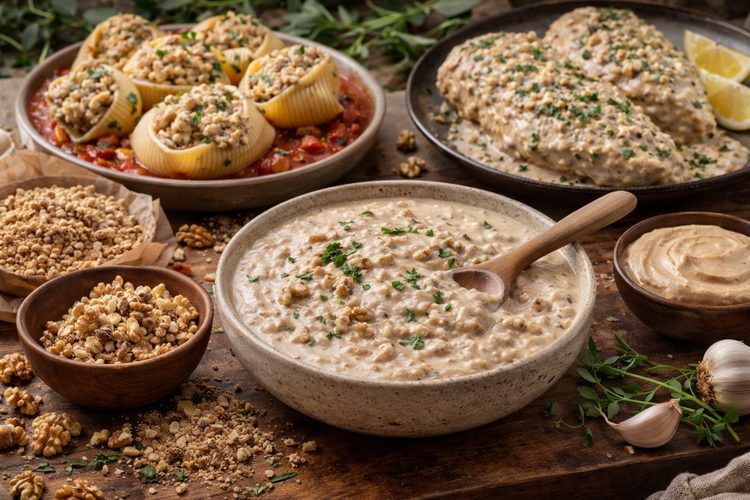
Walnuts can move across multiple end uses, but sauces, fillings and savory preparations are a distinct category because the walnut is often expected to do more than add simple inclusion texture. In these systems, walnuts may build body, contribute natural richness, create visible particulate, support emulsified texture, soften sharp seasoning profiles or deliver a deeper nut signature that stays noticeable after cooking, blending or reheating. That means the buying decision is rarely about “walnuts” in the broad sense. It is usually about choosing the exact walnut format that matches the finished texture, process route and commercial handling model.
Atlas generally positions walnut sauce and filling programs by asking what the walnut needs to do on line and in the final product. Does it need to remain visible as a coarse rustic component? Does it need to blend down into a smoother paste-like base? Is the objective creaminess, particulate texture, thickening effect, oil contribution, flavor depth or a combination of those? The stronger commercial outcome usually comes from aligning particle size, roast style, packaging, inventory rhythm and shipment timing before the order is placed rather than trying to adjust these variables later.
Why walnuts work well in sauces, fillings and savory systems
Walnuts are particularly useful in savory preparations because they can bring both sensory and structural value. Flavor-wise, they add richness and nut depth that can complement herb-forward, dairy-based, roasted vegetable, spice-led or regional savory profiles. Functionally, they can help build texture, especially where the formulation benefits from natural nut solids and fat content. In some applications, the walnut acts like a visible inclusion. In others, it behaves more like a thickening or body-building ingredient once milled, ground or blended.
That dual role is commercially important. A buyer may be sourcing the walnut not only for taste, but also because it helps the sauce or filling reach a certain mouthfeel or visual identity. In premium foodservice and prepared-food systems, walnuts can help position the product as more artisanal or more culinary. In industrial applications, they may be selected because they support texture and flavor simultaneously, reducing the need to solve those two objectives separately.
Buyer framing: walnut sauce and filling programs should be specified by function. The real question is whether the walnut is there to create visible texture, smooth body, creamy richness, flavor lift or all of these together.
How this topic shows up in real buying decisions
In practice, buyers usually compare several walnut formats before settling on a program for sauces and fillings. They may review chopped walnuts for visible texture, meal for broader incorporation, fine granulations for controlled body, butter or paste for smooth richness, or roasted formats for stronger flavor development. The right choice depends on the balance between appearance, blendability, oil release, target viscosity, finished bite and total delivered cost.
For walnut buyers, the usable product menu often includes raw walnuts, pasteurized walnuts, dry roasted walnuts and processed formats such as diced cuts, meal, fine flour-style reductions, butter and oil. Which of those makes sense depends on whether the customer is manufacturing further, packing retail sauces, supplying foodservice or planning export distribution. A foodservice dip, a frozen prepared filling and a premium shelf-stable savory spread may all use walnuts, yet each one creates a different quote request.
Walnut formats commonly used in sauces and fillings
Format selection is usually the most important technical and commercial decision in this category because it determines how the walnuts interact with the rest of the formulation. A large cut may deliver visible rustic character but be unsuitable for a smooth or pumpable system. A fine meal may create broad body and flavor distribution but remove the premium particulate effect. Butter or paste can contribute creaminess and nut richness, but those formats behave very differently from chopped or meal-grade walnuts in storage, handling and application cost.
Common commercial options include:
- Chopped walnuts: used when the sauce or filling needs visible walnut identity, rustic texture or a more handcrafted appearance.
- Fine chopped or granulated walnuts: useful where some visible particulate is desired but the system needs better distribution and more controlled mouthfeel.
- Walnut meal: often selected when the goal is broader integration, thickness contribution and nut flavor without large visible pieces.
- Walnut paste or butter: relevant when the target system is smoother, richer and more spreadable, or when a more emulsified texture is required.
- Walnut oil: sometimes considered for flavor or texture adjustment, although it usually belongs to a more specialized commercial discussion.
The best choice depends on what the customer wants the finished product to look and feel like, not just on which walnut format is easiest to quote.
Texture goals: visible particulate versus smooth integration
Texture is often the main reason buyers choose one walnut format over another in savory systems. Some sauce and filling programs intentionally want a coarser, rustic profile with visible nut character. Others need a more refined, smooth or semi-smooth texture for pumping, portioning, depositing or spreading. The exact target affects whether the walnut should behave as an inclusion, a structural solid, a fine flavor carrier or a creamy base.
For example, a savory pastry filling may benefit from finely chopped walnuts that remain perceptible but do not interfere with depositing or bite. A regional-style sauce may call for walnut meal or fine granulation that blends into the matrix while still contributing density and nut complexity. A premium dip or spread may instead move toward butter or paste where the walnut becomes part of the core body rather than a visible inclusion. These are materially different commercial decisions even though all fall under “using walnuts in sauces and fillings.”
Oil release and why it matters in formulation planning
Walnuts do not only contribute solids. They also contribute oil, and the degree of processing changes how much of that oil becomes functionally available in the system. Larger chopped walnuts behave differently than meal. Meal behaves differently than paste or butter. That matters because oil release can affect mouthfeel, richness perception, cohesion, surface appearance and overall process behavior. In some savory systems, this is beneficial because it helps build a more luxurious texture. In others, too much oil expression may complicate handling or alter the finished look.
From a buying perspective, that means a shift in format is not merely a cosmetic change. Moving from chopped walnut to meal or paste usually changes the functional behavior of the formulation. This is why commercial buyers often stage these projects through trials and validation runs rather than assuming one walnut form can be swapped directly for another without consequence.
Specification tip: if the walnut is being used partly for texture and partly for richness, say so in the first inquiry. That helps frame whether a chopped, meal or butter format is more commercially realistic.
Raw, pasteurized and roasted options for savory systems
Roast state influences flavor intensity, color and how the walnut behaves in the final savory preparation. Raw or pasteurized walnuts may be preferred where the manufacturing process itself will generate sufficient flavor or where the buyer wants a cleaner and less developed walnut note. Dry roasted walnuts are often considered where the goal is a more immediate nut aroma, stronger savory depth or a fuller flavor profile in a finished sauce or filling.
Commercially, the roast decision should be tied to the end application. A sauce that is blended and lightly heated may need more pre-developed walnut character than a filling that undergoes baking or a multi-step cooking process. A roasted walnut may strengthen flavor perception, but it can also change color and visual tone in the finished product. The correct choice depends on whether the final system is intended to read as fresh, rustic, deeply savory or more neutral and versatile.
Application-specific examples
Walnuts appear in a wide range of savory systems, and each one changes the sourcing logic:
- Savory sauces: walnuts may be used for body, richness, visible texture or regional culinary identity. Meal and fine granulation are often practical starting points, though chopped formats can work for more rustic concepts.
- Prepared fillings: fillings for baked or savory products often need balance between flavor, depositability and texture. This may move the project toward fine chopped or meal formats rather than larger pieces.
- Spreads and dips: smoother or more creamy systems may require paste or butter, sometimes supported by a smaller particulate fraction for texture.
- Savory preparations for foodservice: menu-driven products may want visible walnut identity because the ingredient supports premium positioning and menu description.
- Frozen or reheated prepared foods: the walnut format must tolerate the product’s full life cycle, not just initial processing.
That is why Atlas generally encourages buyers to describe the exact end use instead of asking only for walnut pricing by format.
Process route and line practicality
In sauce and filling systems, the process route matters as much as the ingredient itself. A walnut format that works well in a bench sample may not behave the same way in kettles, mixers, grinders, depositors or packout equipment. Pumpability, depositor consistency, blend uniformity, reheating behavior and hold stability can all influence whether a chosen format is practical at scale. For this reason, the quote should reflect the real manufacturing route and not just the conceptual product idea.
For example, a visible chopped walnut may look compelling in a premium savory filling, but if it interferes with nozzle performance or causes inconsistent deposit weight, it may not be the right production format. A finer meal or controlled granulation may provide a better commercial solution even if it changes the original visual concept slightly. Buyers usually get better outcomes when process reality is included early in the brief.
Packaging and handling considerations
Packaging matters because different walnut formats are handled differently in sauce and filling production. A coarse chopped product used quickly in industrial manufacturing may be commercially suited to one pack style. A finer walnut meal or butter intended for slower or staged usage may require different handling assumptions. In export or retail-oriented programs, packaging must also support transit, storage and documentation requirements in a way that fits the finished product route.
For walnut sauce and filling projects, buyers should normally define whether the program is industrial bulk, foodservice, retail-ready, private label or export-oriented. That single clarification often changes packaging, documentation and timing assumptions. The same walnut format may remain technically acceptable, but the commercial pack logic may change substantially.
What Atlas would ask before quoting
For walnut sauce, filling and savory preparation projects, Atlas recommends converting the product concept into a clear quote request. That makes it easier to discuss realistic California partner options instead of a generic price-only inquiry. Atlas would typically want to know:
- the target walnut format: chopped, fine chopped, meal, paste, butter or another defined form,
- the intended application: sauce, filling, dip, spread, savory prepared food or foodservice preparation,
- whether the target texture is rustic, semi-smooth, smooth or creamy,
- whether the walnut should remain visible or integrate fully into the system,
- whether the buyer prefers raw, pasteurized or roasted walnut input,
- the pack style and production handling requirement,
- the destination market and timeline,
- the expected volume rhythm: sample, trial, validation, launch quantity or repeat replenishment.
These inputs help reduce avoidable back-and-forth and improve comparability across California supply options. They also help determine whether the walnut is being sourced as a flavor-building ingredient, a texture ingredient or both.
Commercial planning points
Commercially, these projects often develop in stages: trial quantity, validation run, launch volume and repeat replenishment. That logic is especially useful in sauces and fillings because the functional behavior of the walnut format is difficult to judge fully without real formulation work. A chopped walnut that seems correct in principle may create handling issues. A meal or butter format that seems less visually exciting may outperform in process consistency, body and finished sensory profile.
From a trading standpoint, the best programs are built around repeatability rather than one-off emergency buying. That means clear format definition, agreed packaging, sensible shipment cadence and a commercial structure that supports continuity. When relevant, the brief should also mention whether the project is industrial bulk, foodservice, retail-ready, private label or export-oriented. That single clarification often changes packaging, documentation and timing assumptions.
Buyers should also evaluate total delivered value rather than isolated raw material price. The right walnut format may reduce formula adjustment, improve processing consistency, strengthen finished flavor and create a better premium position in market. Those gains often matter more than a narrow nominal cost comparison.
Buyer planning note
Atlas Global Trading Co. uses topics like this to move conversations from broad interest to a specification-minded inquiry. If you are evaluating walnut supply for sauces, fillings or savory preparations, share the target format, texture goal, process route, pack style, estimated volume and destination using the floating contact form. That gives the next step a real commercial foundation.
Whether the need is for rustic savory fillings, smoother sauce bases, premium foodservice preparations or export-oriented retail products, the same principle applies: walnuts sourcing works better when the product form, intended application, packaging and commercial timing are defined together.
Need help sourcing around this walnut sauce and filling topic?
Use the contact form to share your product, packaging, destination and timing requirements for a practical quotation.
- State the exact walnut format and target texture
- Add target monthly or trial volume
- Include destination market, pack style and timing
Frequently Asked Questions
What is the main buyer takeaway from “Using Walnuts in Sauces, Fillings and Savory Preparations”?
The main buyer takeaway is that walnut sauce and filling programs work better when particle size, texture target, oil release, packaging format and commercial timing are defined together rather than treated as a generic walnut purchase.
Which walnut format usually works best in sauces and fillings?
There is no single best format for every system. Buyers typically compare chopped walnuts, meal, fine granulation, paste, butter and sometimes oil depending on whether the goal is visible texture, thickening, body, creaminess or nut flavor development.
Can this topic be applied to both U.S. and export programs?
Yes. The same technical logic applies to domestic and export walnut sauce and filling programs, although packaging, shelf-life planning, documentation and logistics requirements may vary by market.