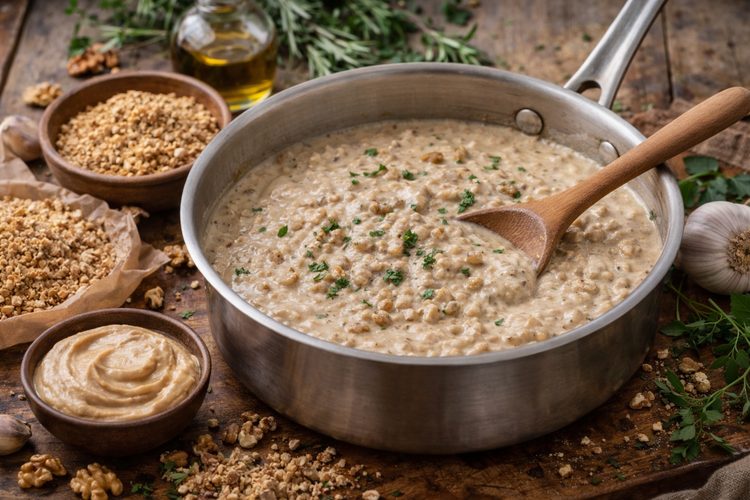
Walnut sauce systems matter because industrial nut buying is rarely only about nominal price. In sauce applications, the ingredient is often expected to do several jobs at once: deepen flavor, provide natural richness, influence viscosity, contribute body, support emulsified texture or leave a visible particulate signature that distinguishes the finished product from simpler sauce concepts. The stronger commercial outcome usually comes from aligning the walnut format, the processing route, the packaging plan and the shipment timing before the order is placed.
For Atlas, the most practical starting point is not simply asking whether the customer wants walnuts in a sauce. The real question is what the walnut needs to do in the finished system. Should it remain visible and rustic? Should it blend down into a smooth body? Is the objective creaminess, thickening effect, rounded savory flavor or a premium nut-forward identity? Those decisions affect whether the buyer should be looking at chopped kernels, fine granulations, meal, butter, paste or another walnut-derived format.
Why walnuts are used in sauce systems
Walnuts are useful in sauce systems because they can contribute both flavor and structure. Their nut solids can help create body, their natural oil can bring richness and roundness, and their flavor profile can help sauces feel deeper, more premium and more culinary. In some applications, the walnut behaves mainly as a flavor ingredient. In others, it behaves more like a texture-building component that changes the mouthfeel, coating properties and visual style of the finished sauce.
This is why walnut sauce programs are often more specification-sensitive than standard nut ingredient purchases. A walnut sauce can fail commercially even when the base walnut quality is acceptable if the chosen format is wrong for the line, the product texture target or the final shelf-life strategy. The right walnut format is the one that supports the finished sauce system, not just the one with the lowest unit price.
Buyer takeaway: in sauce systems, walnut sourcing should be framed around the finished texture and flavor target. The product brief should define whether the walnut is expected to create visible texture, smooth body, richness, flavor lift or all of these together.
How this topic shows up in real buying decisions
For walnuts, the quote should reflect the real format and route. Whole or kernel material is different from diced, meal, extra fine flour, butter or oil. The commercial logic also changes when the material is raw, pasteurized, dry roasted or oil roasted. Sauce manufacturers often compare several of these routes because the finished system may need a specific balance between blendability, oil release, flavor intensity and visual appearance.
For walnut buyers, the usable product menu usually includes raw walnuts, pasteurized walnuts, dry roasted walnuts and processed formats such as chopped cuts, meal, butter and oil. Which of those makes sense depends on the end use, whether the customer is manufacturing further, packing retail sauces, supplying foodservice or planning export distribution. A foodservice sauce concentrate, a chilled ready-to-use sauce and a shelf-stable retail sauce may all use walnuts, yet the correct ingredient route for each can be very different.
Format options for walnut sauce systems
Format selection is usually the first major technical choice because it determines how the walnut behaves under shear, heat and blending. A coarser chopped format may preserve visible identity but may not create the smoothness or viscosity stability the customer wants. Walnut meal may integrate more broadly into the matrix while still bringing nut solids and body. Paste or butter may move the system toward a more uniform, rich texture while changing handling and cost assumptions.
Common commercial options include:
- Chopped walnuts: chosen when the sauce needs visible walnut texture, rustic character or premium particulate appearance.
- Fine chopped or granulated walnuts: useful when some walnut visibility is desired but the system must remain more controlled and more evenly distributed.
- Walnut meal: often selected for broader integration, body contribution and less obvious particulate texture.
- Walnut paste or butter: relevant where the target system is smoother, richer, creamier or more spreadable.
- Walnut oil: sometimes considered in more specialized programs where flavor adjustment or oil-phase tuning is part of the commercial brief.
The right answer depends on the exact sauce target rather than a general category preference. A premium rustic savory sauce may need visible walnut character, while a finer processed sauce may need meal or butter to achieve the required flow and mouthfeel.
Texture control: from rustic body to smooth emulsified systems
Texture control is often the main reason buyers turn to walnuts in sauce development. In some systems, the goal is to produce a coarse, artisanal sauce with visible particulates and a more handcrafted impression. In others, the target is a refined, smooth or semi-smooth system that still benefits from walnut richness without obvious pieces. These two directions can require completely different walnut formats and processing routes.
For example, a rustic savory sauce may work well with chopped or coarse granulated walnuts that provide visible suspension and a more natural appearance. A smoother sauce base may instead rely on meal or butter to build body and nut depth without compromising the flow or finish. The most commercially practical decision is not always the most visually impressive walnut sample; it is the format that performs consistently in the final sauce system under real plant conditions.
Flavor depth and roast state
Roast state matters in sauce systems because it affects both flavor intensity and tonal direction. Raw or pasteurized walnuts may be preferred where the manufacturing process itself is expected to build enough flavor or where a cleaner and lighter nut note is desirable. Dry roasted walnuts may be more suitable where the buyer wants stronger nut character, deeper savory dimension or a more immediately expressive walnut presence.
Commercially, this decision should be tied to how the sauce is processed. A sauce that undergoes cooking, reduction or other thermal steps may not need the same pre-developed roast flavor as a blended or lightly heated sauce. At the same time, a more developed walnut input can help achieve a premium sensory target with less dependence on other flavor-building components. The correct choice depends on the finished flavor direction, not only on the walnut itself.
Flavor planning point: when asking for a quote, specify whether the walnut is meant to provide a mild background nut note or a more distinct roasted walnut profile. That single distinction can change the most suitable input format.
Oil release and richness management
Walnuts do not only contribute solids. They also contribute oil, and the amount of available oil changes as the particle size becomes smaller and as the product moves from chopped to meal to paste or butter. This matters because oil release influences mouthfeel, perceived richness, viscosity behavior and the final visual look of the sauce. In some sauce systems, this is highly desirable because it creates a fuller and more luxurious texture. In others, too much oil expression can complicate handling, stability or the target finish.
From a commercial standpoint, buyers should treat oil release as part of specification thinking, not as an incidental side effect. A walnut butter or paste route can be excellent when the goal is richness and body, but it will not behave like chopped walnut suspended in a sauce. Likewise, a meal-grade walnut may build body differently than a more visible granulation. Trial work is often necessary because the practical effect on texture can be material.
Where walnuts fit in different sauce categories
Walnuts can be relevant across several savory sauce styles, but the quote request changes by category:
- Rustic savory sauces: often favor visible particulate and more natural visual identity, which can move the project toward chopped or coarse granulated walnuts.
- Semi-smooth finished sauces: may use fine granulations or meal where some body is desired but visible chunkiness must be controlled.
- Spreadable savory bases: may require paste or butter where smoothness and richness are central.
- Foodservice sauce preparations: often need a balance between premium sensory profile and practical handling in kitchens or production systems.
- Retail sauce programs: may require more deliberate thinking around pack style, shelf-life planning and repeat texture consistency.
This is why Atlas generally encourages buyers to describe the real application, not only the ingredient format they think they want. The best walnut route sometimes becomes clearer once the end system is defined more precisely.
Process route and manufacturing reality
In sauce programs, the process route matters as much as the ingredient itself. Mixers, kettles, grinders, shear systems, depositors and filling equipment all influence whether a chosen walnut format is practical at scale. A format that looks ideal in a bench concept may become difficult under production shear, heating or filling conditions. Conversely, a less visually dramatic format may deliver the best overall result once flow, texture consistency and repeatability are considered.
For this reason, the quote request should reflect the real manufacturing path. Buyers generally get better sourcing outcomes when they explain whether the walnuts will be blended, milled, cooked, held hot, filled cold, reheated later or packed for longer distribution. These details materially affect the most suitable walnut format and the most realistic commercial conversation.
Packaging and handling considerations
Packaging matters because different walnut formats create different handling needs. Chopped or granulated walnuts used quickly in industrial production may fit one packaging logic. Walnut meal, butter or paste may require another, especially if the usage pattern is slower or if the ingredient is staged across multiple runs. In export and retail programs, packaging also has to support shelf-life protection, labeling and transit expectations in addition to plant handling.
When relevant, the brief should mention whether the program is industrial bulk, foodservice, retail-ready, private label or export-oriented. That single clarification often changes packaging, documentation and timing assumptions. In many cases, the same walnut format may still work technically, but the pack configuration and commercial route will need to be adjusted.
What Atlas would ask before quoting
Atlas encourages buyers to define intended use, pack style, destination, timeline and quality expectations early. For walnut sauce systems, those inputs usually need to be even more specific. Before quoting, Atlas would typically want to understand:
- the exact walnut format required: chopped, fine chopped, meal, paste, butter or another defined form,
- the intended sauce application and whether the target system is rustic, semi-smooth, smooth or creamy,
- whether the walnuts should remain visible or integrate fully into the matrix,
- whether the product should be raw, pasteurized or roasted before use,
- the pack style and production handling requirement,
- the destination market and whether the route is domestic or export,
- the expected volume rhythm: sample, trial, validation run, launch quantity or repeat replenishment,
- any specific quality expectations around flavor intensity, texture control or oil behavior.
Those inputs help reduce avoidable back-and-forth and improve comparability across California supply options. They also help frame whether the walnut is being sourced as a texture-building ingredient, a flavor-building ingredient or both.
Commercial planning points
From a trading standpoint, the best programs are built around repeatability. That means clear documentation, agreed packaging, sensible shipment cadence and a commercial structure that supports continuity rather than one-off emergency buying. Sauce programs often benefit from a staged commercial path: trial quantity, validation run, launch volume and repeat replenishment. This is especially useful where the customer is still optimizing texture, viscosity or flavor profile.
When relevant, the brief should also mention whether the program is industrial bulk, foodservice, retail-ready, private label or export-oriented. That single clarification often changes packaging, documentation and timing assumptions. A fast-turn industrial sauce program may permit one approach, while an export retail line may require tighter shelf-life planning, more protective pack logic and more structured documentation.
Commercially, buyers should compare total delivered value rather than only raw ingredient price. The correct walnut format may reduce reformulation time, improve plant consistency, support a stronger premium profile and lower the risk of texture-related production problems. Those gains often matter more than a narrow nominal difference on the quote line.
Buyer planning note
Atlas Global Trading Co. uses topics like this to move conversations from broad interest to a specification-minded inquiry. If you are evaluating walnut supply for sauces, share the target format, texture goal, flavor direction, pack style, estimated volume and destination using the floating contact form. That gives the next step a practical commercial basis rather than a generic ingredient request.
Whether the need is for rustic savory sauces, smoother blended systems, foodservice preparations or export-oriented retail programs, the same principle applies: walnuts sourcing works better when product form, intended application, packaging and commercial timing are defined together.
Need help sourcing around this walnut sauce topic?
Use the contact form to share your product, packaging, destination and timing requirements for a practical quotation.
- State the exact walnut format and target sauce texture
- Add target monthly or trial volume
- Include destination market, pack style and target timing
Frequently Asked Questions
What is the main buyer takeaway from “Walnuts in Sauce Systems: Flavor Depth and Texture Control”?
The main buyer takeaway is that walnut sauce programs work best when the target format, texture objective, oil release, packaging route and commercial timing are defined together rather than treated as a generic walnut purchase.
Which walnut format usually works best in sauce systems?
There is no single best format for every sauce system. Buyers usually compare chopped walnuts, fine granulations, walnut meal, walnut paste, walnut butter and in some cases walnut oil depending on whether the goal is visible texture, smooth body, flavor lift, richness or controlled viscosity.
Can this topic be applied to both U.S. and export programs?
Yes. The same technical and commercial logic applies to domestic and export walnut sauce programs, although packaging, transit, shelf-life planning and documentation requirements may differ by destination.