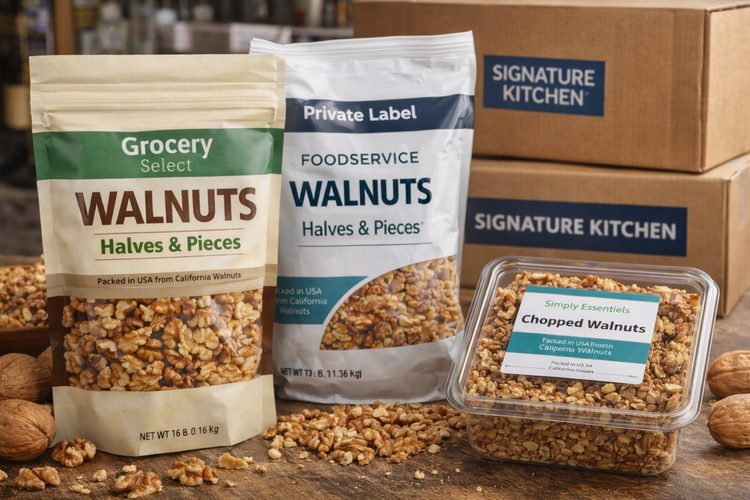
Private label walnut programs matter because they sit between commodity supply and finished consumer or operator-ready product. Once walnuts move into a private label structure, the project is no longer only about buying a walnut format. It becomes a packaging, documentation, branding and channel-execution program that must still be supported by stable product quality and workable commercial timing. For that reason, industrial nut buying here is rarely only about nominal price. The stronger commercial outcome usually comes from aligning the walnut specification, packaging route, label requirements and shipment timing before the order is placed.
Atlas generally approaches private label walnuts by asking what the finished product must accomplish in market. Is it a value-oriented grocery pouch, a premium walnut line, a foodservice back-of-house pack, a club-style format, a specialty retail SKU or an export-oriented retail offer? The answer determines far more than just the walnut inside the pack. It affects pack size, case counts, pallet efficiency, artwork workflow, label compliance, margin structure, replenishment rhythm and the level of commercial complexity that the program can realistically support.
Private label buyer view: the finished walnut pack is the product. The walnut format, pack structure, brand position and channel economics must make sense together, or the program becomes difficult to scale even when the raw material itself is sound.
Why private label walnut programs are different from simple bulk walnut sourcing
Bulk walnut purchasing is usually driven by product format, quality tolerance, shipment timing and price. Private label programs still depend on those fundamentals, but they add another layer of complexity. The buyer must now consider retail or foodservice channel fit, final pack design, shelf presentation, label claims, case handling, artwork approval, retailer or distributor expectations and launch timing. This means the sourcing conversation has to be more complete from the start.
Private label also introduces accountability to a third-party market-facing brand identity, whether that is a retailer house brand, a distributor brand, a hospitality label or a regional foodservice label. The commercial risk is therefore different. A late shipment, inconsistent pack execution or mismatch between product format and label positioning is not just an operational issue; it becomes a brand issue. That is why private label walnut projects benefit from specification-minded planning much earlier than ordinary transactional buying.
How this topic shows up in real buying decisions
For walnuts, the quote should reflect the real format and route. Whole or kernel material is different from diced, meal, extra fine flour, butter or oil, and private label programs may include more than one of these depending on channel. The commercial logic also changes when the material is raw, pasteurized, dry roasted or oil roasted. A foodservice pouch or tub, a retail pouch, an in-shell festive pack or a snack-ready roasted line all create different packaging, labeling and price architecture.
For walnut buyers, the usable product menu usually includes in-shell walnuts for traditional or seasonal trade, raw walnuts, pasteurized walnuts, dry roasted walnuts and, in some retail structures, seasoned or more processed variants. Which of those makes sense depends on the end use, whether the customer is building a retailer line, a distributor portfolio, a foodservice item or an export-ready private label program. The private label brief should therefore describe the actual channel, not only the walnut itself.
Retail private label versus foodservice private label
Retail and foodservice are often mentioned together, but they create meaningfully different walnut programs. Retail private label usually prioritizes consumer pack appearance, shelf presentation, price ladder, label messaging and unit turnover. Foodservice private label usually prioritizes pack practicality, back-of-house handling, case efficiency, portion logic and consistent supply. The walnut may be similar in both cases, but the commercial structure is not.
In retail, the pack needs to work as a selling unit. That means the product format, weight, visual presentation and label story must all be coherent. In foodservice, the pack is usually expected to work as an operating unit. Ease of handling, waste control, repeat availability and cost discipline may carry more weight than shelf aesthetics. Buyers should therefore specify the target channel early because that one decision often changes the entire quote structure.
Choosing the right walnut format for a private label line
Format selection is one of the first commercial decisions because it influences both brand perception and target price. A premium private label line may favor strong visual formats such as attractive kernel presentations or larger halves and pieces where visible quality reinforces the pack message. A value-oriented line may move toward more commercial kernel mixes or price-conscious presentations if the channel demands tighter shelf pricing. Roasted options may be suitable where the program is intended as snack-ready retail or foodservice use, while raw and pasteurized formats may be more appropriate for ingredient-forward or pantry-style positioning.
This means the walnut format should be chosen in relation to the product promise. A premium-looking pouch with a weaker internal visual standard can create commercial tension. On the other hand, over-specifying the walnut for a value line can make the shelf price unrealistic. Strong private label programs usually start with a clear answer to what tier the line is meant to occupy.
Pack architecture and how it affects the business case
Packaging is one of the most important commercial decisions in a private label program because it affects more than appearance. It shapes fill efficiency, line practicality, transit protection, pallet yield, case counts and how the product is perceived by the end user. For retail, packaging can influence whether the line reads as premium, mainstream, giftable or commodity-like. For foodservice, pack design determines whether the product is convenient for operators, easy to stage in storage and practical for repeat use.
Typical private label pack routes may include:
- Retail pouches: often used for grocery, specialty and export retail where unit presentation matters.
- Stand-up resealable packs: common when repeat household use and shelf presence are both important.
- Window cartons or premium presentation packs: relevant where appearance and brand storytelling are part of the offer.
- Foodservice bags or liners in case packs: suited to kitchens, catering or distribution where operator practicality matters more than shelf graphics.
- Larger private label foodservice units: relevant for back-of-house usage, bakery supply or hospitality programs.
The right pack is the one that supports both the commercial channel and the actual walnut usage pattern.
Pack planning point: private label walnut projects should not be quoted only by unit size. The buyer should define whether the pack is intended for shelf merchandising, household reuse, back-of-house efficiency or distribution convenience.
Labeling, compliance and artwork workflow
In private label work, labeling is not a final cosmetic step. It is a core part of project execution. Retailers, importers, foodservice groups and regional brands often need precise control over label declarations, language, branding assets, pack claims and market-specific information. Even when the walnut product itself is straightforward, the label workflow can affect timeline, cost and launch readiness.
This is particularly important in export programs, where destination-specific language, regulatory declarations, barcode needs, importer information, nutrition presentation or carton markings may differ by market. A private label walnut program may therefore be commercially delayed not because of the walnut itself, but because the documentation and artwork path was not defined early enough. Atlas generally encourages buyers to surface label expectations as soon as possible so the pack and timing assumptions remain realistic.
Brand positioning in private label walnuts
Not every private label walnut program is trying to say the same thing. Some are clearly value-led. Some are intended to look premium without becoming super-premium. Some are built around natural pantry positioning, and others are aimed at foodservice practicality. The walnut format and pack choice should support the specific channel story. For example, a premium private label grocery line may depend heavily on strong visible kernel presentation, while a foodservice private label offer may rely more on consistency, operator confidence and repeat availability.
That is why Atlas generally asks buyers whether the line is being designed as a value tier, core tier, premium tier, giftable retail concept or practical foodservice line. The answer influences not only which walnut format makes sense, but also how tightly the margin structure can support a given specification.
Case configuration, pallet logic and replenishment rhythm
In private label programs, secondary packaging and replenishment matter nearly as much as the consumer or operator pack. Retailers and distributors often care deeply about case counts, case dimensions, pallet efficiency and replenishment stability. Foodservice buyers may focus more on storage practicality, case handling and ease of reorder. These details are easy to overlook early, but they can materially affect whether a program scales smoothly after launch.
A walnut private label project that looks attractive in principle can still struggle if case counts are inefficient, if pallet yield is poor, or if the replenishment rhythm does not match the customer’s actual ordering cycle. That is why Atlas treats private label walnuts as a program rather than a one-time product sale.
Domestic versus export private label programs
The same private label walnut concept can behave differently in domestic and export routes. Export programs usually introduce more complexity around language, carton markings, documentation, transit time, shelf-life assumptions and import-side coordination. Some export customers also need different case formats or label structures based on local channel norms. These are not small administrative details; they can change the commercial feasibility of a program.
For that reason, Atlas generally recommends that buyers identify the destination market early. A private label pack built for domestic shelf turnover may need different protection, lead-time planning or labeling logic when moved into an export retail or foodservice route.
What Atlas would ask before quoting
Atlas encourages buyers to define intended use, pack style, destination, timeline and quality expectations early. In private label walnut projects, the brief usually needs to go further. Before quoting, Atlas would typically want to understand:
- the target channel: retail, foodservice, private label grocery, hospitality, distributor brand or export private label,
- the exact walnut format required: in-shell, raw kernels, halves and pieces, pasteurized, dry roasted or another defined option,
- the pack style, unit weight and case structure,
- whether the project is value-led, core shelf, premium, gift-oriented or operator-focused,
- the artwork and label workflow requirements,
- the destination market and any language or market-specific compliance needs,
- the estimated commercial rhythm: sample review, line review, launch volume or repeat replenishment,
- the launch timing and promotional or seasonal calendar if relevant.
Those inputs help reduce avoidable back-and-forth and improve comparability across California supply and packout options. They also help determine whether the project is best approached as a simple private label packout or as a more structured multi-step commercial program.
Commercial planning points
From a trading standpoint, the best private label walnut programs are built around repeatability. That means clear documentation, agreed packaging, sensible shipment cadence and a commercial structure that supports continuity rather than one-off emergency buying. In many cases, the project will develop through sample review, packaging alignment, artwork approval, validation run, launch volume and repeat replenishment. That staged approach is practical because the brand, pack and case structure all need to work together before the program becomes truly scalable.
When relevant, the brief should also mention whether the program is retail-ready, foodservice, industrial bulk for later packout, private label export or mixed-channel. That single clarification often changes packaging, documentation and timing assumptions. A fast-turn domestic foodservice line may allow one commercial rhythm, while a retailer-facing export program may require much tighter coordination and longer lead planning.
Buyers should also compare total delivered program value rather than only raw walnut cost. The correct private label structure may support stronger shelf performance, better operator fit, smoother replenishment and more reliable commercial continuity. Those gains often matter more than a narrow difference in ingredient price when the project involves finished packs and brand exposure.
Buyer planning note
Atlas Global Trading Co. uses topics like this to move conversations from broad interest to a specification-minded inquiry. If you are evaluating a private label walnut program, share the target format, channel, pack style, estimated volume and destination using the floating contact form so the next step can be grounded in a real commercial need.
Whether the requirement is for grocery private label, foodservice packs, premium retail lines or export-oriented walnut programs, the same principle applies: private label walnuts work better when product form, intended application, packaging and commercial timing are defined together.
Need help sourcing around this private label walnut topic?
Use the contact form to share your product, packaging, destination and timing requirements for a practical quotation.
- State the exact walnut format and channel
- Add target monthly or trial volume
- Include destination market, pack style and launch timing
Frequently Asked Questions
What is the main buyer takeaway from “Private Label Walnut Programs for Retail and Foodservice”?
The main buyer takeaway is that private label walnut programs work best when product format, pack architecture, channel, labeling requirements and commercial timing are defined together rather than treated as separate decisions.
What should buyers define before requesting a private label walnut quote?
Buyers should define the walnut format, target channel, pack size, artwork and label requirements, destination market, quality expectations, estimated volume and launch timeline.
Can private label walnut programs apply to both retail and foodservice?
Yes. The same sourcing logic applies to both retail and foodservice, although pack sizes, case configurations, labeling, pricing structure and replenishment rhythm usually differ by channel.