1. Define the visual requirement
State whether premium presentation actually matters. If yes, specify color expectation and whether half-kernel appearance must be preserved.
Buyer guidance on walnut grade language, color expectations, size classifications, specification writing and buying decisions for California supply programs.
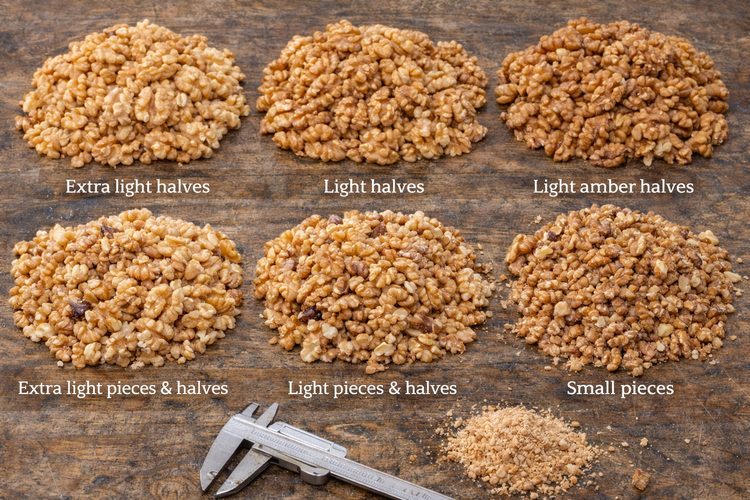
Walnut buying looks simple until a commercial discussion gets into the details that actually affect acceptance, yield and shelf-life. Buyers often ask for “light walnuts” or “good halves,” but the supply decision becomes much clearer when grade, color, size class, process condition, pack style and destination are written together in the brief. That is the difference between a nominal inquiry and a procurement-ready specification.
California walnut programs frequently move across several commercial routes at once. One buyer may need cleaner-looking halves for premium retail or food gifting, another may need economical pieces for bakery inclusion, and another may need chopped or meal-type walnut material for fillings, sauces, spreads or formed applications. All three buyers are buying walnuts, but not the same walnuts commercially.
In practice, walnut grade language sets the baseline, color affects visual value and merchandising perception, and size affects functionality in production. Separating those three items usually creates confusion during quoting. A light-colored lot with the wrong size mix may still fail the intended application. A correct size class with too much darker material may still underperform for premium retail presentation. A very attractive visual pack may also be commercially inefficient if the application is going to chop, blend or enrobe the product later.
For this reason, experienced buyers usually move from broad wording to specification wording quickly. Instead of requesting “California walnut kernels,” the stronger inquiry identifies the target grade, the preferred color range, the required size class, the process condition and the intended use. That helps the seller quote realistic options and helps the buyer compare offers on a like-for-like basis.
For shelled walnuts, buyers commonly encounter U.S. No. 1 and U.S. Commercial grade terminology. The grade framework matters because it influences defect tolerance, quality expectation and the way lots are described during commercial discussions. Grade is not the whole brief, but it is the first layer of clarity.
At a practical buyer level, U.S. No. 1 is typically associated with cleaner, better-presenting walnut material for applications where appearance matters and where buyers are less tolerant of visual inconsistency. U.S. Commercial can still be a correct buying choice in more price-sensitive or more processed applications, especially where the product will be chopped, incorporated, blended or used in secondary manufacturing rather than sold on appearance alone.
Commercial note: grade language should not replace application language. A buyer asking for U.S. No. 1 should still state whether the walnuts are for premium snack packing, bakery topping, confectionery inclusion, granola, sauce, filling, butter or export retail because the end use may justify a different cost-performance balance.
Color is one of the most commercially visible parts of the walnut brief. In the California market, the core color classifications used in grade language are typically extra light, light, light amber and amber, with red color handled separately where relevant. Lighter kernels generally support a more premium visual impression, which is why buyers serving retail, gifting, topping, garnish and premium snack applications often pay close attention to color sorting.
However, color should be evaluated in context. For some bakery, confectionery, cereal, filling, butter or ground applications, paying the highest premium for the lightest color may not improve finished product performance enough to justify the cost. In those cases, an efficient light/light amber combination or an application-appropriate commercial mix may be the stronger choice.
Color also influences consistency. If a brand promise depends on bright, uniform walnut appearance from lot to lot, the inquiry should say so explicitly. If the walnuts will be broken down, coated, seasoned, blended with other particulates or used inside a finished product where visual variation is less critical, the buyer may have more flexibility. The point is not that one color class is always better. The point is that color only creates value when it matches the way the walnut will actually be used.
Size classification changes the economics of the program because it affects line handling, visual presentation, inclusion size, yield in further processing and waste tolerance. California shelled walnuts are commonly discussed in the market as halves, pieces and halves, pieces, medium pieces, small pieces and meal or double diced forms. Each of those forms has a different role in the buying conversation.
Halves are usually the most presentation-driven choice. They are relevant where the buyer wants the natural walnut shape to remain visible in the finished product or package. Premium snack packs, garnish programs, bakery decoration, confectionery packs and some foodservice uses often favor halves because shape itself is part of the value proposition.
But halves should only be specified when whole-kernel appearance will actually be monetized. If the manufacturing step will chop, crumble or compress the walnut later, halves may add unnecessary raw material cost without creating finished-product value.
Pieces and halves can be a useful middle position when buyers want a visually respectable pack with better cost efficiency than a tighter half-kernel program. This type of mix can work well in trail mixes, topping applications, baking inclusions and other uses where some visible half kernels are desirable but absolute half-kernel uniformity is not essential.
This category also matters commercially because buyers sometimes ask for “mostly halves” when what they really need is a balanced pieces-and-halves offer with acceptable appearance and stronger delivered economics.
Pieces are often the practical choice for industrial manufacturing. They can be more suitable for bakery batters, cereal and granola systems, fillings, confectionery centers, bars, snack blends and secondary processing. A buyer may give up some premium visual appearance, but gain better cost control, easier dispersion and more application-appropriate sizing.
Medium and small pieces become increasingly important when the walnut is being deposited, blended, metered, rolled into a formulation or distributed across a line where piece size must be controlled to support consistency. These cuts are commonly discussed in the industry even when the commercial language used in everyday trade goes beyond the most basic grade conversation.
For bakery, cereal, snack clusters, bars and some confectionery systems, finer size control can support portion regularity, more predictable pickup, improved line flow and more stable costing from formula to formula.
Walnut meal, finely cut material or double diced styles matter when the nut is no longer being purchased primarily for visual identity but for flavor, body, particulate distribution or functional contribution. This form can support dough systems, fillings, sauces, pastes, coatings, crumb-like applications and some compound preparations where the buyer wants walnut character without large visible kernel pieces.
Even when a buyer mainly uses commercial shorthand, it helps to understand how the size classes are described technically. In California walnut trade practice, size tolerances are linked to kernel composition and screen-pass criteria. Halves are typically described as lots made predominantly of half kernels, while pieces and smaller forms are described by what may or may not pass through specified screen openings.
This matters because two suppliers can both say “pieces,” yet the actual size distribution may not behave identically in a depositor, bakery line, cereal blend or retail pack. If the buyer has a sensitive application, requesting screen-based or sample-based alignment before approval can reduce unpleasant surprises after shipment.
Specification note: if your line performance depends on tighter particulate control, ask not only for the commercial cut name but also for size distribution expectations, visual reference samples or retained-sample approval language before the order is locked.
In real sourcing work, buyers are usually solving one of five problems:
These are very different purchasing situations. That is why the right walnut grade and size combination is not universal. It depends on where value is created in the buyer’s own chain.
Snack and retail packs: buyers often prioritize appearance, lighter color, cleaner halves or attractive pieces-and-halves composition, pack consistency and shelf-life protection.
Bakery: buyers typically balance size against dispersion, bite, visual signature, batter compatibility and cost. Pieces, medium pieces or small pieces may be more efficient than halves unless the walnut is used as a top garnish.
Confectionery: inclusion size, fat migration management, coating compatibility and visual contrast matter. Depending on the piece size and chocolate or sugar system, buyers may prefer selected pieces rather than whole halves.
Granola, cereal and bars: mechanical handling and consistent distribution often matter more than premium half-kernel visuals. Buyers usually specify the cut that best supports mix integrity, line flow and targeted piece count per serving.
Fillings, sauces, spreads and compounds: meal, double diced or smaller particle formats may perform better than large pieces because they integrate more evenly and reduce the need for extra in-house reduction.
Walnut specifications do not stop at size and color. The quote can change materially depending on whether the product is raw, pasteurized, dry roasted or further processed for a specific application. A buyer who only specifies “light walnut pieces” may still receive non-comparable offers if the process condition is not stated clearly.
Raw or natural walnut kernels may be the right starting point for manufacturers that roast, season, coat or further process in-house. Pasteurized programs may be relevant depending on customer protocols or downstream product requirements. Dry roasted material changes flavor, moisture behavior, brittleness and application fit. As processing increases, the buyer should expect the commercial discussion to include both added value and added process sensitivity.
Walnuts are valued for flavor and nutritional profile, but they are also more sensitive than some other ingredients because their oil composition makes them vulnerable to oxidation. That means the visual specification alone is never enough for a serious industrial or export program. Buyers should also think about freshness management, storage discipline and the likely age profile of the material relative to their shipment schedule.
For commercial planning, this shows up in several ways. Smaller cuts expose more surface area and can be more vulnerable during storage and handling than intact halves. Rework, repeated air exposure, warm warehouses, long transit or weak packaging can all erode quality faster than the nominal product name suggests. The buyer who specifies a cut more finely than necessary may therefore be accepting both functional and shelf-life implications.
For longer-chain programs, it is reasonable to ask about freshness controls, storage conditions, rotation practices and the chemistry checks that support premium-quality handling. In the California industry, buyers may also encounter voluntary quality guidance that references peroxide value, free fatty acid control, refrigerated storage after certain seasonal points and the use of objective color grading practices. Those details become especially relevant for buyers shipping into hot climates, maintaining inventory for longer periods or supplying quality-sensitive finished products.
Packaging is not a final administrative detail. It changes how the walnut performs during storage, internal handling and transit. Bulk industrial packs, foodservice packs, retail-ready packs, private label configurations and export-oriented pack styles all create different risks and requirements.
A high-appearance halves program may justify stronger protective packaging and faster stock rotation. An industrial pieces program may focus more on efficient bulk handling, internal hygiene and line feed practicality. Export business may add pallet logic, labeling, documentation, container discipline and transit-temperature considerations. The more presentation-sensitive or shelf-life-sensitive the walnut program is, the more closely packaging should be aligned with product form.
Walnut purchasing is also a timing decision. Harvest timing, seasonal market coverage, shipping windows and the buyer’s own production calendar all influence what constitutes a good commercial choice. A specification that is easy to cover at one point in the year may be more difficult or more expensive at another point, especially if the buyer is asking for tighter color, cleaner halves or narrow particle distributions.
That is why experienced buyers do not wait until the product is urgently needed to define grade, color and size. They qualify the specification earlier, validate samples, decide what is truly non-negotiable and distinguish between “must-have” criteria and “commercial preference” criteria. This is particularly important for repeat replenishment programs and export lanes where production and logistics must stay coordinated.
To move a walnut inquiry from general interest to a commercially useful quote, Atlas would usually ask the following:
Those questions are not meant to slow down the process. They are meant to make the quote usable. A fast but incomplete quote can cost more time later if the product does not match the application.
The most common issue is over-specification in one area and under-specification in another. For example, a buyer may insist on a very attractive color range but fail to define particle size tightly enough for the production line. Or the buyer may push for the lowest-cost size class without thinking through breakage, appearance or deposition behavior. Another common issue is asking for samples that look ideal visually, then buying against a looser commercial description that does not protect that same performance.
Another frequent issue is treating walnuts as a fully generic ingredient across all channels. In reality, the right commercial answer for premium retail, industrial bakery, snack manufacturing, confectionery, sauces or export retail is often different even when the same origin is involved.
Strong walnut programs are usually built in phases:
That staged approach is especially important when the product will be exported, used in quality-sensitive applications or integrated into a branded finished good where appearance consistency matters from lot to lot.
Weak brief: “Please quote California walnut kernels, light color.”
Stronger brief: “Please quote California walnut pieces and halves, U.S. No. 1 or equivalent commercial offer for comparison, light/light amber acceptable for bakery inclusion, raw kernels for further processing, 10 kg trial and monthly replenishment estimate after validation, bulk industrial pack, destination EU, target first shipment in October.”
The second version gives procurement, sales, quality and logistics teams something they can actually work with.
Atlas Global Trading Co. uses walnut academy topics like this to help buyers move from general category research to a cleaner sourcing decision. The practical goal is not to make the specification longer than necessary. It is to make it commercially accurate. When grade, color, size, application, packaging and timing are defined together, the resulting quote is usually faster to compare and easier to execute.
If you are building a California walnut program, share the product form, intended use, packaging target, estimated volume and destination market. That lets Atlas respond with a specification-minded quotation discussion rather than a generic price indication.
State whether premium presentation actually matters. If yes, specify color expectation and whether half-kernel appearance must be preserved.
State whether the walnuts will remain visible, be chopped further, be blended into a formulation or be used as meal or paste input.
Clarify whether the program is industrial bulk, foodservice, retail-ready, private label or export-oriented because packaging and documentation may change.
Include trial need date, expected replenishment rhythm and the likely inventory hold period after receipt.
It can make sense to pay up for a tighter spec when the finished product depends on visual quality, when breakage directly reduces sellable value, when the application is extremely size-sensitive, or when customer-facing consistency must be protected across many production runs. Premium snack, gifting, premium bakery decoration and some retail-facing mixes are typical examples.
It usually makes less sense to pay a premium for the tightest visual presentation when the walnut will be cut down further, blended into a dense system, used internally in a formula, coated heavily or otherwise hidden from the consumer. In those cases, the stronger question is not “What is the nicest walnut?” but “What is the most commercially efficient walnut that still performs correctly?”
Export walnut programs add another layer of decision-making. Transit duration, ambient heat exposure, port dwell, destination humidity, documentation requirements and inventory aging at destination all matter. Buyers shipping to warmer markets should think carefully about pack protection, temperature discipline, stock rotation and whether the selected cut is more exposed than it needs to be.
For destination markets with long lead times or fragmented distribution, the inquiry should also mention whether the product is meant for immediate turnover or for longer storage in-channel. That distinction may affect the recommended pack style, the tolerance for very fine cuts and the discussion around freshness management.
California walnut grades, color and size are not just technical descriptors. They are commercial tools. Buyers who understand that can write better briefs, compare quotes more accurately and build stronger repeat programs. The core discipline is simple: define what the walnut needs to do, not just what it needs to be called.
When the application, visual requirement, size class, process condition, packaging and shipment timing are aligned, the sourcing discussion becomes faster and more useful. That is the point of a good buyer walnut specification.
Use the contact form to turn this research topic into a practical quote request for Atlas. Include grade language, color target, size class, pack style and market destination so the discussion starts from a usable specification.
A strong inquiry should identify whether the target is U.S. No. 1, U.S. Commercial or a buyer-specific specification, then add color, size class, process condition, packaging, destination and timing. The clearer the brief, the easier it is to compare realistic California offers.
Color affects perceived premium quality and visual consistency. Size affects yield, appearance, handling, line performance and application fit. Together they influence both finished-product quality and delivered cost.
No. Halves are often best where shape and appearance matter, but many industrial uses are better served by pieces, pieces and halves, medium pieces, small pieces or meal-type material. The right answer depends on the application.
Yes. Atlas structures walnut quotations around specification, application, packaging, trial volume, shipment timing and destination so buyers can compare commercially meaningful options rather than nominal prices alone.