Choose the retail route
State clearly whether the line is in-shell or shelled. This is the starting point for pricing, pack design and consumer positioning.
Buyer guidance on in-shell versus shelled retail routes, packaging formats, export labeling, shelf presentation and commercial planning for California walnut retail programs.
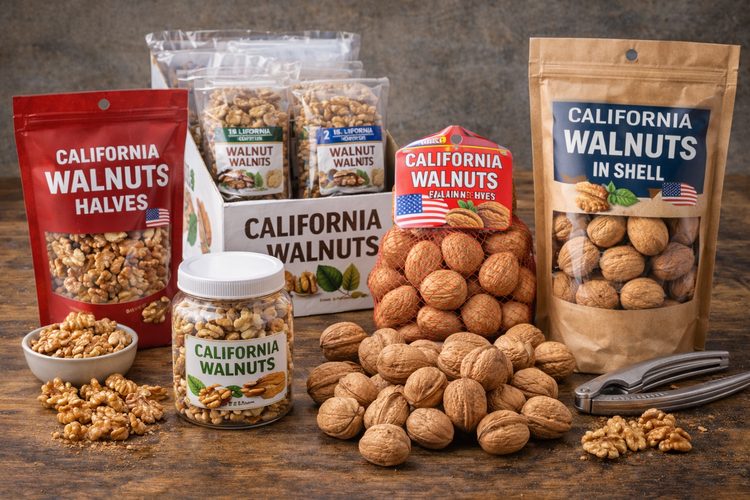
Export retail walnut lines are usually won or lost long before the product reaches the shelf. Buyers often begin by asking for California walnuts and a retail pack, but the real commercial outcome depends on whether the product form, shell option, pack size, case structure, label language, destination market and shipment timing were aligned early. In export business, the walnut itself is only one part of the program. The rest is packaging discipline, retail fit and market-specific execution.
Walnut retail programs can move through very different channels. Some markets favor in-shell presentation for gifting, seasonal merchandising or traditional consumer use. Others prioritize shelled kernels because convenience, resealable packs, nutrition-led positioning and ready-to-eat formats are more important. In some export markets, the retail buyer wants a premium California-origin walnut line with visible kernel quality. In others, the decision is driven more by price band, pack count per carton and how well the product matches local shelf norms.
Atlas approaches export walnut retail projects by asking what the finished retail line has to accomplish commercially. Is the product intended for supermarket dry fruit shelves, club packs, neighborhood retail, modern trade, gifting, value retail, travel retail or private label? Is the buyer building a premium California-origin proposition, or looking for a more price-disciplined everyday nut line? Those answers influence whether in-shell or shelled walnuts make sense, which pack formats are realistic, and how the export program should be structured from quote through shipment.
Bulk walnut ingredient business can often move with a more direct discussion around grade, format, packaging and destination. Export retail is different. Retail lines add consumer presentation, shelf-life expectations, market-specific labeling, unit economics, carton architecture and possibly promotional requirements. A walnut that works perfectly in bulk may still be the wrong choice for export retail if the pack does not fit local price points, consumer expectations or retail display logic.
This is especially important for walnuts because shell choice changes everything. In-shell walnuts create a very different retail proposition from shelled kernels. One route emphasizes natural whole-fruit presentation, cracking experience and often seasonal or traditional consumption patterns. The other emphasizes convenience, easier usage, portioning and clearer visibility of kernel appearance. Neither route is universally better. The correct route depends on what the destination market values and what the buyer needs the shelf offer to communicate.
For most export retail walnut programs, the first serious commercial choice is whether the line will be built around in-shell walnuts or shelled walnuts. That is not a minor technical distinction. It is the foundation of the program.
In-shell retail lines are relevant where the market values whole natural presentation, traditional cracking use, festive consumption, gifting or consumer perception of authenticity. In-shell walnuts can also present a strong visual impression in bags, mesh packs, cartons or window packs. In some markets, the shell itself supports perceived freshness and naturalness.
However, in-shell programs also change the commercial model. They affect freight economics, case weight, consumer yield expectation, display density and the way product value is communicated at shelf. A visually attractive in-shell walnut may still be wrong for a market that prioritizes convenience, everyday snacking or direct recipe use.
Shelled retail lines are usually preferred where convenience, immediate usability and clearer portioning matter. They are common in modern retail, resealable pouch formats, better-for-you snacking, recipe-use packs and premium nut assortments. Shelled walnuts can also support more precise price positioning because the consumer is buying edible kernel weight directly rather than shell plus edible yield.
But shelled lines require careful decisions around kernel format, size mix, appearance, color and breakage tolerance. For a consumer-facing product, those details influence both purchase intent and repeat purchase satisfaction. Shelled walnuts may be commercially stronger in convenience-led markets, but they also expose kernel appearance more directly, which means the specification and pack presentation have to be better aligned.
Export note: a buyer should not ask for “retail walnuts” without first deciding whether the product is intended to sell as a natural whole in-shell line or as a convenience-focused shelled line. That single choice affects pricing, pack design, consumer messaging and shipment structure.
When an export line is built around in-shell walnuts, the shell condition matters commercially. Buyers may see demand for natural in-shell presentation, cleaner-looking shells, or retail lines where shell appearance consistency matters more than in bulk trade. Shell appearance can affect the visual shelf proposition, especially in transparent or mesh-based retail formats.
In practical terms, the commercial discussion around shell options usually touches on:
Shell presentation does not replace overall quality planning, but it can strongly influence retail acceptance where the product is sold by visual impression first. A stronger-looking in-shell line may justify higher retail confidence in some markets, while in others a more economical natural presentation is commercially acceptable.
Where the line is based on shelled walnuts, buyers should define the intended kernel presentation more precisely. Retail programs may be built around halves, pieces and halves, selected pieces or other application-fit retail styles. The correct answer depends on the price point, shelf positioning, pack size and whether the product is sold primarily as a snack, recipe ingredient or premium nut assortment component.
Halves are often used where the buyer wants stronger premium cues, better visible kernel identity and a more giftable or high-spec appearance. They can work well in premium pouches, jars and small retail cartons.
Pieces and halves often make sense for everyday retail because they still provide a respectable walnut appearance while supporting more flexible economics. For many export programs, this is a practical middle route.
Pieces may fit smaller value-oriented retail packs, recipe-use packs or markets where consumer convenience matters more than large-kernel visual presentation. In the right channel, this can be a commercially sound choice rather than a compromise.
Pack selection is one of the most important commercial decisions in export retail walnuts because it affects not only shelf appearance, but also case count, freight utilization, retail pricing logic, pack protection and private label execution. The same walnut can become three very different retail propositions depending on whether it is packed in a pillow pouch, stand-up pouch, zipper pouch, tray pack, carton, jar or mesh bag.
Common export retail routes include:
The right format depends on the destination market and channel. A premium stand-up pouch may be ideal in one region but commercially weak in another if local buyers expect a different price architecture or shelf footprint. Export retail pack planning should therefore begin with channel reality, not only design preference.
Retail format should be aligned with the channel where the product will actually sell. A supermarket line, an ethnic grocery program, a gifting line and an e-commerce-focused pack often need different solutions even when the walnut source is the same.
Modern retail supermarkets often favor clear shelf-ready structures, strong front-of-pack communication and reliable barcoding, while traditional trade may require sharper price-point discipline and simpler unit formats. Gift or festive channels may justify higher appearance standards, premium windows or cartons. Club or bulk-value retail may prioritize larger units and freight-efficient case structure. Private label programs may be highly sensitive to carton count, filling efficiency and print lead times.
This is why export retail walnut programs work better when the buyer shares the intended channel early. Without that, the pack recommendation may be technically correct but commercially wrong.
In practice, export retail buyers compare more than just in-shell versus shelled. They usually compare:
Those comparisons reflect real retail trade-offs. The best commercial answer is usually the one that best matches destination market behavior and replenishment logic, not simply the one with the highest nominal appearance standard.
Export retail walnut lines need to be discussed with labeling in mind from the start. A commercially sound retail program must consider destination language requirements, retail barcode needs, pack claims, allergen statements, origin communication, nutritional panel format and any importer or retailer-specific packaging conventions. The product may be the same walnut, but the documentation and label execution can change materially by destination.
That means buyers should mention early whether the line is intended for branded retail, distributor label, supermarket private label or a hybrid route. Those routes influence artwork timelines, packaging approvals, carton markings and how much flexibility exists around ongoing replenishment packaging.
Walnuts are premium products, but they also require sensible protection because retail programs may involve longer distribution chains, warehousing steps and time on shelf. For export retail, shelf-life planning is not only a quality issue but also a commercial one. A line that arrives with insufficient remaining shelf life or inadequate pack protection may still be technically saleable but commercially unattractive to the importer or retailer.
This is one reason pack material, closure style, oxygen management and shipment timing matter. A simple pack that works for rapid domestic turnover may not be appropriate for a slower export channel. Likewise, a beautifully designed retail pack can still underperform if it is not robust enough for container transport, handling and shelf exposure.
For export retail walnut projects, Atlas typically recommends translating the concept into a quote request with the following points:
Those points help turn a broad export conversation into a more realistic commercial quotation discussion. Without them, comparisons between suppliers can become misleading because the products being offered are not truly comparable.
Typical use cases for walnuts on this website include bakery, confectionery, sauces and fillings, snacks and granola. In export retail, however, the stronger brief is usually retail-channel specific and must explain not just the walnut form, but also how the product is meant to sit on shelf and move in trade.
Most successful export retail walnut lines are built in stages rather than all at once:
This staged model reduces risk because export retail programs often fail when the buyer tries to solve product form, packaging, labeling and freight structure all at the last minute. A more structured program usually produces a better quotation and a smoother launch.
Pack size is not only a marketing decision. It affects per-unit price, freight cost allocation, case count, shelf position, importer margin and promotional flexibility. Smaller packs may open entry-level retail pricing and trial purchase, but they can increase packaging cost per edible kilogram. Larger retail packs may improve pack economics, but they can move the product into a different consumer buying occasion or retailer category position.
This is why export walnut pack size should be selected with retail channel logic in mind. A premium small pouch may be right for specialty grocery. A larger resealable pack may be better for family-use retail. A festive in-shell bag may work seasonally but not year-round. These are commercial design questions as much as packaging questions.
Several issues come up repeatedly in export walnut retail projects:
These problems usually come from treating export retail as a simple extension of bulk walnut trade. In reality, it is a different commercial discipline.
Branded walnut retail programs tend to emphasize shelf differentiation, California origin messaging, visual premium cues and more deliberate pack design. Private label programs usually move with tighter cost targets, stricter retailer formats and more structured packaging specifications. Neither is easier by default. They simply prioritize different parts of the commercial equation.
For private label, the buyer should usually define expected pack size, case count, destination language and price band as early as possible. For branded programs, the buyer should also clarify what makes the product distinct on shelf: premium halves, in-shell authenticity, resealable convenience, gifting presentation or a strong origin message. These are not small branding details. They change how the whole program should be quoted.
Atlas Global Trading Co. uses walnut academy topics like this to help buyers move from broad export interest to more specification-minded retail discussions. If you are evaluating an export retail walnut line, the most useful next step is to define whether the product should be in-shell or shelled, what retail pack style is required, which market it is going to and what type of retail channel will carry it.
That information allows Atlas to frame California walnut options in a way that reflects real export needs, including pack structure, kernel or shell presentation, commercial timing and destination fit. For export retail, that is usually what separates a general inquiry from a workable program.
State clearly whether the line is in-shell or shelled. This is the starting point for pricing, pack design and consumer positioning.
Pouch, zipper pouch, carton, mesh bag, tray and jar formats each create different freight, shelf and price-point implications.
Modern retail, traditional trade, gifting, private label and club channels usually need different product and pack assumptions.
Trial volume, launch quantity, repeat replenishment cadence and destination market requirements should be discussed before quotation.
Use the contact form to turn this research topic into a practical quote request for Atlas. Include shell option, pack style, retail channel, market destination and expected volume so the discussion starts from a real export retail requirement.
Buyers should define the target retail format first: in-shell or shelled, kernel style, pack size, destination market, label language and commercial channel. Those choices affect pricing, packaging, documentation and container planning.
In-shell walnuts can make sense when the market values natural presentation, consumer cracking experience or gifting-oriented retail formats. Shelled kernels generally make more sense where convenience, ready-to-eat use and controlled retail presentation are more important.
Pack selection affects shelf appeal, shelf-life protection, case configuration, freight efficiency, retail pricing structure and compliance with destination market requirements. A good walnut product can still underperform commercially if the pack is not right for the market.
Yes. Atlas uses the same product, packaging, specification and shipment logic covered in the academy to help buyers move from concept-stage discussions to more practical export retail walnut quotation requests.