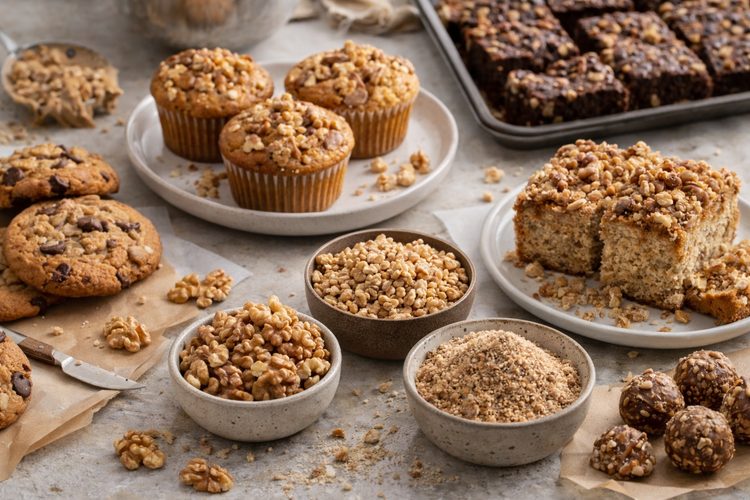
Walnuts in bakery are rarely purchased as a generic ingredient. Bakers usually need the format to do a specific job on line and in the finished product. That may mean creating visible premium texture in cookies, distributing evenly through brownie batter, holding identity in muffin dough, blending into a streusel or filling, or delivering walnut flavor and richness through a finer meal system. The technical and commercial issue is therefore not simply “buy walnuts,” but “buy the walnut format that supports process performance, target appearance, sensory profile and delivered cost.”
That is why bakery buyers usually compare more than price per pound. They review kernel size, cut range, piece integrity, fines level, oil expression, dispersion behavior, roast or raw condition, pack style, storage expectations and how the walnut format behaves through mixing, depositing, proofing, baking, cooling and post-bake handling. A walnut format that looks attractive in a sample bag can still be a weak fit if it breaks down excessively in dough, releases more oil than desired, settles unevenly during depositor flow, or creates too much variation in finished-piece appearance.
For Atlas, this topic is about helping buyers translate a product idea into a bakery-ready quote request. California walnut supply becomes easier to quote and compare when the buyer identifies the exact format, the line application, the pack type, the destination and the expected volume rhythm. That moves the conversation away from broad category language and closer to an ingredient program that can actually be validated and repeated.
Why format selection matters more in bakery than many buyers expect
Bakery systems are highly sensitive to inclusion size, particle distribution and fat contribution. Even when the walnut origin and general quality are acceptable, the wrong cut or format can still create avoidable production issues. Large kernels may fracture during mixing or cause uneven distribution in smaller baked pieces. Very small cuts may disappear visually after bake, contribute more fines than desired or migrate differently in soft dough systems. Walnut meal may improve flavor carry and uniformity, but it changes texture, absorption behavior and visible identity compared with a diced inclusion program.
The right decision depends on what the bakery product is trying to achieve. A premium café cookie may benefit from larger kernel or coarse piece inclusion that remains clearly visible after baking. A high-speed muffin or loaf line may prefer more controlled diced pieces that distribute evenly and reduce variation from unit to unit. A filling, batter or topping blend may use walnut meal when a smoother texture and broader walnut flavor presence are more important than visible piece definition.
In other words, format choice sits at the intersection of process efficiency, finished appearance and cost control. That is why bakery walnut sourcing usually works best when product development, purchasing and operations all define their priorities early.
Bakery buyer takeaway: walnuts should be specified by function, not only by category. “Walnuts for bakery” is too broad for accurate quoting. Buyers get better results when they define whether the ingredient is meant to create visual identity, controlled bite, flavor carry, mix-in distribution, topping performance or formula enrichment.
Common walnut formats used in bakery programs
Bakery buyers typically work from a practical menu of walnut formats rather than a single commodity type. Depending on the application, the usable product range may include raw walnut kernels, pasteurized walnuts, dry roasted walnuts, chopped walnuts, diced cuts, granulated walnuts, walnut meal, fine walnut flour or specialty further-processed walnut components. Each format changes how the ingredient behaves on line and how the finished product is perceived by the end user.
In broad commercial terms, the most relevant bakery formats are:
- Kernel formats: halves, large pieces and mixed kernel grades used where visual presence and premium perception matter.
- Diced or chopped formats: controlled cut sizes selected for more even dispersion through doughs, batters, fillings and toppings.
- Meal or fine granulation: smaller particle formats used where walnut flavor, nut solids and texture contribution matter more than visible piece identity.
- Fine flour or powder-adjacent formats: used in select bakery systems where a very fine texture is needed, though commercially this becomes a more specialized discussion.
- Roasted formats: chosen when the bakery program wants a more pronounced nut note, different bite or reduced need for in-process flavor development.
Each of these can be commercially valid. The strongest option depends on how the product is mixed, what the product should look like after bake, and how closely the bakery needs to control material cost, size consistency and line behavior.
Kernel formats in bakery: where they work and where they do not
Kernel formats are usually chosen when the bakery team wants the walnut to remain visible and recognizable. This is common in premium cookies, artisanal breads, loaf cakes, brownies, traybakes and certain seasonal or gift-oriented bakery items where larger nut identity supports a higher-value visual. Larger pieces can also help communicate quality in foodservice bakery items sold through cafés, hotels or grab-and-go premium counters.
The technical advantage of larger kernel formats is visual impact and distinct bite. The tradeoff is process variability. Larger pieces are more likely to break under high-intensity mixing or aggressive depositing systems. They may settle unevenly in some batters, interfere with portion uniformity in small-format bakery items, or create more variation in cross-section appearance if the product geometry is small. In laminated or more delicate systems, larger nuts may also affect sheet integrity or cutting consistency.
Commercially, kernel programs can be attractive when the finished product can justify a premium appearance and when line conditions are gentle enough to preserve piece identity. They may be less efficient when the baker is mainly paying for appearance that will not survive the process or will not be visible in the final SKU.
Diced walnut formats: the workhorse option for controlled bakery performance
Diced or chopped walnuts are often the most practical format for industrial bakery use because they balance identity, distribution and operational consistency. A controlled cut range can help bakery teams achieve more even inclusion loading, reduced breakage, more predictable deposit appearance and better coverage throughout the dough or batter matrix. This format is widely relevant for cookies, muffins, quick breads, bars, brownie systems, granola-style bakery hybrids, topping blends and filled bakery applications.
The main technical reason buyers move toward diced formats is control. Piece size affects how the walnut travels through the system, whether it sinks or stays suspended, how visible it remains after bake and how easy it is to scale the formula without overloading the line. Smaller cuts generally support more even distribution and reduce unit-to-unit variability. Larger diced formats may improve bite and appearance but can raise breakage or segregation risk in some mixes.
From a purchasing perspective, diced formats also make it easier to match the walnut to the bakery item rather than forcing every product to use the same kernel grade. That can improve cost management across a portfolio. A premium cookie line may use a coarser cut than a cake mix inclusion or brownie batter. Both are “walnuts for bakery,” but they are not necessarily the same sourcing decision.
Walnut meal in bakery: where flavor and integration matter more than piece identity
Walnut meal is usually selected when the bakery team wants the walnut to integrate more thoroughly into the product system. Instead of delivering a strong visible inclusion, meal contributes nut flavor, fat richness and fine particulate texture. It can be useful in fillings, streusels, crumb toppings, bakery pastes, specialty dough systems, nut-forward batters or formulations where visual specking is acceptable or even desirable but large pieces are not.
In commercial use, walnut meal may help reduce visible piece variation while still preserving a walnut profile. It can also be useful when bakery products need a smoother bite or when larger inclusions would interfere with sheeting, depositing or post-bake slicing. The tradeoff is that meal changes formula behavior more directly than larger piece formats. Because the particle size is smaller and the nut solids are more integrated into the mass, the meal can influence texture, moisture perception, oil migration and finished crumb character more than a discrete kernel inclusion would.
This is why walnut meal should not be treated as simply “cheap chopped walnut.” It is a distinct ingredient choice. Buyers should specify it based on the bakery system and intended sensory outcome, not only as a cost-down substitute.
How format choice changes by bakery application
Format selection becomes easier when it is tied to a real bakery use case. Different bakery systems place different demands on the walnut ingredient.
Cookies
Cookies often tolerate and even benefit from visible walnut identity. Medium to larger diced formats or selected kernel pieces can support premium positioning and clear visual differentiation, especially in café-style, soft-baked or indulgent cookie programs. Smaller cuts may work better in deposited or wire-cut systems where inclusion consistency is critical and finished-piece size is smaller.
Brownies and bars
Brownie systems commonly use diced or broken kernel formats that remain visible after bake but still distribute evenly. Overly large pieces can create slicing inconsistency or irregular topping appearance, while overly fine cuts may disappear visually. The right middle ground is usually driven by pan depth, batter viscosity and whether the walnut is mixed in, top-applied or both.
Muffins and loaf cakes
Muffins and loaf formats often favor diced walnuts because they balance distribution and bite. Bakers usually want the walnut to show in the crumb without excessive settling or isolated clusters. In some premium loaf applications, larger pieces may be desired, but process handling needs to support that choice.
Breads and specialty doughs
Rustic breads and specialty loaves may accept larger kernel or coarse piece inclusion when the walnut is part of the product identity. However, dough handling, fermentation tolerance and slicing expectations should be considered before choosing a larger format.
Fillings, streusels and toppings
These systems often use smaller diced material or walnut meal depending on whether the goal is crunch, visual texture or broad nut flavor distribution. Walnut meal can be especially effective when a cohesive topping blend or filling base is desired.
Bakery mixes and preblends
When walnuts are part of a dry blend or mix kit, the buyer typically pays closer attention to particle consistency, breakage resistance and packaging stability because the ingredient may pass through multiple handling steps before final bake.
Raw, pasteurized and roasted considerations for bakery buyers
Bakery buyers also need to consider the processing state of the walnut. Raw and pasteurized formats are common starting points when the bakery wants more control over flavor development during the bake itself or when the product system already provides enough thermal input. Dry roasted walnuts may be attractive when a stronger nut note is desired before the ingredient enters the dough or topping blend. The choice depends on product style, processing sequence, flavor target and cost logic.
Roasted walnuts can provide a more immediate and developed nut profile, but they are not automatically better for every bakery item. In some systems, the bakery process itself is enough to create the desired character. In others, starting with a roasted walnut may help deliver the target flavor more reliably. From a sourcing standpoint, buyers should decide whether they are purchasing walnuts as a structural inclusion, a flavor driver or both. That clarity changes what should be quoted.
Technical points bakery teams usually evaluate
When bakery teams validate walnut formats, the discussion often becomes very practical. The most relevant questions are not theoretical. They relate to what happens on the line and in the finished product.
- How visible should the walnut remain after mixing and baking?
- How much piece breakage is acceptable through the process route?
- Does the application require controlled dispersion rather than large visual variation?
- Is the walnut contributing primarily crunch, flavor, richness or premium appearance?
- Will smaller particles improve throughput and deposit consistency?
- Does the bakery system tolerate added nut solids and oil release from finer meal formats?
- Is the walnut mixed in, folded in, top-applied or layered into a filling?
- Will the finished product be sliced, frozen, thawed, packed or exported after bake?
Those points often matter more than general category language. A walnut format that is perfect for a hand-finished brownie top may be poor for a high-speed muffin line or a fine-crumb loaf application.
On-line function matters: buyers usually get better results when they specify what the walnut needs to do on line. For example: remain visible after bake, disperse evenly without clustering, blend into a streusel, support a premium cross-section, or contribute flavor in a finer meal system without slowing production.
Particle size, distribution and visual economics
One of the most important but under-discussed commercial decisions in bakery walnut buying is the relationship between particle size and perceived value. Larger walnut pieces usually create a more obvious premium signal to the consumer, but they are not always the most efficient choice for the bakery. Smaller diced cuts often create better distribution and less variability, which can improve process control and reduce waste. Walnut meal can spread flavor across more units, but it does not deliver the same premium visual.
The right choice is often a portfolio decision. A bakery company may use one walnut cut for premium cookies, a second for muffins and bars, and meal for fillings or toppings. Treating all bakery SKUs as if they need the same walnut format can increase cost or reduce product quality unnecessarily.
Oil release, absorption and textural impact
Walnuts are not only visual inclusions. They are also functional fat-bearing ingredients, and the degree to which they are cut or reduced changes how they interact with the bakery system. Larger kernels behave more like discrete inclusions. Finer cuts and meal create more exposed surface area, which can change how the ingredient disperses, contributes richness and interacts with the surrounding formula. That can be useful or problematic depending on the bakery objective.
For this reason, moving from diced walnut to meal should be treated as a formula choice, not merely a format substitution. The buyer should expect changes in crumb feel, nut intensity, particulate perception and sometimes handling behavior. In commercial discussions, that usually means trial quantities and validation runs are appropriate before a large-volume transition.
Packaging and handling choices for bakery walnut programs
Packaging affects bakery operations more than many first-time buyers assume. Bulk industrial bakery programs may prioritize efficient pack sizes for high-throughput use, while smaller foodservice or regional bakery accounts may need more manageable case formats. Export programs can require different shipping configurations, pallet logic or labeling details even when the walnut cut remains the same.
For walnut bakery supply, buyers should normally define whether the requirement is industrial bulk, foodservice, retail-ready, private label or export-oriented. That single clarification often changes pack type, shipping pattern and document flow. A walnut ingredient that is commercially correct in a bulk domestic bakery program may need a different packaging approach for export distribution or multi-site regional rollout.
It is also useful to define whether the bakery consumes the walnuts immediately in production or whether the material will be staged, repacked or transferred within the customer’s network. Those handling realities can influence the preferred pack size and the practical choice between kernel, diced and meal formats.
How this topic shows up in real buying decisions
In practice, buyers comparing walnut bakery formats usually weigh appearance, bite, blendability, oil release, label positioning and total delivered cost together. A format that looks technically attractive can still be commercially weak if it is over-specified for the application or difficult to run efficiently. Likewise, a cheaper format can become expensive if it creates excess fines, poor visual consistency, greater formula adjustment or higher rejection during validation.
For walnuts buyers, the usable product menu usually includes raw walnuts, pasteurized walnuts, dry roasted walnuts, kernel grades, diced cuts, chopped material, granulations, meal and finer processed formats. Which of those makes sense depends on whether the customer is baking further, packing finished bakery products for retail, running foodservice programs or planning export-oriented supply with additional packaging and documentation requirements.
What Atlas would ask before quoting
For bakery walnut projects, Atlas recommends converting the product idea into a quote request with a few concrete points. That usually creates a much better commercial discussion than a price-only inquiry and makes partner matching easier.
- Target format: kernel, coarse piece, diced, chopped, meal or another defined bakery-use format.
- Application: cookies, brownies, muffins, loaf cakes, breads, fillings, streusels, toppings or mix systems.
- Process state: raw, pasteurized, dry roasted or otherwise specified.
- Pack style: industrial bulk, foodservice, retail-ready, private label or export-configured.
- Destination market: domestic U.S. or export region, since packaging and documentation may vary.
- Volume rhythm: sample, trial, validation run, monthly drawdown, seasonal load-in or container program.
Atlas would also want to know whether the walnut is primarily a visual inclusion, a flavor carrier, a topping component or a formulation ingredient. That single clarification often determines whether kernel, diced or meal should be quoted first.
Typical walnut use cases on this website include bakery, confectionery, sauces and fillings, snacks and granola. In a bakery brief, it helps to state the finished product clearly: for example, “soft cookie inclusion,” “brownie topper,” “muffin mix-in,” “crumb topping,” or “walnut meal for filling base.”
Commercial planning points
Most bakery walnut programs develop in stages. The first step is often a sample review or small trial quantity. That is followed by a validation run under real production conditions, then by launch volume and repeat replenishment if the format performs well. This staged approach is commercially useful because bakery behavior is application-specific. A walnut cut that seems correct in concept may still need adjustment after line trials.
From a trading standpoint, buyers should also decide whether the program is opportunistic buying, a recurring production requirement, a seasonal bakery launch or a private-label rollout. That affects how supply continuity, pack planning and shipment timing should be handled. For some buyers, the key issue is quick access to a trial quantity. For others, it is stable repeat supply for a multi-SKU bakery portfolio. Those are different commercial discussions even if the ingredient family is the same.
Quote quality usually improves when the buyer shares target monthly usage, seasonal peaks, preferred shipment cadence and whether the program is tied to industrial bulk, foodservice, retail-ready or export retail. Those inputs help Atlas frame realistic California sourcing options instead of an abstract market indication.
Cost control without buying the wrong bakery format
Cost control in bakery walnut programs should focus on usable value, not nominal price alone. A cheaper coarse format may appear attractive until it creates excessive breakage or poor distribution. A premium kernel format may look strong until the finished bakery item does not show enough walnut identity to justify the added cost. Walnut meal may reduce cost or improve blend integration in some systems, but it is not a direct replacement when the product depends on visible nut pieces.
That is why the most effective bakery buyers compare cost at the application level. They ask which format achieves the target sensory and visual result with the least waste, the best process fit and the most stable replenishment logic. In many cases, that application-first view saves more money than negotiating aggressively around a poorly defined format.
Domestic and export bakery programs
The same walnut format logic can apply to both U.S. and export bakery discussions, but the commercial structure often changes. Export programs may require different packaging, palletization, paperwork, lead-time planning or importer-facing label details. Retail bakery or private-label export supply can add another layer of coordination beyond the ingredient itself.
For that reason, buyers should mention destination market early. A diced walnut program for domestic industrial baking may be quoted differently from a similar cut intended for export-oriented finished goods or distribution into a more documentation-heavy channel. The walnut itself may be similar, but the commercial route is not necessarily the same.
Buyer planning note
Atlas Global Trading Co. uses topics like this to help buyers move from broad product interest to a bakery-ready, specification-minded walnut inquiry. If you are evaluating walnuts for cookies, brownies, cakes, muffins, breads, fillings, toppings or other bakery systems, the most useful next step is to share the target format, application, packaging style, destination and expected volume.
That makes it easier to discuss practical California partner options, compare kernel versus diced versus meal formats more accurately, and structure the next stage around a real trial or replenishment need rather than a generic price question.
How buyers often think about kernel, diced and meal formats
The exact fit always depends on the application, but the commercial logic often follows a practical pattern:
- Kernel formats: best where premium visual, distinct bite and recognizable nut identity are major priorities.
- Diced formats: best where controlled distribution, line consistency and balanced visual performance are required.
- Meal formats: best where flavor integration, finer texture and broad nut presence matter more than visible walnut pieces.
Many bakery portfolios use more than one of these at the same time. That is often a stronger strategy than trying to force one walnut format across every SKU.
Need help sourcing walnuts for bakery use?
Use the contact form to turn this bakery topic into a practical quote request for Atlas and its California supply partners.
- State the exact walnut format and bakery application
- Add trial, monthly or seasonal volume expectations
- Include destination market, pack style and target timing
Frequently Asked Questions
Which walnut format usually works best in bakery production?
There is no single best format for every bakery use. Walnut halves and larger kernel grades are often chosen when visual appeal matters, diced cuts are commonly selected for controlled distribution in doughs and fillings, and walnut meal is used when bakers want nut flavor and fat contribution with minimal visible particulate.
What should buyers specify before requesting a quote for bakery walnuts?
Buyers should define the walnut format, target bakery application, raw or roasted condition, preferred cut size, packaging style, expected trial or monthly volume, destination market and any handling, allergen or documentation requirements.
Can the same walnut format work for both industrial bakery and export retail programs?
Sometimes, but not always. The kernel or cut may be similar, yet pack format, labeling, documentation, shelf-life planning and shipment cadence often differ between industrial bulk bakery supply and export retail or private-label programs.