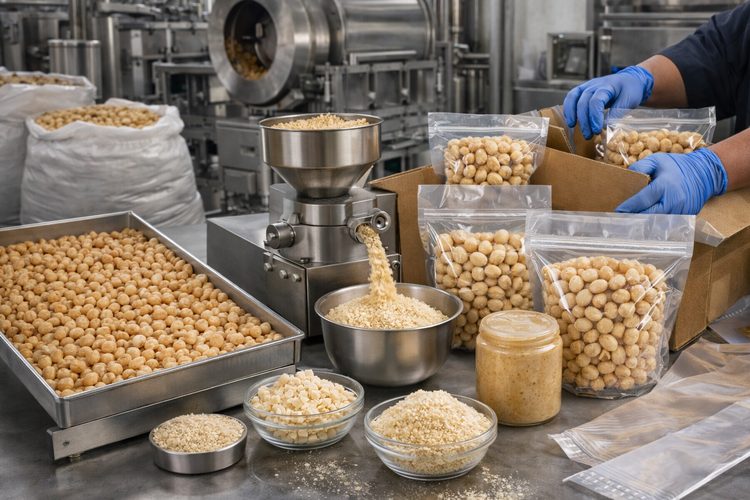
Toll roasting, grinding and packing for macadamias becomes relevant when a buyer has either raw material that needs downstream processing or a finished product concept that requires a more controlled process route than simply purchasing an off-the-shelf item. In practice, this is where many commercial programs either become efficient and repeatable or become expensive, slow and inconsistent. The difference usually comes down to specification discipline.
Macadamias are a premium nut category with a high oil content, a delicate texture and a strong link between process control and final eating quality. That means toll processing is not only a capacity question. It is also a quality-management question. Roast development, breakage control, grind temperature, oil release, packaging barrier performance and freight timing all shape the final commercial result.
Why buyers use toll processing for macadamias
There are several common reasons a buyer or brand chooses toll services rather than only sourcing a standard finished SKU. One case is when a company owns or controls raw or semi-processed kernel and needs roasting, cutting, grinding or packing under a custom commercial brief. Another is when a brand wants a specific roast profile, granulation range or packaging presentation that is not easy to source as a standard catalog item. Toll processing also makes sense when a customer wants to separate ingredient ownership from processing cost, preserve flexibility across multiple finished formats or manage a staged launch that starts with pilot volume and later scales into repeat production.
For macadamias in particular, toll processing is often used for premium snack lines, cookie and bakery inclusions, confectionery toppings, ice cream and frozen dessert inclusions, nut butter applications, macadamia flour or meal programs, and export retail formats where pack identity and labeling matter as much as product quality.
Commercially, the strongest toll-processing brief usually combines five things at the start: incoming material description, target finished format, package style, destination market and production timing. Leaving any one of those vague can create quotation gaps, yield surprises or avoidable rework.
How macadamias behave in toll roasting and grinding
Macadamias are valued for richness, creamy mouthfeel and a clean premium flavor profile, but those same characteristics create process sensitivity. The oil level is meaningful in both roast and grind operations. During roasting, the goal is usually to develop flavor and improve crunch without pushing color too aggressively or creating an overly oily surface. During grinding, heat build-up can push the product from a controlled particulate texture into a more paste-like mass faster than some buyers expect.
That is why macadamia processing discussions should not stop at broad terms such as “roasted” or “ground.” Buyers should define what they actually need the product to do in the application. A topping for premium cookies may need visible identity, a light golden roast and low fines. A filling or spread base may need a more developed flavor and finer grind. A bakery inclusion may prioritize bite integrity after mixing. A sauce or dairy-alternative application may prioritize smoothness, pumpability or consistent particle reduction.
Commercial formats commonly produced through toll processing
Depending on the program, toll processing for macadamias may support several finished forms:
- Whole kernels or style-defined halves: often used for premium retail, confectionery placement and upscale bakery decoration where visual appearance matters.
- Roasted kernels: dry roasted or oil roasted, depending on flavor objectives, surface finish and labeling logic.
- Diced or chopped macadamias: used for bakery, granola, chocolate, snack and dessert applications where coverage, bite and portion control matter.
- Granulated material or coarse meal: relevant for coatings, toppings, inclusions and applications where a smaller particle is preferred but full flour is unnecessary.
- Fine meal or flour: used in bakery, fillings, crust systems, mixes and some specialty formulations.
- Macadamia butter or paste: relevant for confectionery, fillings, premium spreads, sauces and dairy-alternative bases.
- Retail-ready or private-label packed formats: where the toll service extends beyond processing into packing, labeling and shipment preparation.
Each form changes line economics, yield considerations and quality checkpoints. A quote for roasted whole kernels packed into bulk cartons is not directly comparable to a quote for fine ground meal packed into consumer pouches, even if the same raw kernel is used at the start.
Roast style choices and their commercial implications
When buyers request toll roasting, they should clarify whether they want raw-to-roasted conversion, roast refresh, or a roast-and-pack workflow. They should also identify the target flavor direction. Some programs want a light roast that protects the natural creamy profile. Others want stronger toasted notes to stand up against chocolate, caramel, coffee, coconut or savory seasoning systems.
The commercial discussion often includes:
- target color range or visual standard
- expected bite and crunch
- acceptable surface oil expression
- whether salt, seasoning or other surface additions are planned
- whether post-roast cooling is important for downstream packing stability
- whether the roasted product will later be cut or ground
Those details matter because macadamias intended for direct snacking are not always roasted the same way as material intended to become butter or inclusion-grade diced product. The process route should fit the finished commercial use, not only the intermediate product description.
Grinding, meal and butter production: what buyers should clarify
Grinding macadamias is not a single process outcome. It can produce a wide range of textures, from coarse particulate cuts to fine meal to smooth butter-like paste. The brief should state whether the target is free-flowing particulate material, a cohesive ground product, or a spreadable/emulsifiable butter. Particle-size intent affects equipment selection, pass count, screening and process temperature management.
From a commercial standpoint, the buyer should specify:
- whether the ground product is intended for bakery, confectionery, frozen dessert, sauce, dairy alternative or snack applications
- coarse, medium or fine texture expectations
- allowable oiling-off or separation behavior
- whether ingredient declaration should remain simple or include added stabilizers, salt or sweeteners
- whether the ground product must be packed hot, cooled first or filled under a controlled workflow
- finished package type and target fill weights
These are not small details. They determine whether the commercial outcome is a usable ingredient or a product that creates handling issues at the customer plant.
Typical toll-processing workflow for macadamias
Although the exact route varies by program, a typical macadamia toll-processing sequence may include receiving, intake review, lot identification, pre-cleaning or visual sorting as needed, roasting, cooling, cutting or grinding, screening, packing, coding, palletizing and shipment release. For certain programs, metal detection, weight checks, seal verification and sample retention become important documented control points.
For buyers, this matters because every additional step adds both value and cost. The purpose of the quote is not simply to show the processing fee. It is to map the actual workflow required to reach the intended finished state. A simpler route can reduce cost and lead time, but only if it still delivers the needed product performance.
Incoming raw material affects the final result
Toll processing begins with the condition of the incoming macadamias. Buyers sometimes underestimate how much the starting material shapes the finished product. Kernel size distribution, moisture condition, pre-existing breakage, age of stock, prior handling and lot uniformity all influence roast consistency and grind behavior. If the incoming product is mixed in style, aged or mechanically stressed, the toll processor may have less room to deliver a highly uniform premium result.
That is why it helps to document whether the raw material is whole kernel, halves, mixed styles or pre-broken input; whether it is already pasteurized; whether it has been vacuum packed or otherwise protected; and whether the lots are single-origin, blended or accumulated over time. The better the incoming product is defined, the less guesswork there is when quoting process expectations and likely yield.
Quality checkpoints buyers often care about
Even when a program is commercial rather than deeply technical, most serious buyers still want several quality checkpoints addressed clearly. For macadamia toll roasting and grinding, common discussion points include appearance, roast uniformity, flavor cleanliness, breakage level, particle-size consistency, absence of burnt or overly dark material, packaging integrity and lot traceability.
For more specification-driven customers, the discussion may extend to moisture targets, screen-size tolerances, visual foreign-material controls, allergen handling logic, metal detection, retained sample procedures and document flow for lot identification. Export and branded retail programs may also need artwork control, label review, code date alignment and outer-case marking standards.
How packaging changes the economics of the program
Packing is often treated as the final step, but commercially it should be discussed much earlier. Packaging affects fill efficiency, storage stability, handling losses, retail presentation, pallet configuration and freight cost. It also affects how much labor and line changeover is built into the toll fee.
Typical packaging scopes may include:
- Industrial bulk: suitable for manufacturers using roasted, diced or ground macadamias as ingredients in production.
- Foodservice packs: relevant for kitchens, dessert operations and bakery groups that need controlled pack sizes rather than large industrial bulk.
- Retail-ready pouches, jars or bags: often used for private label, premium shelf presentation and e-commerce oriented packs.
- Export-oriented cartons or labeled units: where ship-worthiness, coding, language requirements and documentation readiness matter.
If the buyer does not define pack style upfront, early pricing can look artificially simple and later become less comparable. The same product packed in bulk lined cartons versus consumer stand-up pouches can have very different total conversion economics.
Private label and export considerations
Macadamias are often positioned as a premium nut, so many projects eventually move beyond plain bulk processing into branded or private-label programs. In those cases, toll packing may involve artwork coordination, label application, code-date placement, case packing logic and market-specific shipping documentation. The product itself may not change much, but the commercial workload does.
For export, buyers should identify destination market at the inquiry stage. This helps frame packaging strength, labeling expectations, master-case marking, pallet preference and document preparation. Even when the product is technically the same, operational assumptions can differ between a U.S. domestic replenishment program and an export container program serving the Middle East, Europe or Asia.
Applications where toll-roasted or toll-ground macadamias are commonly used
Macadamias processed through toll workflows can serve a wide range of higher-value applications. Some examples include premium cookies where visible kernel pieces support the product identity; bakery fillings or inclusions where controlled roast flavor matters; confectionery toppings where cut size and visual brightness are important; snack mixes where the nut must retain quality through packing and shelf life; ice cream and frozen dessert inclusions where fat release and crunch balance should be controlled; and butter or paste systems for premium spreads, sauces, flavor bases or non-dairy formulations.
What connects these applications is that the buyer is usually not purchasing “macadamias” in the abstract. They are purchasing a specific functionality. The toll brief should therefore describe what the processed material needs to accomplish after it leaves the line.
What Atlas would ask before quoting a toll-processing program
Atlas would normally ask for a more complete commercial brief before giving the most useful indication. A serious quotation conversation often starts with questions like:
- What is the incoming material and who owns it?
- Do you need roasting only, grinding only, or a full roast-grind-pack route?
- What finished format do you need: whole, diced, meal, flour, butter or retail pack?
- What is the end use?
- Do you have a target roast style, particle-size expectation or sensory reference?
- What packaging format and fill weight are required?
- What are the trial, monthly and annual volume assumptions?
- Is the program domestic, export, foodservice, industrial or private label?
- What timing matters most: trial speed, launch readiness or repeat replenishment cadence?
These questions are not meant to slow down the process. They are meant to make the quote commercially real. A specification-minded inquiry saves time later by reducing false comparisons and avoiding assumptions that need to be corrected after sampling or first production.
How buyers can structure a more useful quote request
A strong quote request for toll processing should read more like an operating outline than a casual request. Instead of asking only for “price to roast and pack macadamias,” it helps to define the exact route. For example: raw kernel supplied by owner, dry roasted to a light-golden premium profile, diced to bakery inclusion size, packed into lined bulk cartons, shipped for cookie manufacturing, initial trial volume followed by monthly replenishment. A brief like that gives the processor enough context to estimate setup logic, packaging needs and realistic conversion cost.
Even when not every technical detail is available yet, the buyer should still communicate the intended commercial direction. Trial quantity, validation run, launch volume and repeat cadence often matter as much as the processing description itself.
Commercial planning points that affect continuity
From a trading and operations standpoint, good toll-processing programs are repeatable programs. Repeatability usually depends on four things: a clear product brief, stable packaging assumptions, sensible production scheduling and a realistic replenishment rhythm. Emergency one-off buying tends to create inefficiency, especially in premium nut categories where line changeovers, handling care and packaging choice materially affect cost.
It is also helpful to decide early whether the program is best managed as customer-owned material with service conversion, or as a broader supply arrangement that integrates sourcing and processing. Some buyers prefer to separate raw material ownership from processing. Others prefer a more consolidated route where fewer counterparties are involved. The right answer depends on commercial structure, internal purchasing policy and scale.
What can change the final quote
Buyers sometimes ask why quotes vary even when the product seems similar. In macadamia toll processing, quotation changes are often driven by real operational differences, not arbitrary pricing. The most common variables include roast intensity, breakage tolerance, number of process steps, need for screening or sorting, target particle size, packaging material, number of SKUs, fill weight complexity, label application, pallet configuration, trial versus production scale and destination-related handling.
This is why comparing two quotes without comparing scope can be misleading. One quote may assume simple bulk conversion. Another may include more careful handling, finer grind tolerances, smaller packs or retail presentation steps. The line item only becomes comparable when the process route is comparable too.
Buyer planning note
Atlas Global Trading Co. uses academy topics like this to help buyers move from general interest to a practical sourcing and processing discussion. For macadamias, the fastest path to a useful quote is to define the target format, process route, pack style, destination market and expected volume rhythm together. That creates a more workable basis for discussing feasibility, likely commercial structure and supply continuity through trusted California processing relationships.
If you are planning roasted macadamias, diced inclusions, macadamia meal, flour, butter or retail packing, Use the contact form to share the operational brief. A better initial brief usually produces a better commercial answer.
Need help structuring a macadamia toll-processing inquiry?
Send Atlas the product form, process route, packaging target and shipment timing so the next commercial discussion starts from a real specification rather than a generic price request.
- State incoming material and required finished format
- Add trial volume, monthly demand or container rhythm
- Include packaging style, destination market and launch timing
Frequently Asked Questions
What should buyers specify before requesting toll roasting for macadamias?
Buyers should define the incoming raw material, target roast style, color and flavor profile, cut or particle size, acceptable oil release, packaging format, destination market, labeling needs, and expected production volume. A better brief leads to a more comparable toll-processing quotation.
Can macadamias be toll processed into more than one commercial format?
Yes. Depending on the program, macadamias may be toll roasted, diced, ground into meal or flour, converted into butter-style pastes, and packed in industrial, foodservice, retail-ready or export-oriented formats.
Why does packaging matter in a macadamia toll-processing quote?
Packaging affects line setup, fill weights, labeling, pallet efficiency, freight economics, shelf-life protection, and export documentation. The same processed macadamia item can have a different commercial outcome depending on whether it is packed for bulk manufacturing, foodservice or retail distribution.