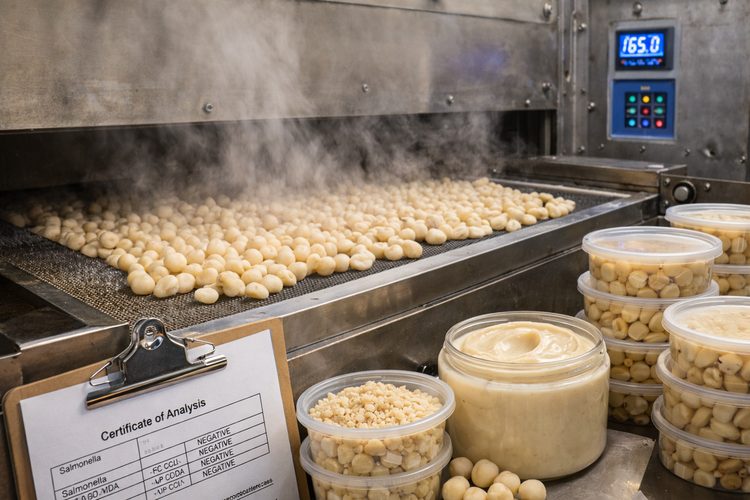
For commercial buyers, pasteurization is not a small secondary attribute. In macadamias, it often sits at the intersection of food safety, process compatibility, sensory quality, shelf-life planning and documentation. A buyer may start with a simple question such as “Do we need pasteurized kernels?” but the better sourcing discussion is broader: what hazard profile is being managed, what processing happens after receipt, what finished product is being made, what specification must be met, and how will the material move through warehousing, packing, export or manufacturing?
Macadamias are premium ingredients. Their high oil content, clean buttery flavor, pale cream appearance and delicate bite make them attractive in bakery, confectionery, snack, premium inclusions, nut butter and foodservice applications. Those same characteristics also mean that process choices need to be handled carefully. Buyers usually do not want a microbiological control step that creates unnecessary color change, brittle texture, excess breakage, scorched notes or reduced shelf-life performance. In practical terms, the pasteurization conversation is always both technical and commercial.
Why pasteurization becomes a buying decision instead of just a processing detail
Many ingredient teams first encounter the topic because their customer, plant QA team or retail program asks whether a nut ingredient is raw, pasteurized, roasted or otherwise treated. Once that question is raised, it affects specification language, supplier approval, inbound quality checks and quote comparability. One supplier may be offering raw whole kernels, another may be offering a validated treated item, while a third may expect the buyer to apply a later lethality step during roasting or finished product processing. Those are not equivalent commercial offers even when the nominal product description still says “macadamia kernels.”
Pasteurization status can also change the packaging and handling brief. A treated product may require tighter control around post-process handling, sealing integrity, storage conditions, lot segregation and documentation retention. For some buyers, especially those producing ready-to-eat products, the upstream treatment step is essential. For others, particularly manufacturers with their own validated downstream thermal process, untreated material may still be acceptable if the process map and risk controls support that decision.
Commercial takeaway: buyers should avoid asking only for “macadamias” or even only for “pasteurized macadamias.” A practical inquiry should state the product form, the downstream application, whether the item is ready-to-eat or receives further kill-step processing, the packaging requirement, the destination market and the expected volume rhythm.
What buyers usually mean when they ask for pasteurized macadamias
In most sourcing conversations, the buyer is not asking for a generic marketing claim. They are usually trying to confirm one or more of the following points:
- whether the product has passed through a defined microbial reduction step,
- whether there is a documented process route and supporting food safety paperwork,
- whether the treatment has been applied before or after sizing, cutting or further conversion,
- whether the treatment affects flavor, color, breakage or oil expression,
- whether the finished item is intended for direct inclusion in a ready-to-eat application, and
- whether the resulting offer supports the customer’s regulatory, customer-audit or internal QA requirements.
That is why product descriptions need to be specific. “Whole raw kernel,” “pasteurized halves and pieces,” “dry roasted diced macadamias,” “macadamia meal for bakery blend,” and “macadamia butter base” each involve different production assumptions. The same buyer may accept different process routes depending on the end use. A premium cookie inclusion, a confectionery topping, a nut butter base and a retail pouch program do not carry the same performance requirements.
Pasteurization versus roasting: not the same specification
In commercial nut buying, pasteurization and roasting are often mentioned together, but they should not be treated as interchangeable. Pasteurization is generally discussed in relation to microbiological control. Roasting is normally discussed in relation to flavor development, color change, texture modification and finished product sensory profile. Some products may involve only one of those steps. Others may involve both, depending on process design and end use.
A buyer sourcing a bakery inclusion may prefer a controlled treated kernel that will still go through baking in the finished product. A snack manufacturer may want a roasted item with a defined color and flavor target. A confectionery producer may prioritize flavor neutrality and appearance retention before enrobing or depositing into premium inclusions. In each case, the commercial brief changes because the material is being evaluated against a different manufacturing reality.
Where pasteurization sits in the broader macadamia product menu
Macadamia sourcing rarely starts and ends with whole kernels. Industrial buyers typically move among several product forms based on cost, inclusion visibility, texture and process efficiency. Pasteurization questions can apply to all of them, but the operational consequences differ.
- Whole kernels: used when visual premium, large particle identity and intact bite matter. Breakage tolerance and visual sorting become commercially important.
- Halves or large pieces: often used to balance appearance with better yield and lower cost than top whole grades.
- Diced macadamias: suited to cookies, bakery fillings, snack blends and confectionery inclusions where controlled cut size supports deposit accuracy and piece distribution.
- Meal or coarse granulation: chosen for coatings, crumble systems, bakery mixes or texture layers where visible particle identity is less important than consistent dispersion.
- Fine flour: relevant where the nut functions as an ingredient phase rather than a visible inclusion; oil content, grind behavior and flowability matter.
- Macadamia butter or paste: selected for fillings, spreads, premium confectionery centers, sauces and plant-based formulations where smoothness, oil release and flavor profile drive performance.
Each of these forms can create a different question around when the control step occurs, how the product is protected afterward and what quality traits must be preserved. For example, an intact whole kernel program may be highly sensitive to handling and post-process breakage. A butter program may be more focused on flavor cleanliness, oil separation behavior and final microbiological acceptance criteria.
Technical areas buyers often review before approving a pasteurized macadamia item
Although final specifications vary by customer and destination, serious buyer buyers usually evaluate pasteurized macadamias across several technical dimensions rather than relying on a single line item. Typical review points include:
1. Microbiological expectation
The buyer needs to know whether the supplied product is aligned with the microbiological standard required for the intended use. That means understanding whether the treatment is part of a validated food safety system, how the supplier manages post-treatment handling, and whether lot-level documentation supports release.
2. Sensory retention
Macadamias are premium partly because of their delicate creamy flavor. A process that achieves the desired control outcome but flattens the flavor, hardens the bite or introduces stale, cooked or browned notes may not be commercially acceptable for premium applications.
3. Appearance and color
For high-visibility retail and confectionery programs, buyers may care deeply about cream color, lack of excessive browning and consistent visual grade. Treatment conditions and downstream handling can influence that result.
4. Texture and breakage
Whole kernels and larger pieces are especially sensitive to handling. Buyers typically want clarity on expected breakage, tolerance for chipped material and the difference between an inclusion-grade offer and a top visual grade offer.
5. Moisture and stability management
Because macadamias are high-oil nuts, stability planning matters. Buyers often review moisture condition, packaging barrier expectations, warehouse practices and the practical shelf-life assumptions needed for international transit and customer inventory cycles.
6. Packaging integrity and pack configuration
Process status alone does not protect product value. Carton strength, liner design, seal quality, palletization, load pattern and container planning all influence whether the product arrives in the same usable condition in which it was packed.
How the application changes the pasteurization brief
The correct quote request depends heavily on where the macadamias will be used. Buyers get better quotes when they describe the actual manufacturing use case rather than only the ingredient name.
Bakery and cookies
In cookies, premium bars and sweet baked goods, macadamias are often chosen for visual appeal, creamy flavor and texture contrast. Here the buyer may care about cut size consistency, visible piece count per unit, tolerance for fines, and whether the inclusion stays attractive after baking. If the finished product already includes a validated thermal process, the role of upstream pasteurization should be discussed in the context of the full process map rather than in isolation.
Confectionery and chocolate
Chocolate-coated nuts, praline systems, bark, tablet inclusions and premium centers tend to be sensitive to flavor cleanliness, color uniformity and low defect visibility. In these applications, oxidative stability, flavor integrity and low breakage are often just as important as the microbiological discussion. Buyers also need to think about whether the item will be used whole, chopped or converted into paste.
Snack mixes and retail packs
For finished snack programs, the material often sits closer to the consumer-facing stage. This makes packaging, lot traceability, label alignment and ready-to-eat logic more commercially important. The cost discussion may include not only kernel grade and treatment status, but also whether the program is bulk for further packing, finished retail-ready, or private label with destination-specific labeling requirements.
Plant-based dairy, sauces and spreads
Macadamias are attractive in premium plant-based formulations because of their creamy fat profile and mild taste. Here the buyer is often more concerned with grind behavior, smoothness, oil release, sediment control and clean flavor than with top whole-kernel appearance. Pasteurization questions still matter, but they intersect with grinding efficiency, process hygiene and the final formulation’s shelf-life system.
Foodservice and premium culinary use
Foodservice programs may prioritize consistency, pack convenience, recipe repeatability and practical handling. A chef-facing or distributor-facing brief should make clear whether the product is used as a garnish, an inclusion, a crushed topping or a sauce component. A treated item may support a more straightforward handling expectation in some channels, but the buyer still needs to preserve premium sensory performance.
How this topic shows up in real buying decisions
In real purchasing workflows, macadamia pasteurization becomes a decision point when teams compare suppliers and find that the offers are not structured the same way. One quotation may include a treatment step, a different packaging design and a narrower specification range. Another may appear cheaper but assume the buyer will handle the next control step internally. Without aligning those assumptions, the price comparison is misleading.
That is why strong buyers build a comparison sheet around use-case logic rather than only headline cost. Useful fields often include product form, particle size or grade, treatment status, raw versus roasted state, packaging format, target pallet or container load, minimum order quantity, lead time, document set, shelf-life statement and destination-specific requirements. The clearer the brief, the more comparable the market becomes.
Commercial variables that may change when pasteurization is required
Requesting a pasteurized macadamia item can influence more than the ingredient line on the quotation. It may change several parts of the commercial structure:
- Unit economics: treatment, validation, additional handling and packaging controls may alter cost.
- Lead time: treated programs may have different production scheduling assumptions than untreated stock programs.
- MOQ: minimums may rise depending on treatment route, pack style or lot management requirements.
- Inventory strategy: shelf-life planning and post-process handling expectations may influence whether the buyer works on spot, call-off or repeat forecast basis.
- Documentation: COA structure, process declarations and food safety paperwork may become more central to the approval process.
- Export readiness: destination markets may add packaging, labeling or document requirements that need to be reflected at quote stage.
Specification points buyers often include in a practical inquiry
Atlas generally encourages buyers to move beyond broad requests and state the commercial brief in specification-minded language. A useful inquiry for pasteurized macadamias often includes most of the following:
- product form: whole, halves, pieces, diced, meal, flour, butter or paste,
- raw, pasteurized, roasted or further processed status,
- end use: bakery, confectionery, snack, dairy alternative, sauce, retail pack or foodservice,
- size or grade expectations, including tolerance for breakage and fines,
- flavor and appearance expectations,
- microbiological or QA approval requirements,
- desired pack style, such as industrial cartons, lined boxes, bags or retail-ready formats,
- trial quantity, recurring monthly usage or container program volume,
- destination market and import route,
- target ship window and replenishment rhythm, and
- any customer-specific documentation or audit expectations.
Even when every data point is not yet final, sharing a preliminary version of this brief usually helps narrow the correct commercial route much faster than starting with a generic availability question.
What Atlas would ask before quoting
Atlas usually tries to connect the treatment question to the business reality behind it. A quotation is easier to structure when the buyer can answer the following points:
- Is the material going into a ready-to-eat product or a further processed system?
- Do you need whole visual grade material or is an inclusion-grade cut more efficient?
- Is the product for industrial manufacturing, foodservice, retail packing or private label?
- What is the target destination: domestic U.S. distribution or export?
- Do you need a trial, a launch quantity or a recurring contract-style supply rhythm?
- What documents does your QA or customer approval team require?
- Are there pack-size or palletization constraints that matter in your plant or warehouse?
These questions are not administrative. They materially affect whether the most sensible supply option is a premium visual whole grade, a more efficient cut-size program, a treated ingredient for direct use, or a different format better suited to the actual application.
Atlas trade note: the best macadamia programs are rarely built by buying the cheapest nominal kernel. They are built by matching the right process state and grade to the application so the delivered ingredient performs technically and commercially from trial through replenishment.
Inbound QC considerations for pasteurized macadamias
Once a treated macadamia item arrives, receiving teams still need an inbound review plan. Pasteurization is not a substitute for disciplined receiving control. Depending on the buyer’s system, inbound QC may include:
- verification of lot identity and traceability paperwork,
- inspection of carton condition, liner integrity and pallet stability,
- confirmation that labeling matches purchase order and specification,
- review of COA or agreed release documents,
- sensory review for flavor, odor, color and visible defects,
- basic dimensional or cut-size checks where relevant,
- breakage and fines review for visible inclusion programs, and
- warehouse release decisions based on the buyer’s QA protocol.
For export programs, buyers may also want clear confirmation that the pack held up through longer transit assumptions and that the documentation set supports customs and customer receiving requirements.
Packaging logic: why pack style matters as much as process status
Pasteurized product value can be undermined by weak packaging logic. In commercial nut trade, packaging is part of the technical solution. Buyers may need industrial bulk cartons, lined corrugated cases, poly-lined bag systems, foodservice-ready packs, retail-ready secondary packaging or private-label configurations. The correct choice depends on plant handling, storage time, distribution route and the sensitivity of the item.
Macadamias are high-value nuts, so physical protection and freshness preservation both matter. When the program is export-oriented, buyers should think early about pallet pattern, container utilization, liner type, labeling language, case dimensions and whether the shipment will move as a trial pallet, LCL or full container program. These details affect landed cost and practical success, not just packaging appearance.
Domestic versus export programs
The core technical logic of pasteurization can apply across U.S. and export markets, but the commercial framing often changes. Domestic industrial buyers may prioritize delivery cadence, warehouse compatibility and QA document speed. Export buyers may need more advance planning around transit time, customs documents, country-specific labeling, destination packaging and shelf-life allocation across ocean transit and local distribution.
That is why Atlas tends to ask about destination market early. A pasteurized item moving to a nearby domestic bakery and a pasteurized item moving into an export retail or ingredient program may require very different packaging, booking timing and document preparation. Clarifying this early reduces avoidable mismatches at the quotation stage.
Cost-control without overspecifying the item
Buyers sometimes overspecify macadamias because the application sounds premium. In reality, the application may not require the most expensive whole-kernel visual grade or the tightest aesthetic tolerance. If the nut is being chopped, ground or blended into a system where whole appearance is irrelevant, a more efficient format may perform equally well at lower delivered cost. The right question is not “What is the highest grade available?” but “What grade and process state are sufficient for the real use case?”
Likewise, requiring a treated item when the manufacturer already applies a validated downstream kill step may or may not be commercially necessary. That decision belongs within the buyer’s food safety framework, but from a sourcing perspective it should be deliberate. The best value often comes from aligning the specification tightly with the actual manufacturing process instead of layering redundant requirements onto the brief.
How buyers often structure a macadamia program commercially
Macadamia purchasing typically works best when built in stages:
- Trial quantity: used to verify flavor, appearance, processing compatibility and plant handling.
- Validation run: confirms the selected specification in real production conditions and final finished product performance.
- Launch volume: aligns packaging, booking cadence and customer demand assumptions.
- Repeat replenishment: stabilizes the program through clearer forecasts, standard documentation and more reliable continuity.
This staged logic is especially valuable when the program includes treatment requirements, retail commitments or export elements. It reduces the risk of treating a high-value ingredient as a one-time spot purchase when the real goal is repeatable supply.
How this article translates into a stronger RFQ
A weak RFQ says: “Please quote pasteurized macadamias.” A stronger RFQ says: “Please quote pasteurized macadamia pieces for premium cookie manufacturing, 10 kg lined cartons preferred, trial pallet followed by monthly usage, destination EU, target ship window July, low visible fines preferred, documents required for QA review.” The second brief gives the supplier enough information to structure a commercial answer that reflects the actual job to be done.
The goal is not paperwork for its own sake. The goal is to make sure the quotation reflects the right product form, handling route and commercial assumptions so that the approved sample, the booked production lot and the delivered shipment all belong to the same program logic.
Buyer planning note
Atlas Global Trading Co. uses topics like macadamia pasteurization to help buyers move from general research to usable buying language. For California-processed macadamia programs, the strongest starting point is a brief that combines format, process state, application, packaging, destination and timing. That approach generally leads to better quote accuracy, easier supplier comparison and a more durable supply decision.
If you are reviewing pasteurized macadamias for bakery, confectionery, retail, foodservice or ingredient manufacturing, Atlas can use the same technical and commercial logic covered here to structure a more practical inquiry and quotation path.
Need help sourcing around this macadamia topic?
Use the contact form to turn this research topic into a practical quote request for Atlas, whether you need a trial lot, a recurring ingredient program or an export-ready pack structure.
- State the exact macadamia format and process status
- Add target monthly, trial or container volume
- Include destination market, pack style and timing
Practical points to define before requesting a quote
For many buyers, the fastest route to a useful quotation is sending a short but structured product brief. For this topic, the most helpful fields are:
- product form: whole, halves, pieces, diced, meal, flour or butter,
- required process state: raw, pasteurized, dry roasted or oil roasted,
- end use and whether the item is further processed after receipt,
- preferred packaging: industrial bulk, foodservice, retail-ready or private label,
- destination market and required documents,
- estimated trial quantity and ongoing usage rhythm, and
- target timing, including any launch or seasonal demand window.
These inputs help make supplier comparisons more realistic and reduce the risk of approving a sample that does not match the later commercial shipment.
Frequently Asked Questions
Why do macadamia buyers ask whether kernels are pasteurized before quoting?
Because pasteurization status can affect process flow, microbiological expectations, labeling discussions, usable shelf-life planning, packaging selection and the total delivered commercial offer.
Does pasteurization replace the need for roasting or further process controls?
No. Pasteurization and roasting solve different problems. A buyer still needs to align food safety expectations, sensory targets, moisture control, oxidation management and downstream handling requirements.
What should be included in a macadamia pasteurization inquiry to Atlas?
A useful brief usually includes product form, raw or roasted status, intended application, target pack format, destination market, trial or monthly volume, timing, and any microbiological, documentation or shelf-life requirements.