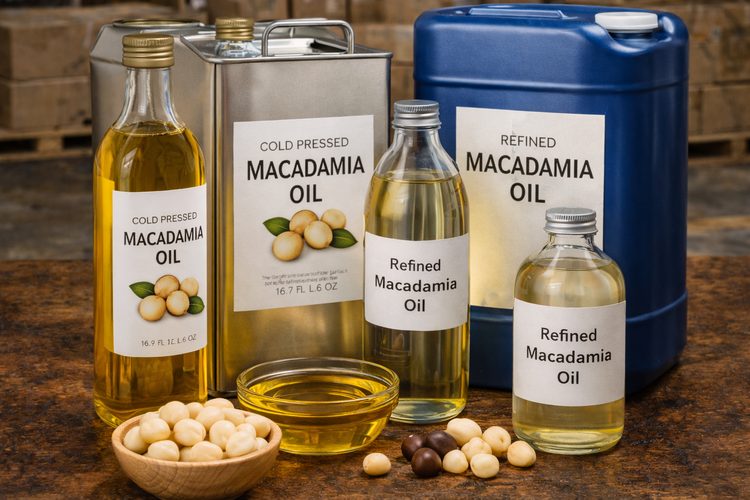
Macadamia oil is one of the more specification-sensitive products in the nut category because the buying decision is rarely about oil alone. The stronger commercial result usually comes from matching the oil stream to the actual end use, sensory target, processing route, packaging system and destination market before the quotation is finalized. In practice, buyers are not simply choosing between two labels that say “macadamia oil.” They are choosing between different functional and commercial routes.
Cold pressed and refined macadamia oil can both be commercially valid, but they serve different product concepts. One may be selected because the finished item benefits from visible premium positioning, natural flavor character and a less processed story. The other may be selected because the formulation needs a cleaner, more neutral ingredient that integrates without dominating taste, color or aroma. The correct answer depends on the application. That is why oil sourcing works best when specification, process expectations and market positioning are discussed together.
Why this topic matters in real buying decisions
Macadamias are often associated with premium kernels, inclusions, nut butters and high-end snack formats, but the oil stream has its own commercial role. Macadamia oil can be used in dressings, sauces, marinades, bakery fat systems, premium cooking oil lines, gourmet retail products, cosmetic-adjacent food concepts, nut-based spreads and selected plant-based formulations. In each case, the buyer needs to decide whether flavor expression or sensory neutrality matters more.
That choice affects more than the label copy. It can influence pricing, packaging, product appearance, oxidation management, order size expectations, route-to-market positioning and the final value proposition. A brand building a premium culinary oil line may want the identity and perceived authenticity of cold pressed material. A manufacturer working on a blended formulation may instead want refined oil because it behaves more quietly in the final system. Those are different commercial use cases and should not be quoted as though they are interchangeable.
Buyer takeaway: cold pressed versus refined should be decided with the finished product in mind. The strongest quote request states whether the oil is expected to deliver flavor and premium story, or whether it is expected to provide a cleaner functional fat phase with less sensory impact.
What buyers usually mean when they ask for macadamia oil
In buyer trade, a request for “macadamia oil” can hide several different needs. Some buyers want a premium oil that can be sold as a featured ingredient with visible culinary positioning. Others want a formulation component whose role is to support mouthfeel, lubrication, richness or fat balance without becoming the sensory headline. Some want retail-ready pack programs. Others need foodservice, industrial bulk or private label formats. Until those points are clarified, it is difficult to build a precise quotation.
The usual buying questions are not limited to the oil type itself. Buyers often need clarity on:
- whether the oil should retain natural macadamia character or remain comparatively neutral,
- whether color and aroma matter in the final product,
- whether the oil will be sold as a finished product or used as an ingredient,
- whether the program requires retail, foodservice or industrial bulk packaging,
- whether there are shelf-life, export or documentation requirements, and
- whether the buying pattern is trial, launch volume or recurring replenishment.
Cold pressed macadamia oil: where it tends to fit commercially
Cold pressed macadamia oil is generally chosen when the buyer wants the oil to carry part of the product story. It is commonly associated with premium positioning, culinary interest, less processed image and visible ingredient character. In commercial terms, it can be attractive where the brand wants consumers or professional users to recognize the ingredient rather than hide it inside the system.
Typical commercial use cases may include gourmet culinary oils, high-end dressings, finishing oils, marinades, premium gift food programs, specialty retail ranges and some premium snack or deli concepts. In these applications, flavor and identity are usually assets rather than variables to be minimized. Buyers may also view cold pressed oil as more compatible with storytelling around origin, premium nut value and artisanal or elevated product positioning.
Sensory logic of cold pressed oil
The commercial appeal of cold pressed macadamia oil usually starts with sensory expression. Buyers often expect more recognizable nut character, a more natural aromatic profile and a premium feel that can support a differentiated final product. That can be valuable in products where ingredient identity helps justify a higher retail price or a more upscale brand proposition.
However, stronger identity is not always better. In some formulations, the oil needs to stay in the background. If the application calls for a delicate seasoning profile, a neutral sauce base or controlled finished color, a more expressive oil may not be the easiest fit. This is why the purchasing brief should always include the intended use, not just the preferred process route.
Commercial realities of cold pressed oil
Because cold pressed oil is often purchased for premium positioning, buyers should usually think through packaging presentation, fill size architecture, channel strategy and label language at the same time. A premium oil packed in a purely utilitarian presentation may undersell its value, while an overdeveloped premium package can create margin pressure if the route to market does not support it.
Cold pressed programs often benefit from early alignment on:
- target flavor profile and acceptance range,
- appearance expectations,
- consumer-facing or chef-facing pack size,
- light-protective packaging choices where relevant,
- premium gift or specialty shelf presentation, and
- the difference between a one-off seasonal program and a repeat product line.
Refined macadamia oil: where it tends to fit commercially
Refined macadamia oil is usually chosen when the application requires a more neutral working ingredient. Buyers in manufacturing environments may prefer it when they want the functional contribution of the oil without asking it to carry the entire sensory identity of the finished product. This can be especially relevant in dressings, sauces, bakery systems, emulsified products, blended fats or premium prepared foods where the oil should support texture and richness but not interfere with the broader formulation profile.
Commercially, refined oil often appeals to buyers who want more process flexibility, more predictable batch-to-batch behavior and a more controlled finished profile. It can also be easier to position in applications where ingredient neutrality supports flavor consistency across larger production volumes. For some buyers, refined oil may provide a better balance between premium ingredient value and formulation practicality.
Sensory logic of refined oil
In refined form, the buyer is generally prioritizing controlled performance over overt identity. The oil can be selected because it contributes body, lubricity or fat functionality without pushing the finished product too far toward a distinctive nut profile. That may be commercially useful in systems where the recipe already includes spices, acids, herbs, sweeteners or other dominant sensory components.
This does not make refined oil lower value in every context. In many industrial settings, neutrality is exactly the premium. A product developer may see refined macadamia oil as the better choice because it allows the desired texture or premium fat positioning without complicating flavor balance.
Commercial realities of refined oil
Refined oil often fits well in industrial ingredient programs, contract manufacturing, selected foodservice applications and formulations where the buyer needs the macadamia oil line item to serve a technical purpose inside a larger system. In such cases, the RFQ usually focuses less on retail storytelling and more on compatibility, pack format, volume cadence and specification consistency.
Useful buying considerations may include:
- whether the oil is used neat or inside a blend,
- whether appearance must remain very light or visually quiet,
- whether the final product requires strong flavor consistency across batches,
- whether the program is domestic or export-oriented, and
- whether industrial bulk packaging is more appropriate than retail-ready formats.
Cold pressed versus refined: the practical buyer comparison
From a buyer standpoint, the most useful way to compare these oil streams is not by treating one as universally better. The real question is which stream fits the application more naturally. Cold pressed oil is often the stronger choice when the oil is expected to communicate premium ingredient identity. Refined oil is often the stronger choice when the oil is expected to integrate into a formulation with less sensory disruption.
In practical buying terms, the comparison often comes down to six areas:
- Flavor role: featured ingredient character versus quieter background function.
- Appearance target: visible natural identity versus more controlled neutrality.
- Product concept: premium culinary presentation versus broader formulation use.
- Pack style: consumer-facing premium formats versus industrial or foodservice efficiency.
- Commercial positioning: ingredient storytelling versus process compatibility.
- Quote structure: premium pack-led programs versus recurring formulation supply.
How application changes the oil brief
The right macadamia oil specification depends heavily on what the buyer is making. Below are some common application lenses that help clarify which stream may be more appropriate.
Dressings, vinaigrettes and marinades
In premium dressings and culinary marinades, cold pressed oil may make sense when the oil contributes part of the consumer value story and the flavor profile benefits from a more natural nut identity. Refined oil may make more sense when the dressing contains assertive herbs, acids or seasonings and the oil is mainly there for texture, richness and premium positioning without becoming the dominant flavor note.
Bakery and confectionery systems
Bakery and confectionery uses often depend on whether the oil is consumer-visible or formulation-led. In filled products, premium icings, glazes or selected bakery fat systems, refined oil may be preferred for control and consistency. If the brand wants to emphasize macadamia as part of the concept, a cold pressed route may support stronger product storytelling, though that choice should still be validated in the finished system.
Premium retail oil programs
For bottled culinary oils, gift formats and specialty grocery concepts, cold pressed oil often aligns well with the commercial model because the product is sold substantially on quality cues, ingredient identity and premium presentation. Packaging, bottle format, closure type and outer case structure become central to the quotation in these programs.
Prepared foods and premium manufacturing
Prepared foods, sauces, dips and premium ready-to-use systems may favor refined oil when consistency, lightness of profile and formulation stability matter more than visible ingredient character. In these cases, industrial or foodservice packaging may be more relevant than consumer bottle formats.
Plant-based and specialty formulations
Macadamia oil can support rich mouthfeel and premium fat positioning in selected plant-based systems. Here the choice between cold pressed and refined usually depends on whether the finished product benefits from a more natural, recognizable oil identity or requires a cleaner supporting fat phase. Sensory balance, emulsion behavior and packaging route should all be discussed at quote stage.
Application note: the same buyer may use both oil streams in different products. A premium bottled oil line may justify cold pressed oil, while the same company may prefer refined oil for sauces, spreads or multi-ingredient manufacturing where neutrality matters more.
Specification thinking: what buyers should define early
Macadamia oil quotations become much more useful when the buyer moves beyond general interest and defines the technical-commercial brief clearly. Atlas usually encourages buyers to clarify:
- cold pressed or refined requirement,
- intended end use and processing conditions,
- desired flavor intensity and appearance profile,
- whether the oil is sold as a finished item or used as an ingredient,
- preferred packaging route,
- destination market and documentation needs,
- trial quantity, monthly usage or container program, and
- target timeline for sample, validation run or launch shipment.
Even when the buyer is still testing concepts, these early inputs help narrow the commercially relevant supply options and reduce avoidable back-and-forth later.
Packaging logic for macadamia oil programs
Packaging is a major part of the oil decision because cold pressed and refined programs often move through different commercial channels. A premium cold pressed retail oil may require bottle presentation, label area, closure quality, case aesthetics and premium outer packaging suitable for shelf or gifting. A refined oil ingredient program may instead need efficient industrial bulk, foodservice containers or larger pack formats aligned with plant handling and recurring supply.
From a commercial standpoint, buyers should think about packaging in three categories:
- Retail-ready: bottles or finished consumer units for specialty grocery, gourmet or premium private label programs.
- Foodservice: practical intermediate pack sizes for hospitality, culinary operations or chef-led use.
- Industrial bulk: formats designed for manufacturing efficiency, batching and repeat volume use.
When the buyer clarifies the packaging route early, the quote can reflect the true business model rather than an incomplete product concept.
Documentation and quality discussions
As with other high-value nut-derived ingredients, macadamia oil sourcing works better when quality expectations are explicit. For many buyers, the discussion includes not only the oil stream but also how the lot will be approved, what documents are expected and what shelf-life logic is needed for the route to market. Domestic industrial use, export retail and premium foodservice all create different documentation emphasis.
Typical discussion points may include:
- product description and agreed oil stream,
- lot identification and traceability,
- COA or other routine release documents,
- pack date or shelf-life statement,
- packaging confirmation, and
- destination-specific documentation where applicable.
The exact document set varies by program, but the broader point is consistent: oil should be quoted as a managed ingredient, not as a generic commodity line.
Commercial planning points
The best macadamia oil programs are usually built around repeatability. That means clear product definitions, realistic pack selection, sensible order cadence and a supply structure that supports continuity rather than emergency buying. For premium cold pressed programs, that may mean starting with a validation run and then moving into a brand-ready repeat format. For refined industrial programs, it may mean establishing an efficient recurring supply rhythm tied to production demand.
Buyers also benefit from thinking in stages:
- Concept sample: validate flavor, appearance and fit in the application.
- Trial run: confirm processing behavior and pack practicality.
- Launch volume: align the oil stream, pack format and route to market.
- Repeat replenishment: stabilize forecasts, packaging and documentation.
This structure is especially helpful when the program includes export, private label retail or premium positioning, since those routes usually involve more coordination than straightforward industrial ingredient purchasing.
What Atlas would ask before quoting
Atlas generally uses the same specification-minded approach across nut ingredient categories. For macadamia oil, the most useful starting questions are:
- Do you need cold pressed oil for premium identity, or refined oil for more neutral formulation use?
- Is the oil for retail sale, foodservice use or industrial manufacturing?
- What is the intended application?
- What pack format best fits the route to market?
- Is this a trial, launch volume or repeat program?
- What is the destination market and target timing?
- Are there any documentation, approval or shelf-life requirements that need to be reflected in the offer?
When those answers are known early, the quotation is more practical and easier to compare across supply options.
How this topic shows up in real RFQs
A weak RFQ says: “Please quote macadamia oil.” A stronger RFQ says: “Please quote cold pressed macadamia oil for premium retail bottled use, export destination, finished consumer packs preferred, initial trial followed by recurring shipments.” Or: “Please quote refined macadamia oil for sauce manufacturing, industrial bulk packaging, monthly usage forecast available.” The second version gives the supplier enough information to respond with a commercially relevant offer.
The point is not to overcomplicate the brief. The point is to make sure the oil stream, packaging route and commercial assumptions all match the actual business objective.
Buyer planning note
Atlas Global Trading Co. uses topics like cold pressed and refined macadamia oil to help buyers move from general product interest to a more precise quote request. In practice, the best outcome usually comes when buyers define whether they need premium ingredient character or functional neutrality, then align that decision with the application, pack format, destination and timing.
If you are evaluating macadamia oil for premium retail, culinary, foodservice or industrial ingredient use, Atlas can use the same framework outlined here to turn the topic into a more practical inquiry and quotation path.
What to include in a practical macadamia oil inquiry
For this topic, a more useful product brief usually includes:
- oil stream required: cold pressed or refined,
- finished application or channel,
- flavor and appearance expectations,
- preferred packaging format,
- domestic or export destination,
- trial, monthly or contract-style volume estimate,
- target launch or ship window, and
- any quality, documentation or shelf-life requirements.
Those inputs help Atlas structure a more comparable and specification-led quotation rather than a broad generic offer.
Need help sourcing around this macadamia oil topic?
Use the contact form to turn this research topic into a practical quote request for cold pressed or refined macadamia oil supply.
- State the required oil stream and application
- Add pack format and target monthly or trial volume
- Include destination market and target timing
Frequently Asked Questions
What is the main buyer takeaway from “Cold Press and Refined Macadamia Oil: Commercial Use Cases”?
The main buyer takeaway is that macadamia oil should be sourced as a specification-led ingredient. Buyers need to decide early whether the application needs cold pressed character or refined neutrality, because that choice affects flavor, appearance, process behavior, packaging and commercial structure.
How do cold press and refined macadamia oil differ commercially?
Cold pressed macadamia oil is usually chosen for premium positioning, natural flavor expression and label storytelling, while refined macadamia oil is typically selected for more neutral sensory performance, broader process flexibility and easier use in formulations where the oil should not dominate the finished profile.
What should buyers include when requesting a quote for macadamia oil?
A practical macadamia oil inquiry should include the oil type required, intended application, sensory expectations, packaging format, destination market, trial or recurring volume, timing and any shelf-life, documentation or quality requirements.