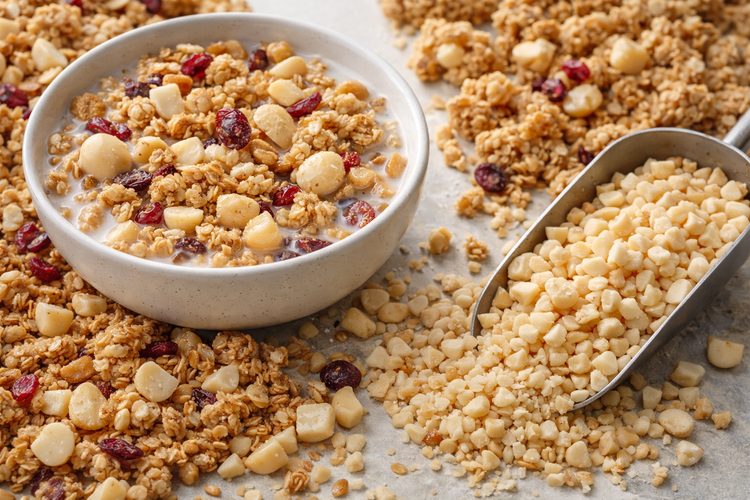
Macadamias can perform exceptionally well in premium granola, clusters and cereal applications, but only when the inclusion is chosen with the production line and the finished eating experience in mind. This is not a category where buyers should ask only for “macadamias” and compare price. The stronger commercial outcome usually comes from aligning cut size, roast style, inclusion rate, packaging, line handling and shipment timing before the order is placed.
In granola and cereal, macadamias are rarely used as a generic nut. They are usually selected because the brand wants a more indulgent texture, a creamier nut note, a lighter premium visual or a more upscale positioning than standard nut mixes provide. That premium advantage can be commercially valuable, but it also means the ingredient has to justify itself in formulation cost, process behavior and finished pack appearance. A well-selected macadamia inclusion can elevate the product. A poorly selected one can create breakage, uneven piece distribution, oil handling issues, inconsistent bite or unnecessary cost pressure.
Why macadamias are attractive in granola and cereal systems
Macadamias bring a distinct sensory profile to the breakfast and snack category. Compared with harder or more assertive nut inclusions, they are often associated with a smoother bite, richer mouthfeel and a more luxurious eating experience. For premium cereal brands, that can help support price architecture, “elevated breakfast” positioning and visual differentiation on pack. For granola and cluster lines, macadamias can add indulgence while still fitting into clean-label, better-for-you or gourmet product stories depending on the overall formulation.
That said, macadamias are not automatically the right fit for every cereal system. Their value is highest where the brand wants the nut to be noticed. In mainstream cereal at aggressive cost targets, lower-cost nut forms or granulated inclusions may be more practical. In premium granola, travel retail snack mixes, high-end hotel breakfast formats or export premium cereal lines, macadamias may have a stronger commercial role because their sensory and visual contribution can be monetized more clearly.
Commercial takeaway: macadamias work best in granola and cereal when the brand is intentionally buying premium texture, a softer rich nut profile and visible value perception, not just adding another nut line item.
How this topic shows up in real buying decisions
In practice, buyers are not choosing between macadamias and no macadamias in the abstract. They are deciding what the ingredient needs to do on line and in the finished pack. Some products need visible large pieces that stand out on shelf and in bowl presentation. Others need smaller controlled cuts that stay evenly distributed in granola clusters without dominating cost or causing too much breakage. Some brands want a lighter natural appearance. Others want a roasted note that fits honey, maple, vanilla, coconut, dark chocolate or tropical fruit profiles.
This means the quoting conversation usually comes down to five operational questions. What cut size is required? Is the inclusion raw, pasteurized, dry roasted or oil roasted? At which step is it added to the process? What defect and breakage tolerance is commercially acceptable? And what packaging and shipment pattern support continuity? Until these points are clear, two supplier offers may not actually be comparable even if both say “macadamia pieces.”
The main macadamia formats used in granola and cereal
Macadamias can enter the granola and cereal category in several forms, but each form creates a different balance between visual impact, processing practicality and delivered cost.
Whole kernels
Whole kernels are usually more relevant to luxury snack mixes or very premium cluster applications than to mainstream cereal. They create strong visual premium value but can be commercially inefficient in high-volume cereal systems because of their higher cost, breakage sensitivity and uneven distribution risk. If used, they are generally chosen for products where the macadamia itself is part of the headline product identity.
Halves and large pieces
These are often a more practical premium cereal choice. They still provide visible piece identity but are easier to distribute and usually lower in cost than top whole grades. For premium granola sold in pouches, cartons or club-style packs, halves and large pieces can offer a good balance between appearance and economics.
Diced cuts
Diced macadamias are often the most commercially useful format in clusters and cereal. They provide controlled inclusion distribution, more predictable bowl presentation and easier process integration than whole kernels. Buyers often select diced cuts when they want visible nut content in every serving without the price and handling burden of larger grades.
Granulated or smaller inclusion grades
Smaller cuts may be suitable when the nut is there to enrich flavor and texture rather than function as the dominant visual inclusion. They are often relevant in cluster systems where the nut is integrated into the mass, or in premium cereal bases where uniformity matters more than large visible pieces.
Macadamia meal, butter or oil as secondary streams
While whole-piece inclusions dominate most granola discussions, some product developers also look at meal, butter or oil for niche cereal or cluster concepts. Meal may contribute to coatings or textured blends. Butter can support premium binder systems or flavored applications. Oil may be relevant in selected process systems. These are more specialized routes, but they are worth considering when the brand wants a macadamia story beyond visible pieces alone.
Raw versus roasted: what changes in granola and cereal
The question of raw versus roasted matters more than many buyers initially expect. In granola and cereal manufacturing, roast state affects flavor development, color, line behavior and how the macadamia interacts with syrups, binders, sugar systems and finished product crunch.
Raw macadamias may be chosen when the manufacturer expects additional thermal processing and wants more control over the final flavor expression. This can make sense when the inclusion is baked with the granola base or when the buyer wants to avoid paying for a roast profile that will be modified later in the process.
Dry roasted macadamias are often chosen when the nut flavor needs to come through more clearly and when the manufacturer wants a more ready-to-use inclusion with less dependence on downstream roasting effects.
Oil roasted macadamias may be relevant in selected snack-oriented or indulgent cereal applications, but buyers should confirm whether that process state supports the label direction, finished appearance and overall cost model of the product.
The right answer depends on the process map. If the nut is added pre-bake, the buyer should think about whether the roast profile will intensify or flatten. If it is added later in a cluster blend or post-bake inclusion step, the chosen roast state may carry through more directly into the consumer experience.
Where macadamias work best inside granola systems
Premium loose granola
Loose granola formats often reward visible inclusions because consumers can immediately see the mix of oats, fruit, seeds and nuts through the pouch window or on bowl presentation. In these products, large pieces or well-defined diced cuts can help signal premium value. Macadamias perform especially well in flavor systems such as coconut, vanilla, honey, maple, white chocolate, tropical fruit and selected dark chocolate combinations.
Clusters
Cluster products require more attention to inclusion size and mechanical stability. Oversized or fragile pieces can break during mixing, forming, conveying or bag filling. This is why many buyers prefer controlled cuts rather than whole kernels in cluster programs. The nut has to survive the process while still being visible enough to justify the premium positioning.
Premium cereal blends
In cereal applications, the macadamia often functions as a premium accent rather than the dominant component. The buyer may want enough visible inclusion to support the pack claim and sensory promise, but not so much that cost or bowl balance becomes difficult. Diced or medium cuts are frequently the most practical choice here because they help deliver consistency across servings.
How application changes the quote request
The correct quote request depends heavily on how the product is made. Two granola brands may both ask for macadamias, but one may be producing a baked oat granola with visible inclusions while the other is producing soft clusters with a syrup binder and fruit pieces. Those are not the same technical assignment for the nut.
Useful process questions include:
- Is the macadamia added before baking, during cluster formation or after thermal processing?
- Is the nut expected to remain visually distinct or partly blend into the system?
- Does the product need a strong crunchy bite or a softer richer texture?
- Will the final pack be a pouch, carton, sachet, club format or foodservice pack?
- Is the product domestic retail, export retail, private label or foodservice?
These questions help determine whether the buyer should prioritize larger visual cuts, more efficient diced grades or a different form entirely.
Atlas application note: the best inclusion choice is usually not the most expensive kernel grade. It is the format that gives the product the right visual density, bite and process stability at an acceptable delivered cost.
Texture, piece integrity and line performance
Granola and cereal buyers often underestimate how strongly line conditions affect inclusion performance. Macadamias are valued partly for their rich texture, but they are not indestructible. Excessive conveying, aggressive blending, long drop heights or overly dense pack compression can increase breakage and fines. That matters commercially because broken material can reduce premium appearance and change serving consistency.
For this reason, buyers should think not only about the ingredient specification but also about plant handling. A diced cut that looks too small on paper may perform better in the real process if it survives the line more consistently than a larger, more fragile piece. Likewise, a premium visual large piece may be justified if the line is gentle and the finished product price point supports it. The key is to match the inclusion to the actual manufacturing environment.
Inclusion rate and cost control
Macadamias are usually used in premium cereal not because they are the cheapest nut, but because they support a higher-value proposition. That makes inclusion rate especially important. The buyer needs to decide what level of macadamia presence is necessary for claim support, bowl appearance and sensory impact. Beyond that point, extra inclusion may increase cost without proportionate commercial return.
Many successful programs balance premium perception with cost discipline by using the right cut size instead of simply increasing inclusion level. A well-selected medium or diced cut can create better perceived distribution across servings than a lower count of large pieces. In commercial terms, this can help the buyer support “macadamia” positioning without overspending on top visual grades.
Flavor pairing logic in premium cereal programs
Macadamias often work best where the surrounding flavor system supports their richer, smoother profile. They pair naturally with coconut, vanilla, caramel, honey, maple, banana, pineapple, mango and selected chocolate systems. They can also support premium seed-and-nut blends where the nut is meant to soften the overall bite and create a more indulgent breakfast experience.
from a buyer's perspective, this matters because the surrounding formulation affects what type of macadamia inclusion makes sense. A darker, highly roasted, spice-heavy granola may not need the most delicate premium nut expression. A lighter, tropical or vanilla-led premium cereal may benefit more directly from a cleaner macadamia note and a more refined cut appearance.
Packaging and commercial route
The packaging route materially affects the macadamia brief. An industrial bulk buyer manufacturing granola for internal use has very different needs from a brand launching export-ready retail pouches. Bulk ingredient programs usually prioritize case efficiency, line handling and repeat replenishment. Retail and private label programs often need more attention to labeling, shelf-life allocation, shipment timing and pack presentation. Club and export programs may place more emphasis on pallet efficiency and transport durability.
That is why Atlas usually asks early whether the program is industrial bulk, foodservice, retail-ready, private label or export-oriented. The same nut format may remain technically usable across these routes, but packaging, documents and replenishment logic often change significantly.
What Atlas would ask before quoting
For macadamia granola and cereal projects, Atlas usually encourages buyers to turn the product idea into a specification-minded quote request. Useful questions include:
- What cut size or inclusion format is required?
- Is the nut raw, pasteurized, dry roasted or oil roasted?
- At what stage in the process is the nut added?
- Is the application loose granola, clusters, premium cereal or a mixed snack-cereal concept?
- What pack format and channel are planned?
- Is the program domestic, export, private label or foodservice?
- What are the trial and recurring volume expectations?
- What is the target launch or ship timing?
These inputs help reduce avoidable back-and-forth and make supplier offers easier to compare on a like-for-like basis.
Commercial planning points
Commercially, many premium cereal projects develop in stages. The first stage is usually a trial quantity used to validate cut size, texture, bake performance and serving appearance. The second stage is a validation run under actual line conditions. The third stage is launch volume, where packaging, shipment timing and broader cost assumptions are locked in. Only after that does the program typically move into repeat replenishment.
This staged logic is especially important in macadamias because the inclusion is premium and the wrong format can be expensive to correct after launch. A deliberate stepwise approach helps buyers confirm that the chosen cut and process route support both the product concept and the commercial target.
How this topic translates into a stronger RFQ
A weak inquiry says: “Please quote macadamias for granola.” A stronger inquiry says: “Please quote dry roasted macadamia diced cuts for premium granola clusters, visible inclusion required, retail pouch program, initial trial followed by monthly volume, destination EU, target launch in Q3.” The second brief gives the supplier enough information to propose the right format and commercial structure instead of replying with a generic kernel offer.
The point is not to make the buying process more complicated. The point is to make sure the ingredient being quoted actually matches the product being built. That is what helps improve costing, trial relevance and repeat supply continuity.
Buyer planning note
Atlas Global Trading Co. uses topics like macadamias in granola and cereal to move conversations from broad product interest to a more precise quote request. For premium breakfast and cluster programs, the strongest outcomes usually come from aligning inclusion format, roast style, packaging, destination and timing before the quotation is finalized.
If you are evaluating macadamias for premium granola, clusters, cereal blends or export-ready breakfast products, Atlas can use the same framework covered here to structure a more practical inquiry and quotation path.
What to include in a granola or cereal macadamia inquiry
A more useful quote request usually includes:
- the required cut size or product form,
- raw, pasteurized, dry roasted or oil roasted status,
- the specific application: loose granola, clusters or premium cereal,
- the process step where the nut is added,
- the packaging route and market channel,
- the destination market,
- trial volume and expected repeat usage, and
- target ship or launch timing.
These details help turn a general interest in macadamias into a more realistic commercial quotation.
Need help sourcing around this macadamia cereal topic?
Use the contact form to share your product, packaging, destination and timing requirements for a practical quotation.
- State the exact macadamia format and roast profile
- Add target monthly or trial volume
- Include destination market, pack style and timing
Frequently Asked Questions
What is the main buyer takeaway from “Macadamias in Granola, Clusters and Premium Cereal Applications”?
The main buyer takeaway is that macadamia sourcing for granola and cereal works best when cut size, roast profile, inclusion visibility, packaging and commercial timing are defined together before quotation.
Which macadamia formats are usually most practical for granola and cereal manufacturing?
Whole kernels are usually too costly and fragile for most cereal systems, so buyers often evaluate halves, large pieces, diced cuts or granulated forms depending on the required visual impact, texture and cost target.
What should buyers include in a quote request for macadamias used in granola or clusters?
A practical quote request should include the target cut size, raw or roasted status, inclusion rate, process step where the nut is added, packaging format, destination market, trial or monthly volume and timing.