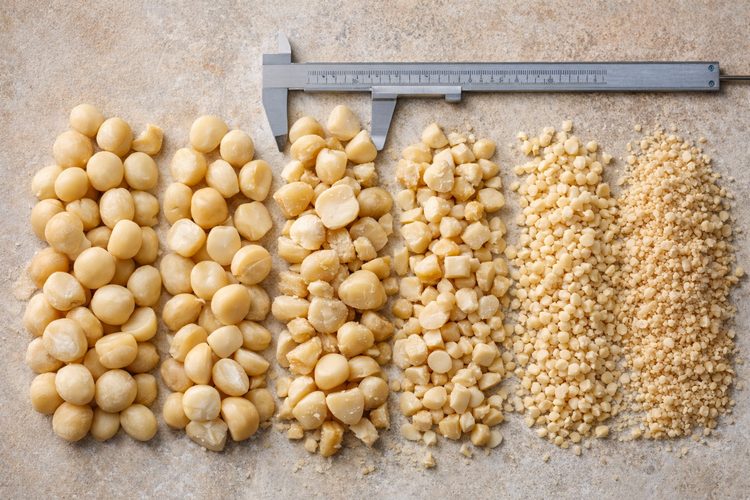
Macadamia buying becomes much clearer when buyers separate three questions that are often mixed together: what physical form they need, what grade level is commercially acceptable and what size range actually suits the end use. These sound like technical details, but in practice they determine whether the delivered product will perform properly on line, look right in pack and support the correct price architecture.
In macadamias, “grade” does not simply mean good versus bad. It is a commercial shorthand for a combination of visual quality, breakage level, usable kernel integrity, defect tolerance and fit for purpose. “Size range” is also more than an aesthetic choice. It influences deposit behavior, bowl appearance, inclusion count, breakage during handling, product yield and the real delivered cost of the finished item. That is why strong buyers do not ask only for “macadamia kernels.” They define the brief tightly enough that suppliers can quote the right product rather than the nearest available product.
Why grades and size ranges matter in real buying decisions
Macadamias are a premium nut category, so small differences in grade and size can have a disproportionate commercial impact. A top visual whole-kernel grade intended for gourmet retail or premium gifting is not the same commercial product as a more economical large piece grade intended for bakery inclusions. Both may be perfectly good macadamias, but they solve different business problems.
For this reason, buyers should think about grade and size in relation to the finished product. A cereal manufacturer may need controlled diced cuts that distribute evenly. A confectionery line may need attractive larger pieces with low fines. A premium snack or gifting brand may need more intact kernels because appearance is part of the value proposition. A nut butter or paste producer may care less about whole-kernel integrity and more about clean raw material, defect control and cost efficiency. The right grade is therefore application-dependent, not universal.
Commercial takeaway: the best macadamia grade is not always the highest whole-kernel grade. It is the grade that delivers the required appearance, process performance and cost structure for the actual application.
How this topic shows up in supplier comparisons
One of the most common buying problems in macadamias is false comparability. Two suppliers may both quote “macadamia kernels,” but one may be quoting a more intact premium grade while the other is quoting a looser spec with more breakage or a different size distribution. If the buyer does not define the grade and size expectation clearly, the price comparison becomes unreliable.
This is why strong RFQs include more than a product name. They describe the target format, the application, the approximate size expectation, the level of acceptable breakage, whether visual appearance matters, the pack format and the destination. Once those variables are known, suppliers can usually answer more precisely and buyers can compare quotations more rationally.
The main macadamia kernel forms buyers usually work with
Before discussing grade, buyers should first define the physical form. In commercial macadamia programs, the product menu usually includes:
- Whole kernels: generally chosen where visual impact, premium appearance and larger intact nut identity matter.
- Halves: useful when buyers want a substantial kernel appearance with slightly more cost efficiency than top whole grades.
- Large pieces: commonly used in bakery, confectionery, granola and premium inclusions where visible nut presence matters but absolute kernel integrity is less critical.
- Diced cuts: selected for more controlled distribution, easier line handling and better cost discipline in cereals, cookies, bars and cluster applications.
- Granulated, meal or flour formats: used where functionality matters more than visible piece identity, such as coatings, baking blends, fillings or fat-rich ingredient systems.
- Butter, paste or oil streams: separate commercial categories where size grading becomes less relevant than input quality and process route.
Many buying mistakes happen when a buyer requests a kernel grade before deciding which of these forms is actually needed. A whole kernel grade may look attractive on paper but be commercially inefficient if the application will chop, grind or heavily process the product anyway.
What “grade” usually means in macadamia trade
Unlike a simple size description, grade usually combines several quality signals. Depending on the supply program, a grade discussion may include:
- the proportion of intact kernels,
- the general visual quality of the lot,
- the amount of breakage or chipped material,
- the expected level of defects or discolored kernels,
- the proportion of fines in cut products, and
- how tightly the lot is sorted for the target application.
That is why a buyer brief should describe not only the desired form but also how strict the grade expectation needs to be. “Premium visual retail” is one commercial language. “Inclusion grade acceptable” is another. “Cost-controlled industrial cut” is another again. These phrases help the supplier understand the commercial use case behind the request.
Why size range matters beyond appearance
Buyers often think of size range as a visual issue, but in industrial practice it affects much more. Size influences how evenly a nut distributes in a mix, how it behaves in deposit systems, how it breaks during conveying and how it presents in the final pack. A size range that is too broad can create inconsistent portion appearance. A size range that is too narrow can raise cost unnecessarily if the end use does not reward that precision.
In premium retail nuts, larger size may support a more upscale perception. In bakery or cereal, a controlled medium or smaller size may provide better serving uniformity. In granola clusters or bars, buyers may want a size that is visible but not so large that it causes line breakage or uneven cluster formation. The commercial point is simple: size should match function, not just preference.
Top whole-kernel grades: when they make sense
Higher-end whole-kernel grades are usually chosen where the nut itself is part of the selling story. This includes premium gifting, gourmet retail packs, high-visibility snack applications, selected confectionery lines and some premium foodservice use. In these applications, the buyer is paying for appearance, integrity and perceived value, not just edible weight.
However, buyers should be realistic about where that premium matters. If the product is going into chopped inclusions, cookies, cereal or nut butter, paying for top whole grade may not improve the final commercial outcome. It may simply raise ingredient cost without adding proportionate value. A specification-minded buyer asks whether the finished product can actually monetize the higher visual grade.
Halves and large pieces: the practical middle ground
For many industrial and premium food applications, halves or large pieces are the most commercially balanced option. They still provide visible nut presence and a premium impression, but typically at a better cost point than top whole kernels. They can work well in bakery, granola, cluster bars, cereal, premium cookies, chocolate bark, confectionery toppings and upscale snack blends.
This middle-ground position is often where buyers can improve their economics without compromising the finished concept. If the application does not require perfect whole-kernel presentation, moving into halves or large pieces can unlock meaningful value.
Diced and controlled cuts: where efficiency meets consistency
Diced formats are often the most commercially efficient choice when the nut must distribute evenly or where line behavior matters more than showpiece appearance. Buyers in cereal, bar, cluster, cookie and inclusions manufacturing often prefer controlled cuts because they are easier to portion, easier to blend and more predictable in finished pack appearance.
Diced cuts can also help support more disciplined cost control. Instead of paying for visual whole-kernel integrity that will later be lost during processing, the buyer starts with a format already matched to the application. That approach often reduces waste, improves repeatability and creates a more realistic delivered cost.
Atlas grade note: many successful buyer macadamia programs are built not by buying the most premium grade available, but by buying the grade that best matches the line function and the finished product’s price point.
Application-specific grade logic
Retail and gifting
Retail-ready whole-kernel packs and gifting programs usually require tighter visual grade control, better intact-kernel presentation and lower visible breakage. The buyer is often paying for the shelf effect and premium consumer impression as much as for the ingredient itself.
Bakery and cookies
Bakery buyers often care about cut size, distribution, bite and bake performance more than whole-kernel perfection. Large pieces, halves or diced cuts may be more sensible than top whole grades, especially when the nut is mixed into doughs, fillings or premium cookies.
Granola and cereal
These applications usually reward controlled size ranges. Buyers often want enough visible macadamia presence to support premium positioning, but not so much size variation that servings become inconsistent or line damage rises.
Confectionery and chocolate
Confectionery sits somewhere in the middle. Certain products benefit from larger attractive pieces, while others work perfectly well with controlled smaller cuts, especially when enrobing, topping or bark-style presentation is involved.
Nut butter, paste and industrial processing
For these routes, top visual kernel grades are usually less important than consistent raw material quality, defect control, sensory cleanliness and commercially efficient pricing. The buyer brief should reflect that reality so the quote is not built around unnecessary visual premiums.
Raw, pasteurized and roasted state also influence grade selection
Kernel form and grade do not exist in isolation from process state. A buyer may need raw kernels for further processing, pasteurized material for ready-to-eat logic, dry roasted material for stronger flavor development or oil roasted product for a specific indulgent profile. These choices can affect how much visible appearance still matters and whether the product should be bought as a top visual grade or a more functional industrial grade.
For example, a raw whole-kernel premium retail pack may justify tighter grade expectations than a roasted diced inclusion for granola or bakery. A buyer who defines both the process state and the grade expectation early will get a much more relevant quote.
How size language should appear in a buyer brief
Many RFQs fail because the sizing request is too vague. Words like “medium,” “large” or “premium” are not always enough on their own. Buyers do not necessarily need to provide an internal laboratory standard in the first message, but they should give commercially useful guidance such as:
- whole kernels for premium retail display,
- halves or large pieces for visible bakery inclusion,
- controlled diced cuts for cereal distribution,
- smaller cuts acceptable for cluster systems, or
- economical industrial grade acceptable for grinding or butter production.
This type of language gives the supplier enough context to propose a realistic product rather than forcing the conversation into generic categories.
What Atlas would ask before quoting
Atlas generally tries to connect the grade discussion to the finished use case. Before quoting, useful questions usually include:
- What is the intended application?
- Do you need whole kernels, halves, large pieces, diced cuts or a more processed form?
- Is the product primarily valued for appearance, texture, distribution or grindability?
- Is the product raw, pasteurized, dry roasted or oil roasted?
- What breakage or defect tolerance is commercially acceptable?
- Is the program industrial bulk, foodservice, retail-ready, private label or export-oriented?
- What are the trial and recurring volume expectations?
- What is the destination market and timing?
These questions help reduce avoidable back-and-forth and keep the quote grounded in a real business need rather than a vague grade description.
How grade and size affect the final price
Grade and size influence product value because they change both usefulness and perception. Higher integrity, tighter visual sorting and larger size ranges often cost more because they create a more selective output. But paying for that selectivity only makes sense if the end use actually benefits from it. Otherwise, the buyer may be overbuying quality that disappears in processing.
The best commercial discipline usually comes from asking: what is the minimum acceptable grade and the most useful size range that still protects the finished product concept? Buyers who answer that question clearly often get stronger margins and more stable replenishment economics.
Commercial planning points
Macadamia programs usually work best when the grade strategy is developed in stages. A buyer may begin with a trial quantity to test piece size, flavor and line handling. Then a validation run confirms how the selected grade performs under real production conditions. Launch volume follows only once the buyer is confident that the chosen grade and size range support both the product concept and the cost model. Repeat replenishment then becomes easier because the grade language and quality expectations are already stable.
This staged approach is especially useful in premium categories where the wrong grade can either waste money or undermine presentation. It helps the buyer avoid both under-specifying and over-specifying the product.
How to build a stronger buyer brief
A weak inquiry says: “Please quote macadamia kernels.” A stronger inquiry says: “Please quote dry roasted macadamia large pieces for premium granola, visible inclusion required, retail pouch program, trial followed by monthly volume, export market.” Another strong example would be: “Please quote economical raw macadamia pieces for butter production, industrial bulk pack, domestic use, repeat volume expected.”
The point is not to make the inquiry longer for its own sake. The point is to describe the product the supplier actually needs to source and quote. When the buyer brief includes the application, grade logic becomes much easier to solve commercially.
Buyer planning note
Atlas Global Trading Co. uses grade and sizing discussions to move buyers from broad product interest to a more specification-minded inquiry. In macadamias, the strongest commercial results usually come when kernel form, size expectation, process route, packaging and destination are defined together. That gives suppliers a better basis for quotation and gives buyers a clearer basis for comparison.
If you are evaluating macadamia kernels for retail, bakery, granola, confectionery, industrial processing or export distribution, Atlas can use the same framework covered here to help structure a more practical quote request.
What to include in a grade or sizing inquiry
A more useful buyer brief usually includes:
- the intended application,
- the required form: whole, halves, pieces, diced or processed stream,
- the process state: raw, pasteurized, dry roasted or oil roasted,
- the practical size expectation or inclusion style,
- the acceptable level of breakage or visual looseness,
- the packaging route and destination market,
- trial volume and expected repeat demand, and
- the target ship or launch timing.
These points usually make supplier quotations more comparable and more relevant to the finished product being planned.
Need help sourcing around this macadamia grades topic?
Use the contact form to turn grade and size questions into a practical quote request for Atlas.
- State the exact kernel form and size expectation
- Add target monthly or trial volume
- Include destination market, pack style and timing
Frequently Asked Questions
What is the main buyer takeaway from “Macadamia Kernel Grades, Size Ranges and Buyer Briefs”?
The main buyer takeaway is that macadamia sourcing works best when the required grade, size range, application, packaging format and commercial timing are defined together before quotation.
Why do kernel grades and size ranges matter so much in macadamia buying?
Because grade and size directly affect visual quality, breakage tolerance, process performance, yield, pack appearance and total delivered cost. Two offers are not really comparable if the kernel grade and size expectations are different.
What should buyers include in a macadamia grade or sizing inquiry?
A practical inquiry should include the intended application, preferred kernel form, target size range or cut style, acceptable defect and breakage tolerance, pack format, destination market, expected volume and target timing.