Incoming material
State whether the line will receive raw wholes, pieces, natural kernels, roasted kernels or another intermediate cashew format. The starting material affects process design and yield expectations.
A buyer guide to structuring cashew toll processing programs across roasting, grinding, particle control, finished pack formats and commercial execution.
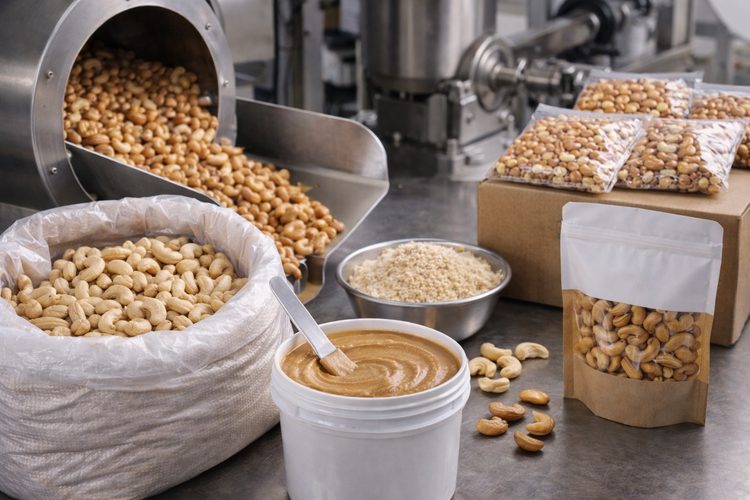
Toll processing for cashews is not only a manufacturing question. It is a commercial structuring question. Many buyers already have a raw material position, an origin relationship or a branded commercial plan, but they do not want to own every downstream processing step. In those cases, toll roasting, grinding and packing can be the most efficient way to convert a basic cashew input into a finished ingredient or market-ready product without adding permanent internal capacity.
For a procurement team, this matters because the toll route changes how the project should be quoted. The buyer may not be purchasing a finished cashew product from stock. They may be paying for specific services applied to customer-owned material or to a controlled raw input under a managed commercial structure. That means yield assumptions, process losses, finished specification tolerances, lot segregation, packaging configuration, service charges and lead times should all be discussed clearly before production begins.
In practice, the strongest toll processing programs are built when the buyer defines the full route: what material arrives, what transformation is required, what finished form is expected, how it will be packed, and where it will go next. A vague instruction such as “roast and pack our cashews” rarely produces the best commercial result. A stronger brief might say: raw whole kernels to be dry roasted to a specified color range, partially screened for fines, packed into a retail pouch format or industrial lined cartons, and released against a destination-specific shipment schedule. The more process and pack logic is specified early, the easier it is to compare options and avoid misalignment later.
For cashews, toll processing often refers to one or more downstream service steps performed after the kernels are sourced or positioned for the project. The service scope may include roasting, seasoning, chopping, granulating, meal production, flour milling, butter grinding, blending, filling and final packing. Sometimes the work is limited to one step, such as grinding customer-owned roasted cashews into butter. In other cases, the program involves a full conversion route from raw kernel to finished retail product.
The reason buyers consider toll processing varies by business model. A brand owner may want to protect its customer relationships while outsourcing production. A manufacturer may need surge capacity during launch periods. A trader may control supply but not have California-based roasting or retail-packing capability. A foodservice distributor may want a custom pack format without purchasing a complete finished goods line from a single standard stock program. Toll processing can support each of those needs, but only when process scope and commercial ownership are clear.
Cashews are especially relevant for toll processing because they are used in several very different finished forms. Whole and split kernels work in snacks, foodservice and premium retail packs. Diced and granulated formats are common in bakery, cereal, bars and confectionery. Meal and flour can support gluten-free, coating or texture applications. Cashew butter and paste are used in spreads, fillings, sauces and plant-based systems. Each of these outputs places different demands on roasting, size reduction, oil management, line sanitation and packaging.
Most buyers reach this topic when they discover that buying a finished cashew item off the shelf is not the same as building a reliable custom supply chain. A standard finished SKU may be acceptable for a simple resale program, but it may not work for a customer needing a defined roast profile, a custom grind, channel-specific packaging or a private label format. Toll processing becomes relevant when the buyer wants more control over the outcome than a generic finished product can deliver.
One common situation is a company that already sources raw or natural cashews but does not operate roasting equipment. Instead of moving the raw material through its own plant, it evaluates a toll roasting route. Another case is a customer that buys roasted kernels but needs them milled into meal, flour or butter at a controlled particle range. A third case is a brand that has a retail concept and packaging artwork but needs contract support to fill, label and pack the line. In all three situations, the commercial discussion must go beyond nominal product price and address service sequence, usable yield, line availability, lot handling and pack-out detail.
There is also a strategic reason why buyers use toll processing. It can reduce capital intensity. Not every growing food brand or ingredient company wants to invest in roasting ovens, grinders, metal detection, filling lines, baggers, labelers or QA systems at the beginning of a program. Outsourcing those steps through a toll arrangement can create flexibility, provided quality expectations and throughput assumptions are properly documented.
Typical use cases for cashews on this website include snacks, bakery, confectionery, plant-based dairy, spreads and premium ingredient systems. A toll processing brief should tie the process route directly to one of those end uses so roast, grind and packaging decisions reflect real application needs.
Not every toll program begins with the same material, and that starting point changes the process plan. Some customers provide raw whole kernels. Others begin with natural cashew pieces, partially processed material or already roasted kernels intended for grinding or repacking. The toll quote should identify the incoming format because line handling, screening, roasting behavior, breakage patterns and yield expectations all depend on the starting material.
Common inputs may include raw whole cashews, raw splits or pieces, natural kernels intended for roasting, roasted kernels intended for chopping or repacking, and intermediate material intended for butter or flour production. The target finished output may then be dry roasted wholes, flavored kernels, chopped pieces, granules, meal, flour, butter, paste or filled consumer packs. Even when the raw ingredient is the same, the process route changes substantially depending on whether the goal is visible snack quality, size-reduced inclusion format, or smooth spreadable paste.
For example, a retail snack program often prioritizes appearance, roast consistency, breakage management, fill weight control and shelf presentation. A butter program may prioritize grinder feed consistency, oil release control, final viscosity, pumpability and packaging suitable for pails, drums or jars. A flour program may prioritize fat behavior, sieve consistency, flowability, color appearance and the extent to which the material should remain coarse, medium or fine. That is why the quote should always specify both the incoming material and the intended finished format.
Roasting is one of the most commercially important steps in a toll cashew project because it changes flavor, color, texture, handling and in some cases usable yield. Buyers should not assume that “roasted cashews” is a sufficient specification. The process route should state whether the program calls for dry roasting or oil roasting, whether the target is light, medium or darker development, and whether the finished product is intended for direct consumption, secondary seasoning, size reduction or further formulation.
For snack and retail uses, roast consistency often affects brand perception. Uneven color, excessive breakage or flavor drift can create complaints that go well beyond simple production inefficiency. For ingredient uses, the roasting step can affect brittleness, particulate generation, flavor strength and grind behavior. A kernel roasted specifically for butter production may not be optimized the same way as a premium retail whole intended for visual presentation.
From a commercial standpoint, roasting can also influence yield and handling cost. Moisture reduction, screening, fines removal and breakage can shift the mass balance between incoming and finished product. That does not automatically make the process unattractive, but it does mean buyers should discuss how yields are measured, whether losses are normal process loss or customer-usable byproduct, and how over- or under-run is handled commercially. Projects become smoother when the toll agreement defines what constitutes standard process loss and what is included in the service model.
Grinding is not one uniform service. In cashew processing, it can refer to several very different finished outputs. A coarse chopped or granulated product may be intended for bakery topping or cereal inclusion. Meal may be selected for coatings, fillings or blend systems. Flour may be specified for fine-textured baking or dry blend work. Butter or paste may be required for smooth spreads, dessert fillings, sauces or plant-based formulations. Each output has different implications for temperature rise, oil release, particle uniformity and pack style.
For meal and flour, buyers should communicate the expected size range and whether the finished material should behave like a coarse particulate, a medium meal or a finer flour. It is also important to define tolerance for oversize particles, visible specking, natural oiling and flow behavior. These factors matter commercially because a broad grind distribution may still be acceptable in some industrial systems but unsuitable in premium baking or repeatable dry blending programs.
For cashew butter or paste, the toll discussion usually becomes more technical. Buyers may need to define whether the finished material should be smooth, slightly textured or more natural and rustic; whether separation is acceptable; whether salt or other ingredients are part of the formula; and whether the butter will be packed hot, cooled, pumped or filled into small, medium or industrial containers. The quote may also need to consider whether multiple grind passes are required, whether homogenization or stabilization is expected, and what clean-down standards apply between runs.
Packing is not simply the last step. It is often the step that determines whether a cashew toll program fits industrial production, foodservice distribution, private label retail or export handling. A good toll processing inquiry should therefore explain not only the finished product but also how it must be packed, labeled, palletized and shipped.
Industrial buyers may require bulk cartons, lined cases, bags, pails or drums for further manufacturing. Foodservice buyers may need mid-sized packs that balance back-of-house convenience with shelf-life control. Retail or private label projects may require pouch filling, jars, canisters, display-ready carton structures, coding and consumer labeling. Export-oriented programs may add another layer of complexity through language, country-specific mark requirements, shipper labeling, pallet standards and documentation matching.
For toll work, packing detail is especially important because the economic model changes with complexity. A simple repack into industrial bulk is different from a finished retail pouch line with coding, labeling, case packing and pallet display requirements. Buyers should therefore describe case count, unit weight, finished pack material, secondary packaging and any shelf-facing presentation needs. That makes it easier to assess whether the program belongs in a basic conversion model or a more involved private label and retail service structure.
Atlas encourages buyers to define the actual process route instead of asking for a generic tolling price. The most useful early questions are usually practical. What is the incoming cashew format? Who owns the material at each stage? What finished product is required? Does the project need roasting only, grinding only, packing only, or a combined process? Is the end use snack, bakery, confectionery, plant-based dairy, sauce, foodservice or retail? Those answers quickly shape the rest of the commercial conversation.
Atlas would also ask whether the project is a trial run, a launch build or an ongoing replenishment program. That matters because a short validation run may accept different scheduling and pack assumptions than a repeat monthly program. Buyers should also mention expected lot size, annualized volume if known, preferred timeline, destination market, and any documentation or customer approval needs. If the project involves branded consumer output, artwork timing, label review and packaging supply coordination may also influence the start date.
Another critical point is quality definition. A toll processor can only target what the buyer describes. If roast development, particle range, butter texture or finished pack presentation matter, they should be written into the brief. It is also helpful to state whether reference samples, previous pack specs or benchmark products exist. Toll projects succeed faster when the processor can compare the target outcome against something tangible rather than interpret a broad description alone.
Several details that appear minor at first can materially affect the success of a toll processing program. One is line sanitation and allergen management. Cashews are a tree nut ingredient, and the buyer may need clarity on how the site handles allergen segregation, sanitation verification and line scheduling. Another is traceability. If customer-owned raw material is entering the process, lot identity and process reconciliation become important for inventory control, QA and complaint response.
Temperature sensitivity is another issue, especially in grinding and butter work. Heat generation during milling can change oil release, texture and pack-fill behavior. A coarse grind or low-shear outcome may require a different route than a very fine, smooth finished butter. Screening, rework handling and fines management should also be understood, particularly when size-reduced formats are commercially sensitive or when visible particulate quality matters.
For finished pack programs, coding, label placement, case configuration and pallet presentation are not small details. They are part of the finished deliverable. A buyer that omits these points at the start often ends up revisiting them later under tighter deadlines. It is more efficient to include them in the original brief so the tolling route is designed around the correct output from day one.
From a trading standpoint, toll processing works best when continuity is built into the arrangement. That means the service model should match the commercial reality of the project. If the customer expects repeated monthly production, then raw material availability, packaging supply, line access and destination shipping windows all need to be planned accordingly. If the project is a one-time conversion, the quote structure and scheduling assumptions may look different.
Buyers should also understand that toll processing changes how total cost should be viewed. The relevant commercial question is not only the service fee. It is the all-in delivered cost of the finished outcome, including incoming material handling, roasting or grinding services, yield effect, packaging, QA support, warehousing if needed, freight preparation and documentation. A service that looks inexpensive on a narrow processing line item may still produce a less efficient total landed cost if the route is poorly specified or generates avoidable repacking, rework or freight complexity.
That is why good programs are usually built around repeatability, not emergency buying. When the route is defined properly, toll processing can support stable launch cycles, seasonal pack programs, industrial ingredient supply or multi-channel private label lines. But when the project is vague, the processor and buyer may spend time resolving issues that could have been addressed in the RFQ stage.
In many cashew programs, toll processing appears at one of four stages. First, it may support a development trial where a buyer needs a limited run to validate roast, grind or package fit. Second, it may support a pre-launch phase where the brand is building inventory before market entry. Third, it may support a growth stage where internal capacity is constrained and outsourced conversion is the fastest route to scale. Fourth, it may become the long-term operating model for a company that prefers to control product design and customer relationships while outsourcing manufacturing steps.
Each stage should be quoted differently. Development work may prioritize flexibility and sample-based refinement. Launch work may prioritize timeline discipline and first-article accuracy. Ongoing production may prioritize consistency, cost control, lot planning and replenishment rhythm. Buyers get better results when they explain which stage applies to the project rather than treating every inquiry as if it were the same type of commercial need.
A raw whole cashew program for dry roasting and industrial bulk packing is different from a flavored snack pouch program even if the same raw ingredient enters the line. Likewise, roasted pieces intended for cereal inclusion require a different handling logic than butter intended for foodservice tubs or industrial pails. The quote changes because labor, screening, processing time, packaging complexity and QA steps all change.
For example, a program that starts with customer-owned raw kernels and ends with lightly roasted whole cashews in lined cartons may be relatively straightforward. A program that involves roasting, chopping to a defined size range, screening, blending with seasonings and filling into branded consumer packs is a far more complex service package. A butter program may introduce separate issues again, such as temperature control, fill viscosity, headspace management and oil behavior during storage. These are not minor differences; they are the core commercial variables behind the tolling model.
A useful request for quotation usually includes the incoming material description, the required process steps, the target finished specification, the packaging format, the destination market and the expected timing. If the project is recurring, monthly or quarterly volume ranges are also helpful. If the buyer has target quality documents, pack drawings or reference samples, those can significantly improve quote accuracy.
For grinding projects, it is helpful to define whether the target is coarse chop, granule, meal, flour, butter or paste, and whether there are any particle, viscosity or separation expectations. For roasting projects, it helps to state whether the customer wants light, medium or darker development, whether the product will be seasoned later, and whether appearance or downstream grind performance is the higher priority. For packing projects, the RFQ should identify unit size, case count, retail or industrial orientation, labeling requirements and whether palletization or export marks must follow a specific format.
When the RFQ combines all three service types, the document should clearly describe the sequence. An example would be: receive raw whole cashews, roast to target profile, grind into butter, fill into specified containers, label and palletize for shipment. Another example would be: receive natural kernels, roast and chop into defined particle range, then pack into bulk industrial cases for shipment to a cereal manufacturer. This level of clarity helps the supplier respond with a process-minded commercial proposal rather than a rough estimate.
Atlas Global Trading Co. uses topics like this to move conversations from broad interest to a specification-minded inquiry. In cashew toll processing, the commercial result is usually stronger when the buyer does not separate process, packaging and shipment logic. The more clearly the project defines the incoming form, the required transformation, the finished pack and the timing expectation, the easier it is to evaluate the right California processing path.
For buyers that already control raw material, toll roasting, grinding and packing can be a practical route to market. For buyers that need a broader solution, the same discussion can lead into managed ingredient sourcing, custom processing, private label support or export-ready packing. In either case, Atlas encourages customers to describe the intended application, target format, packaging type, estimated volume and destination market so the next step reflects an actual commercial program rather than a generic request.
Buyers often get better commercial responses when they organize the inquiry around process route, finished output and shipment reality rather than asking for a general service rate.
State whether the line will receive raw wholes, pieces, natural kernels, roasted kernels or another intermediate cashew format. The starting material affects process design and yield expectations.
Clarify whether the project needs roasting, chopping, milling, butter grinding, blending, filling, repacking or a full multi-step conversion route.
Whole kernels, roasted snack product, diced pieces, meal, flour, butter or paste each require different operating assumptions and QA checkpoints.
Industrial bulk, foodservice, club, retail-ready, private label or export-oriented packaging changes labor content, materials planning and finished unit economics.
Indicate whether the work is a pilot run, launch build, seasonal pack, monthly repeat program or container-based supply cadence.
Domestic and export programs may require different case marks, labels, statements, pallet standards and shipping documents.
Roasting alone, grinding alone and retail packing alone are very different service scopes. Multi-step cashew projects are more accurate to quote when the full conversion path is stated from receiving through finished pack.
The biggest efficiency gains usually come from aligning line capability with the actual market objective. If the program is an industrial ingredient project, packaging simplicity and lot traceability may matter more than shelf-ready presentation. If the project is private label retail, then label execution, pack appearance, coding and pallet presentation become central. Buyers lose efficiency when they use a service model that does not match the channel.
Another common gain comes from defining acceptable tolerance. Not every application requires the highest visual standard, the finest grind or the most elaborate pack style. Some industrial uses can tolerate wider variation in breakage or particle size than premium retail snack lines. That flexibility can affect process route and cost. Procurement teams often benefit from distinguishing between what is truly required and what is merely preferred.
Lead-time planning is also essential. Toll projects frequently involve several moving parts at once: incoming material availability, packaging procurement, artwork approval, production slotting, QA review and outbound shipment booking. The commercial structure is stronger when those dependencies are surfaced early rather than discovered near the ship date.
This route is commonly relevant to branded snack companies, ingredient distributors, private label managers, foodservice suppliers, importers, plant-based product developers, bakery manufacturers and traders that control raw supply but do not want to own the full processing footprint. Some need a seasonal solution. Others use toll processing as a permanent operating model.
In each case, the project becomes easier to execute when the buyer treats tolling as part of the product design, not as an afterthought. Roast style, chop range, butter texture and pack configuration all influence how the finished item will perform in the market. For that reason, the best toll programs are not built around a vague service request. They are built around a commercial outcome.
Toll processing makes sense when a buyer already owns raw cashews or controls the supply stream but needs roasting, grinding, seasoning or packing capacity without building that capability in-house.
Buyers should define the incoming format, target finished format, roast style, grind requirement, packaging configuration, expected yields, documentation needs, destination market and production timing.
Yes. A toll processing program can support industrial bulk, foodservice, club, retail-ready and private label outputs, but packaging, labeling, lot control and documentation expectations will differ by channel.
Yield matters because roasting, screening, grinding and packing can change mass balance, breakage level, fines generation and usable output. Commercial planning is stronger when these points are understood before production starts.