Product identity
Make sure the product description on quote, PO, invoice and packing list reflects the real cashew format and processing route.
Practical notes on shipment paperwork, commercial file control, customs readiness and documentation planning for export-oriented cashew programs.
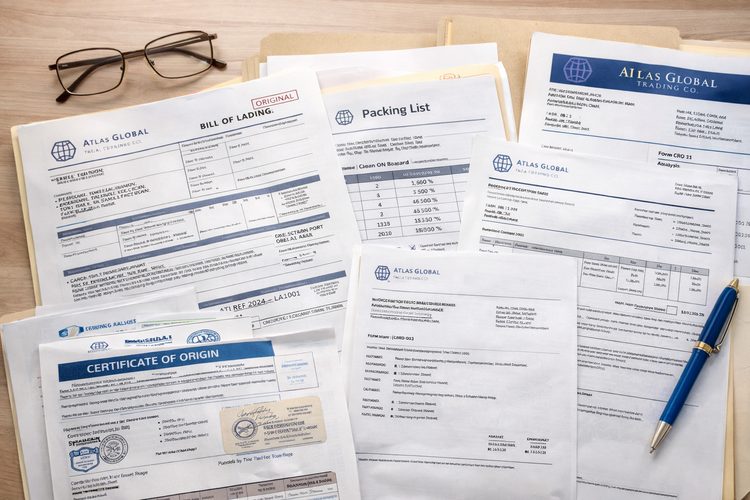
Export documentation for cashew shipments is not a back-office detail that appears after the sale is finished. In real buyer trade, documents are part of the product program itself. A shipment can be commercially acceptable on price, quality and timing and still become problematic if the file set is incomplete, inconsistent or misaligned with the agreed shipment terms. For importers, distributors, private label buyers and food manufacturers, document quality affects customs clearance, warehouse receiving, inventory release, payment timing and downstream customer confidence.
That is why experienced cashew buyers do not separate product specification from paperwork planning. Product form, pack style, destination, Incoterm, importer requirements and document sequence need to be aligned early. A bulk industrial cashew shipment, an export retail program and a private label line may all move under the same broad cashew category, but the paperwork structure can differ materially depending on the product route and destination market.
In many transactions, the document set becomes the operational bridge between commercial agreement and physical delivery. The commercial invoice supports value declaration and payment reference. The packing list supports warehouse counting and customs inspection logic. The transport document links the cargo to the vessel or freight move. Origin, specification and quality files support importer compliance, product release and customer-side recordkeeping. If one field conflicts with another, the issue is often discovered late, when the cargo is already moving or has already arrived.
For cashews, this matters because the product can move into industrial manufacturing, foodservice distribution, retail packing, repacking, private label channels or export retail shelves. Each route can create a different sensitivity to documentation accuracy. Some importers prioritize rapid customs processing. Others prioritize exact product description, internal SKU mapping, pallet data, lot traceability or pre-clearance review. The better sourcing outcome usually comes when the document flow is discussed during quotation and not only after the booking is made.
In practice, buyers do not simply ask whether paperwork can be provided. They ask whether the paperwork will match the real shipment structure. For cashews, the quote and shipment files should reflect the actual product and route: whole kernels are not the same as pieces, flour, meal, butter or oil; raw material is not the same as dry roasted or oil roasted; bulk industrial packs are not the same as retail-ready export cartons. Even a correct document can become commercially unhelpful if the product description is too generic for the importer’s internal system or too different from the purchase order language.
For this reason, documentation planning is usually stronger when the buyer defines the product category with practical precision from the start. A buyer importing raw whole cashews for manufacturing will often frame the paperwork differently from a buyer shipping flavored retail pouches or private label finished packs. Atlas treats the file package as part of shipment readiness, not as a last-minute clerical step.
The exact file package varies by market and transaction structure, but many export cashew programs rely on a recurring set of core commercial documents. These often include:
The point is not that every shipment needs every file in the same way. The point is that buyers should define the required document package before cargo is ready to move.
In export trade, “documents available on request” is weaker than “documents defined in advance.” Buyers usually get smoother shipment execution when the expected file set is agreed before production and loading.
The commercial invoice is often treated as a basic administrative document, but in export nut trade it carries significant operational weight. It usually links the shipment to the purchase order, the Incoterm, the product description, the declared value and the importer’s customs entry process. If the product wording on the invoice is too broad, too inconsistent with the order or too different from the supporting packing list, that mismatch can create avoidable review or delay.
For cashew shipments, buyers often benefit from aligning invoice language with the way the goods are actually bought and received. If the importer’s system distinguishes between raw whole kernels, roasted kernels, diced pieces or retail-packed finished goods, the invoice should not collapse those distinctions into an overly generic label. Clear invoice language improves internal matching, landed cost control and importer-side inventory handling.
A strong packing list does more than repeat the invoice. It supports physical handling. For warehouse teams and customs reviewers, the packing list is often the most practical file for understanding how the shipment is built. This can include carton counts, bag counts, pallet counts, net and gross weights, pack sizes and load structure.
In cashew programs, the packing list becomes especially important when the importer is working with multiple SKUs, multiple pack styles or mixed container loads. Industrial bulk packs, foodservice units and retail-ready cartons all create different receiving workflows. If the packing list is too broad or not aligned with the physical load, problems show up at discharge, unloading or warehouse intake. Clear packing documentation reduces the chance of receiving disputes and simplifies count verification.
The transport document is not just a freight paper. It is part of the ownership and release chain. Depending on the route and commercial structure, the shipment may move under a bill of lading, sea waybill, airway bill or another carrier document. Buyers should understand early how this document interacts with payment terms, customs filing timing and cargo release.
For some programs, especially where the buyer is coordinating with a broker, bank, forwarder or destination warehouse, the timing of document issuance matters almost as much as the content itself. A correct shipment file set delivered too late can still create cost, confusion or missed receiving windows. Atlas therefore views document timing as part of shipment planning, not as a separate administrative follow-up.
Some cashew import programs require origin-related files for customs treatment, importer policy, customer preference or destination compliance. In those cases, the certificate of origin and related origin declarations need to align with the commercial route and product reality. Buyers should not assume that origin documentation is a routine attachment that can be improvised at the end. It should be requested where relevant during the transaction setup.
This is particularly important in export markets where customs treatment, tariff treatment, documentation review or customer-side onboarding depends on origin clarity. Even when the product itself is commercially straightforward, the file requirements can change according to the destination and the importer’s trade framework.
For food ingredients and nut products, the product specification is often the operational link between commercial description and technical acceptance. A shipment can arrive on time and still remain commercially unresolved if the importer cannot reconcile the delivered goods with the expected product format. That is why many buyers want shipment-side reference to specification sheets, internal item codes or technical descriptions that clearly distinguish one cashew program from another.
Quality files such as certificates of analysis, lot references or agreed testing-related documents may also play a role. The specific expectation differs by customer and market, but the commercial principle is the same: if the importer needs quality-related files to release product internally, then those files are part of the shipment package and should be planned accordingly.
Retail and private label cashew programs typically need more document coordination than straightforward bulk ingredient shipments. That is because the product description, pack count, barcode references, label version, artwork approval status and market-facing declarations may all need to stay aligned across internal files. The more consumer-facing the product becomes, the more important it is that the document set reflects the exact commercial presentation.
For example, an export retail cashew pouch program may require the importer to review pack dimensions, master carton structure, labeling language, shelf-life coding logic and shipping marks before the cargo moves. None of that is unusual. It simply means that the file package should be thought of as part of the product program rather than as an afterthought.
Document responsibilities often connect directly to the shipment term. The agreed Incoterm influences how cargo is handed over, which party controls which stage and how paperwork will be used on the buyer side. Even when both parties understand the term in principle, it is still good practice to confirm which documents the buyer expects to receive, in what form and at what stage of shipment.
This helps avoid the common problem where commercial expectations are clear but file expectations remain assumed. In export cashew trade, assumptions create avoidable friction. Atlas therefore encourages buyers to communicate both the trade term and the document list in the same sourcing conversation whenever possible.
Many problems in export trade are not caused by missing documents but by inconsistent details across documents. Product names, weights, counts, consignee references, importer references, SKU language, shipper details or pack descriptions can drift if the file package is assembled too late or by too many disconnected steps. A structured pre-shipment review helps catch these issues before the cargo moves.
For buyers managing recurring cashew shipments, it is often useful to work from an agreed document checklist and template logic. This reduces revision cycles and creates a more repeatable process from one shipment to the next. It also helps new stakeholders on the importer side understand what to expect.
From a trading standpoint, the best programs are built around repeatability. That means clear documentation, agreed packaging, sensible shipment cadence and a commercial structure that supports continuity rather than one-off emergency buying. Buyers who receive clean, timely and usable files tend to trust the program more, process shipments faster and spend less time solving avoidable operational problems.
For cashew suppliers and buyers alike, that matters because repeat business is rarely won only on nominal price. It is won on shipment reliability, communication quality and the ability to support the importer’s internal workflow. Documentation is part of that service value.
Atlas encourages buyers to define intended use, pack style, destination, timeline and quality expectations early. For export shipments, Atlas would usually also ask practical file-related questions such as:
These questions help reduce avoidable back-and-forth and improve comparability across California supply options.
Typical use cases for cashews on this website include snacks, bakery, confectionery, plant-based dairy and spreads. The shipment file package should always match the real commercial route for that product, whether the program is ingredient-focused or retail-facing.
Commercially, export document planning usually works best when it follows the same logic as the product program itself: trial quantity, validation run, launch volume and repeat replenishment. Early-stage business may allow a simpler file flow, while larger recurring programs usually benefit from more defined templates, approval steps and shipment checklists. Atlas uses that logic to guide pack and shipment planning, especially when retail packaging, export retail or private label is part of the conversation.
When relevant, the brief should also mention whether the program is industrial bulk, foodservice, retail-ready, private label or export-oriented. That single clarification often changes packaging, documentation and timing assumptions. A private label pack moving into formal retail channels is not documented in the same operational way as an industrial bulk shipment moving into a manufacturer’s warehouse.
Atlas Global Trading Co. uses topics like export documents and trade files to move conversations from broad interest to a specification-minded inquiry. If you are evaluating cashew supply for export, share the exact format, pack style, destination, estimated volume, timeline and expected document list using the floating contact form. That helps turn a general quotation request into a shipment-ready commercial brief that is easier to price, compare and execute.
Make sure the product description on quote, PO, invoice and packing list reflects the real cashew format and processing route.
Confirm which core files are required for the shipment, including commercial, transport, origin and quality-related documents where relevant.
Clarify whether drafts are needed before loading, which files must be issued post-shipment and when the importer or broker needs them.
Exporter and importer should align on country-specific language, customs, labeling or importer compliance expectations before cargo moves.
Use the contact form to turn this research topic into a practical sourcing and shipment brief for Atlas.
The main buyer takeaway is that export cashew programs work better when product specification, packaging, Incoterm, destination requirements and document flow are defined together before shipment is booked.
The most important files usually include the commercial invoice, packing list, transport document, certificate of origin where required, product specification or COA references, and any destination-specific food, labeling or customs documents needed by the importer.
Yes. Atlas uses the same technical and commercial points covered in the academy to help buyers structure specification-minded quote requests and clearer export shipment briefs.