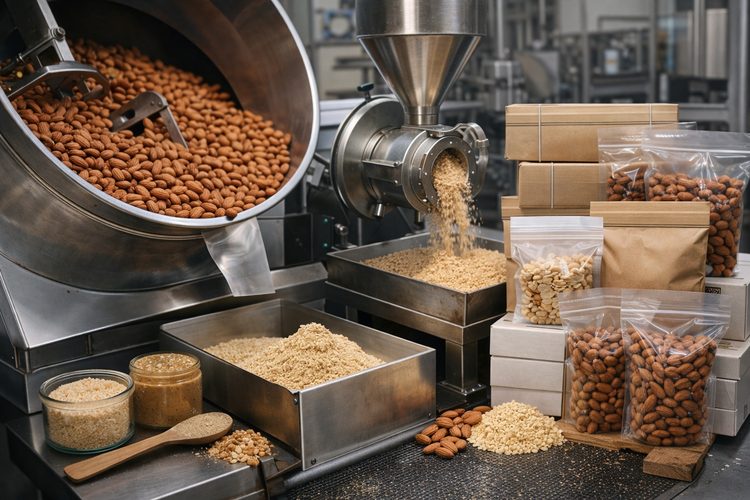
Toll roasting, grinding and packing matter because many almond programs do not begin with a finished, ready-to-ship item. A buyer may have access to raw kernels but still need roasting, slicing, grinding, blending, bulk packing or retail conversion before the product is commercially usable. In other cases, the buyer may not want to invest in internal roasting or grinding capacity and instead needs a contract processing route that is more flexible, scalable and aligned with the real market need.
From a commercial standpoint, toll processing is rarely just a manufacturing discussion. It is also a specification discussion, a QA discussion and a freight discussion. A project can look straightforward on paper but become expensive or slow if the roast profile is not defined, if the grind target is vague, if the pack style is added late, or if the destination market requires a different label structure or documentation set than originally assumed.
What toll processing means in almond programs
In practical buyer use, toll processing means a processor performs one or more conversion steps on behalf of a customer program. For almonds, that may include roasting raw kernels, blanching before further conversion, grinding into meal or flour, producing almond butter or paste, sizing or reworking pieces, and finally packing the finished item into industrial, foodservice or retail-ready formats.
Some projects are based on customer-owned raw material. Others are structured as a combined supply-and-processing program where the commercial partner helps source California almonds, then routes those almonds through the agreed processing sequence. The same broad toll framework can support pilot runs, seasonal demand spikes, private label launches, export programs, or ongoing replenishment for manufacturers who want conversion capability without carrying all processing assets internally.
The most important buyer takeaway is that toll roasting, grinding and packing should not be treated as isolated steps. The right process route depends on the final use, the required specification, the packaging outcome and the shipment plan.
How this topic shows up in real buying decisions
Buyers usually encounter toll processing in one of four ways. First, a manufacturer already buys almonds but wants a more specialized converted format than the current supplier provides. Second, a brand wants to launch a retail or private label line without investing in roasting or packing infrastructure. Third, an importer or distributor wants California processing support before export shipment. Fourth, a food company needs surge capacity or a flexible backup route when internal lines are full.
The commercial logic changes depending on the project. A granola customer may need dry roasted diced almonds with a stable cut range and dependable pallet format. A bakery customer may need blanched flour with a defined mesh range and consistent color. A snack brand may need roasted whole almonds packed into retail pouches with finished case counts and label review. A dessert or spread manufacturer may need almond butter with a defined grind, oil behavior and filling or mixing performance.
When buyers use toll roasting
To achieve a targeted flavor profile, texture or finished appearance without managing roast operations internally.
When buyers use toll grinding
To convert kernels into meal, flour, paste or butter for industrial use where particle, texture and process fit matter.
When buyers use toll packing
To move product into a channel-specific pack format such as industrial cartons, foodservice units, pouches or private label packs.
When buyers use full toll programs
When sourcing, roasting, conversion, packing and outbound shipment all need to be coordinated as one commercial workflow.
Technical scope: roasting, grinding and packing
1. Roasting choices affect more than flavor
Almond roasting decisions should be tied to the application, not only to a general preference for lighter or darker color. Roast development can influence crunch, brittleness, apparent dryness, flavor intensity, oil expression and how the product performs in downstream handling. A roast that works well for direct snack consumption may not be ideal for a further-ground ingredient or for a coated application that needs a different surface behavior.
Buyers should also keep in mind that roasting decisions can interact with breakage risk, filling weights, seasoning adhesion, product identity and finished shelf-life planning. This is why “roasted almonds” is often too broad as a quote request. A better brief connects roast condition to the intended end use.
Dry roasted programs
Often considered when buyers want a cleaner roasted profile, lower added processing variables and a format suitable for snack mixes, toppings or ingredients where a dry finish is preferred.
Oil roasted programs
Relevant when the finished item depends on a different surface feel, richer eating profile or stronger seasoning carry, especially in snack applications.
Roast-to-grind routes
Important when the goal is almond butter, paste or meal, because roast level can influence flavor strength, perceived richness and grind behavior.
Roast consistency
A key concern for repeat business. Commercially, consistency matters because a stable finished product reduces complaints, rework and unnecessary formulation adjustments.
2. Grinding requires a clearer end-use definition
Grinding is not a single specification. Buyers may need coarse meal for coatings, finer meal for bakery systems, flour for gluten-free or batter applications, paste for confectionery or fillings, or almond butter for spreads, sauces and plant-based formulations. Each of these has different commercial and functional implications.
One of the most common problems in early-stage inquiries is that the customer requests “ground almonds” without defining what that means in production terms. The processor then has to work backward from the intended use. In many cases, the better starting point is the application itself: what the almond ingredient needs to do in the finished product, how fine or smooth it should be, whether visible particles are acceptable, whether oil release is desirable, and whether the product will be baked, frozen, mixed, coated or filled.
Meal and coarse grind
Often used where particulate texture is welcome, such as coatings, crusts, toppings, bakery inclusions or structured blends.
Fine flour programs
Usually more relevant for gluten-free baking, batter systems, mixes and applications where a smoother texture or finer distribution is needed.
Paste and butter
Useful in fillings, creams, spreads, sauces and desserts where mouthfeel, oil behavior and flavor concentration should be discussed upfront.
Custom grind targets
Best handled with an application brief, sample review and alignment on acceptable variation rather than a vague generic request.
3. Packing is a technical decision and a sales-channel decision
Packing should be defined as early as roasting and grinding. Industrial bulk packs, foodservice packs, retail pouches, jars, tubs, private label cartons and export shipping configurations are not minor finishing details. They directly affect labor, materials, case configuration, pallet efficiency, label workflow, inventory handling and freight costs.
For bulk ingredient programs, the priority may be fill consistency, handling efficiency and warehouse practicality. For foodservice, the focus may shift toward portion logic, ease of use and back-of-house handling. For retail-ready or private label lines, the pack becomes part of the product itself and can drive artwork timing, barcode setup, claims review, market fit and case-pack economics.
Typical end uses where toll processing often makes sense
Toll roasting, grinding and packing are especially relevant when the almond is only one part of a broader finished-product system. The value is not only in the raw material itself, but in receiving the almond in a form that fits the line, label and sales channel.
Bakery
Sliced, diced, flour or butter programs for toppings, batters, fillings and gluten-free concepts.
Confectionery
Roasted pieces, pastes and nut bases where texture, flavor intensity and visual premium cues matter.
Snack mixes
Dry roasted or oil roasted almonds packed in blend-ready or retail-ready formats with attention to breakage and appearance.
Granola and cereal
Cut control, roast consistency and bulk handling become important when almonds are blended into repeat runs.
Plant-based dairy
Meal, paste, butter or other almond-derived ingredients where grind and body affect processing and finished mouthfeel.
Private label retail
Roasted and packed programs where label execution, pack architecture and commercial timing matter as much as the almond itself.
Commercial structure and price logic
Toll processing projects should be quoted with a full-program mindset. The raw almond input is only one cost layer. Additional commercial components can include conversion steps, yield implications, packaging materials, label handling, setup complexity, pallet configuration, storage requirements and the shipment model. That is why the most useful quote is usually built from a clear brief rather than from a one-line request for “processed almonds.”
Buyers should expect the commercial structure to change based on whether the project is a short sample run, a trial quantity, an initial launch quantity or a repeat replenishment program. Small-volume custom work may be viable, but it usually behaves differently than stable monthly or container-based programs. A processor also needs to understand whether the job is continuous, seasonal, promotion-based or intermittent.
Main price drivers in toll programs
- Raw almond form and whether supply is customer-owned or commercially sourced
- Natural versus blanched input and required preprocessing route
- Roast condition and degree of process customization
- Grinding target, smoothness or size control expectations
- Packaging material, fill format, case configuration and labeling complexity
- Order size, run frequency and urgency
- Destination market, documentation requirements and freight structure
Commercial planning points
- Define whether the project is industrial bulk, foodservice, retail-ready, private label or export-oriented
- Separate pilot runs from regular replenishment volumes
- Clarify whether artwork or labels are customer-supplied or processor-managed
- Discuss lead time around both processing and packing, not just raw material availability
- Confirm whether the final offer should be understood on an ex-works, FOB or other agreed shipment basis
Why toll processing can improve a program
When structured correctly, toll processing can give a buyer more control over the finished commercial outcome. It can reduce the need to buy capital equipment, shorten the path from concept to launch, simplify outsourcing of specialized steps and make it easier to separate raw material sourcing from downstream conversion. It can also help companies test a market before committing to a fixed operating model.
For export buyers, toll packing can be particularly useful because it allows the product, pack architecture and documentation set to be aligned closer to the shipment stage. For brand owners, toll roasting and packing can support private label development without forcing the brand to build its own processing line. For industrial users, toll grinding can provide access to a tighter application-fit format than broad commodity purchasing alone.
Common risks when the brief is weak
Most toll-processing problems are not caused by the idea of outsourcing itself. They are caused by unclear specifications, incomplete communication or late changes to the pack-and-logistics scope. The closer the buyer gets to a complete technical-commercial brief, the easier it becomes to compare options and protect continuity.
Vague roast language
“Roasted” is too broad when the end use depends on color, crunch, flavor development or downstream grind behavior.
Undefined grind target
“Ground almonds” may mean meal, flour, paste or butter depending on the application, so the product can be misaligned from the start.
Packing added too late
Retail packs, labels and export case logic can materially change commercial assumptions and project timing.
No destination clarity
Domestic and export projects can differ in artwork, documents, shipment cadence and packaging requirements.
Sample not tied to production intent
A sample may pass, but the project still struggles if production, packaging and logistics were never aligned with the approved sample.
One-off emergency thinking
Programs are stronger when cadence, repeatability and replenishment logic are built in from the beginning.
QA, documentation and operational control
Buyers evaluating toll roasting, grinding and packing should treat quality control and document flow as part of the processing brief, not as paperwork to request after the fact. Even when the technical process is straightforward, the commercial outcome can still fail if the required specification sheet, quality document, label statement or shipment file is incomplete for the intended customer or market.
In practice, the QA conversation may include raw material status, conversion controls, packaging integrity, handling conditions, allergen management, traceability, lot identification and the paperwork needed for customer approval. Export programs may add market-specific documentation, while private label programs may need closer coordination between artwork, packaging language and finished shipment structure.
Raw material controls
Define whether the input almonds are customer-supplied or commercially sourced, and how lot identification and receiving review will be handled.
Process controls
Clarify the process route, approval logic for roast or grind targets, and whether pilot validation is needed before regular runs.
Packaging controls
State fill format, case setup, label or print requirements, shelf-life expectations and any handling instructions needed downstream.
Release documentation
Align on the documents expected with shipment so procurement, QA and logistics teams are not working from different assumptions.
How industrial almond projects usually move
1. Define the application
Start with the real use case, not just the base almond commodity.
2. Choose the process route
Decide whether the program needs roasting, grinding, packing only or a full sequence.
3. Write the spec
Set roast, grind, pack and destination expectations in usable commercial language.
4. Validate
Use samples or pilot quantities to confirm fit before scaling.
5. Launch and replenish
Move from trial to stable repeat orders with defined shipment rhythm.
What Atlas would ask before quoting
Atlas encourages buyers to define intended use, process route, pack style, destination, timeline and quality expectations early. Those inputs reduce avoidable back-and-forth and make toll roasting, grinding and packing discussions more comparable across California supply and processing options.
Typical buyer briefing fields
- What is the exact almond input: raw kernels, natural or blanched, whole or another starting form?
- Is the buyer supplying the raw material, or should the program include almond sourcing?
- Which processing steps are required: roasting, grinding, sizing, butter production, packing or multiple steps?
- What is the end use: bakery, confectionery, snack mix, granola and cereal, plant-based dairy, sauces, desserts or retail snack packs?
- What output format is needed: whole roasted, diced, sliced, meal, flour, paste, butter or finished consumer pack?
- What pack style applies: industrial bulk, foodservice, retail-ready, private label or export-oriented?
- What is the volume profile: pilot, launch, monthly replenishment, seasonal promotion or container program?
- Which destination market and target shipping window should the quote support?
Sample commercial brief for a stronger inquiry
A practical toll-processing inquiry is usually easier to quote when it reads like a short project summary rather than a general product question. For example: “We need California almonds for a granola line. Input can be commercially sourced. Final requirement is dry roasted diced almonds in an industrial bulk format for a repeat monthly program. Destination is the U.S. Midwest. Pilot quantity first, then regular replenishment after validation. Please quote with processing and pack assumptions clearly separated.”
That type of brief gives the supplier a usable starting point. It does not have to answer every technical detail on day one, but it shows the route: application, input, conversion step, pack style, destination and timing. That is usually enough to move from generic interest to a serious sourcing discussion.
Buyer planning note
Atlas Global Trading Co. uses topics like this to move conversations from broad interest to a more specification-minded inquiry. If you are evaluating an almond toll program, share the raw material starting point, target output format, pack style, estimated volume and destination using the contact form. The closer the brief gets to the real commercial need, the easier it becomes to structure a workable California processing and supply discussion.
Need help structuring a toll-roasted, ground or packed almond program?
Use the contact form to turn this topic into a practical quote request. Atlas can review the format, process route, pack style and destination with a more commercial, specification-led approach.
- State the input almond form and target finished format
- Add trial, launch or repeat volume expectations
- Include destination market, pack style and timing
Frequently Asked Questions
What is toll processing for almond projects?
Toll processing usually means a processor performs one or more conversion steps such as roasting, grinding, sizing or packing on behalf of a customer program. The raw almonds may be customer-supplied, or the commercial partner may help source them and coordinate the process route.
When does toll roasting or grinding make sense for a buyer?
It often makes sense when the buyer needs a more specialized roast profile, grind specification, pack style or outsourced conversion step without investing in dedicated in-house roasting, grinding or packing equipment.
What details should be defined before requesting a toll quote?
Buyers should define the raw material source, almond form, natural or blanched status, required roasting or grinding step, pack style, volume profile, destination market, quality expectations and target shipping window as clearly as possible.
Can toll processing support domestic and export almond programs?
Yes. The same processing logic can support U.S. and export business, although export projects often require more attention to packaging structure, labeling, documentation and freight planning.
Why is pack style important in toll processing discussions?
Pack style affects labor, material cost, case format, label workflow, pallet efficiency and shipment planning. A toll quote that ignores pack style is usually less useful for real commercial comparison.