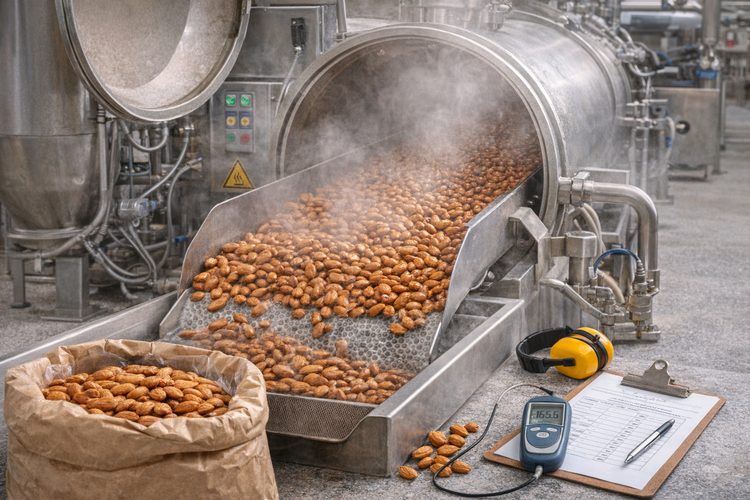
Almond pasteurization programs matter because industrial nut buying is rarely only about nominal price. In many commercial discussions, the buyer is not asking only for almonds. They are asking for almonds that fit a specific internal food safety policy, customer program, co-manufacturing rule or retail supply requirement. The stronger commercial outcome usually comes from aligning pasteurization status, product form, packaging, documentation and shipment timing before the order is placed.
That matters because a quote for raw almonds is not directly comparable with a quote for pasteurized almonds, even when the format looks similar on paper. Pasteurization status can change the process route, documentation package, program timing and sometimes the practical product menu available for a given application. Buyers who define that requirement early usually reduce unnecessary back-and-forth, avoid mismatched price comparisons and move faster from technical discussion to usable quotation.
Why buyers ask for pasteurized almonds
In real buying decisions, pasteurization is often requested because the almond program sits inside a wider quality and risk-management framework. The request may come from an internal procurement standard, a co-packer requirement, a retail customer expectation, an importer's specification or a brand policy designed to keep ingredient requirements consistent across facilities and finished product lines. In other words, pasteurization is frequently a program-level requirement, not just a one-off preference.
Some buyers ask for pasteurized almonds because they want continuity across multiple SKUs and manufacturing sites. Others ask for them because their downstream customer expects a defined ingredient status for nuts used in bakery, cereal, snack, confectionery, plant-based dairy or retail-ready products. In many cases, the request is less about marketing and more about operational alignment. The buyer wants the almonds supply brief to match the rest of the production and approval system.
Commercial takeaway: when a buyer says “pasteurized almonds,” the request usually carries several linked expectations: product status, documentation, traceability, pack handling and program consistency. It should be treated as a full specification point, not as a minor note at the end of an inquiry.
How this topic shows up in real buying decisions
For almonds, the quote should reflect the real format and route. Whole or kernel material is different from diced, meal, extra fine flour, butter or oil. The commercial logic also changes when the material is raw, pasteurized, dry roasted or oil roasted. A buyer evaluating pasteurized almonds for industrial bakery use may not need the same visual standard or packaging route as a buyer planning premium retail snack packs or export-oriented private label lines.
For almonds buyers, the usable product menu usually includes raw almonds, pasteurized almonds, dry roasted almonds, oil roasted almonds and further processed derivatives built from those routes. Which of those makes sense depends on the end use, whether the customer is manufacturing further, packing for retail or planning export distribution. Pasteurization therefore becomes one of the specification filters that helps narrow which California supply options are commercially appropriate.
Pasteurization is not only a status label
One of the most common sourcing mistakes is to treat pasteurization as though it were a simple box to tick without changing anything else in the commercial conversation. In practice, it can influence processing route, schedule coordination, how the product is quoted, how the paperwork is prepared and how the buyer compares multiple offers. It may also interact with format decisions, because the product the buyer needs is often not just “pasteurized almonds,” but “pasteurized diced almonds for granola,” “pasteurized whole kernels for retail snack packs,” or “pasteurized almond flour for further manufacturing.”
That is why Atlas encourages buyers to define the requirement in full commercial language. The most useful question is not only “Do you have pasteurized almonds?” It is “Do you have pasteurized almonds in the exact format, pack style and timing we need for our line?”
Common reasons pasteurization becomes mandatory inside a program
Pasteurization requirements often enter an almond program for several practical reasons. A customer may want a single standard across all nut inputs. A manufacturer may need alignment with an approved ingredient list. A co-manufacturing partner may require a specific input status before accepting delivery. A retail-ready brand may want the same policy applied across domestic and export markets for simplicity and continuity. A private label customer may build the status directly into the product brief from the start.
These reasons are commercial as much as technical. They affect how fast the product can be approved, whether the supplier documentation is sufficient and whether the buyer can compare offers without hidden differences. Pasteurization, in other words, often functions as a gatekeeping requirement that decides which suppliers and product routes are even relevant for the program.
How pasteurization affects price discussions
Pasteurization status can affect price because it changes the real service being quoted. The buyer is not only purchasing almonds by weight. They may also be purchasing a defined process status, a documentation trail, a packaging plan, a scheduling commitment and a more tightly specified supply route. That is why a raw almond quote and a pasteurized almond quote should not be compared casually, even if both originate from California almonds.
In commercial practice, buyers get the clearest comparisons when pasteurization status is fixed before pricing discussions begin. Otherwise one supplier may be quoting raw material, another pasteurized product and a third a different product form entirely. Those quotes may all look like “almond prices,” but they are not commercially equivalent.
Price comparison rule: a pasteurized almond quote only becomes comparable when the product form, pack style, documentation expectation and shipment timing are also aligned. Otherwise the buyer may be comparing different programs rather than different prices.
Product formats commonly requested under pasteurization programs
Pasteurization programs are not limited to one almond format. Buyers may request pasteurized whole kernels for snacking or retail repacking, pasteurized diced cuts for bakery, granola or snack mixes, pasteurized sliced or slivered formats for toppings and decoration, or pasteurized meal and flour for further processing. In some programs, pasteurized almond butter or other derived forms may also be part of the discussion depending on the application and how the product is manufactured.
The important point is that pasteurization should be defined together with the format. A request for “pasteurized almonds” is too broad for accurate commercial work if the real need is “pasteurized sliced almonds in industrial bags” or “pasteurized dry roasted kernels in retail-ready packs.” Atlas typically tries to narrow these details early so the quote reflects the actual business need.
Application-specific logic: why end use still matters
Pasteurization requirements show up differently depending on the end use. In bakery, the buyer may be focused on consistent ingredient status for inclusions, toppings or flour inputs. In confectionery, the concern may combine quality policy with product appearance and further process needs. In snack mixes and retail snack packs, the requirement often becomes part of the total retail specification rather than a standalone sourcing preference.
In granola and cereal, buyers may care about the combination of pasteurization status, cut size and roasting path. In plant-based dairy or other further-processed systems, the requirement may sit inside a broader technical brief involving grind, solids and documentation. This is why the end use should always be named in the quote request. Pasteurization status by itself does not tell the supplier enough.
Documentation and approval workflow
One reason buyers ask for pasteurized almonds is that the requirement often feeds directly into document review and approval workflow. The buyer may need the product specification, the declared status, supporting records, packaging details and consistency across repeated shipments. These administrative steps are not separate from the supply discussion. They are part of what makes the program workable in the real business.
That is also why timing matters. If a program requires a tighter approval chain, late clarification around pasteurization can slow sampling, quotation or first shipment. Buyers who bring the requirement forward earlier often save time because the supplier can shape the commercial response around the full requirement rather than revising the program later.
Why co-manufacturers and downstream customers care
Many almond programs are not managed by a single company from start to finish. The buyer may be sourcing for a co-manufacturer, a retail customer, an export distributor or a contract packing line. In these structures, pasteurization status often matters because it helps all parties work from the same ingredient assumptions. When one ingredient status is embedded in the product brief from the beginning, downstream coordination tends to be smoother.
This matters commercially because the supplier is often being asked to support not only the buyer but the entire chain behind the buyer. If the buyer already knows that a downstream customer expects pasteurized almonds, that detail should appear in the quote request immediately. Waiting until after quotation can make the comparison less reliable and the launch process slower.
Program note: many pasteurization requests are really coordination requests. They help manufacturers, co-packers, retailers and importers work from the same ingredient status so the product can move through approval and replenishment more smoothly.
Domestic and export considerations
Pasteurization programs can apply to both U.S. and export supply discussions, but the surrounding commercial details may differ. Domestic programs may focus more on routine replenishment, shorter lead times and compatibility with local production schedules. Export programs may add another layer of documentation, packaging, shipping and destination-market coordination. The underlying pasteurization requirement may be the same, but the delivery logic may not be.
For that reason, Atlas encourages buyers to define destination early. A domestic industrial buyer and an export private label buyer may both need pasteurized almonds, yet the pack style, paperwork flow and shipment timing assumptions can be materially different. Clarifying the market at the start helps keep the quote grounded in the real route to market.
Packaging and handling implications
Packaging is another area where pasteurization programs become more practical than theoretical. Once the buyer requests a defined ingredient status, the pack style and handling plan also matter. Industrial bulk bags, foodservice cases, retail-ready packs, private label pouches and export cartons each create different operational assumptions. The almond format and pack route should therefore be quoted together rather than in isolation.
For repeated programs, the packaging conversation usually becomes part of continuity planning. The buyer is not only asking for one approved shipment. They are often trying to create a repeatable supply arrangement that can be reordered without reopening the same specification questions every time.
Commercial planning points
From a trading standpoint, the best pasteurization programs are built around repeatability. That means clear documentation, agreed packaging, sensible shipment cadence and a commercial structure that supports continuity rather than one-off emergency buying. If pasteurization is a critical requirement, it should be locked into the brief early so that first samples, first quotes and repeat replenishment all follow the same logic.
When relevant, the brief should also mention whether the program is industrial bulk, foodservice, retail-ready, private label or export-oriented. That single clarification often changes packaging, documentation and timing assumptions. It also helps Atlas understand whether the requirement is primarily an ingredient-control issue, a retail program issue or a broader supply-chain coordination issue.
What Atlas would ask before quoting
Atlas encourages buyers to define intended use, pack style, destination, timeline and quality expectations early. For pasteurization programs specifically, the most useful quote request usually includes:
- The exact almond format required: whole, diced, sliced, slivered, meal, flour or another defined form
- Whether pasteurization status is mandatory for approval or simply preferred
- The intended application and downstream manufacturing context
- The pack style needed: industrial bulk, foodservice, retail-ready, private label or export-oriented
- Any documentation or approval expectations relevant to the program
- The destination market and shipment route
- The commercial stage: trial quantity, validation run, launch volume or repeat replenishment
- The expected volume rhythm and target shipment timing
Typical mistakes buyers can avoid
One common mistake is asking for a raw almond quote and only later mentioning that the program actually requires pasteurized status. Another is using “pasteurized almonds” as a broad term without defining the actual product form or downstream use. A third is comparing multiple supplier offers without checking whether each one is quoting the same status, format, packaging route and records expectation.
It is also common for teams to postpone documentation questions until the end of the process. In a pasteurization program, that usually slows approval. A better approach is to integrate the requirement into the quote request from the beginning, so the supplier can respond with a commercially relevant program rather than a partial price indication.
Buyer planning note
Atlas Global Trading Co. uses topics like this to move conversations from broad interest to a specification-minded inquiry. If you are evaluating pasteurized almonds supply, the most useful next step is to share the format, intended application, pack style, estimated volume, target timing and destination using the contact form below. That allows the next discussion to be grounded in a real commercial need instead of a generic price question.
Need help sourcing a pasteurized almonds program?
Use the contact form to turn this topic into a practical quote request with format, documentation needs, pack style and shipment timing clearly defined.
- State the exact almond format and whether pasteurization is mandatory
- Add target monthly or trial volume and documentation expectations
- Include destination market and target timing
Frequently Asked Questions
Why do buyers ask for pasteurized almonds?
Buyers often ask for pasteurized almonds because their internal food safety programs, customer requirements, retail standards or downstream manufacturing policies call for that status. In commercial practice, pasteurization is frequently part of a broader specification and documentation requirement rather than a standalone preference.
Does pasteurization change the quote compared with raw almonds?
Yes. Pasteurization status can change pricing because it affects process route, documentation, scheduling, handling assumptions and sometimes product format availability. Buyers should compare offers only when pasteurization status, product form and pack style are aligned.
What should buyers specify before requesting a pasteurized almond quote?
Buyers should specify the almond format, intended application, pasteurization requirement, pack style, documentation expectations, destination market, estimated volume and target timing. Those details make quotations more comparable and commercially useful.
Can pasteurization programs apply to both domestic and export supply?
Yes. Pasteurization programs are relevant to both U.S. and export supply discussions, although packaging, records, destination documentation and shipment planning may differ by market.