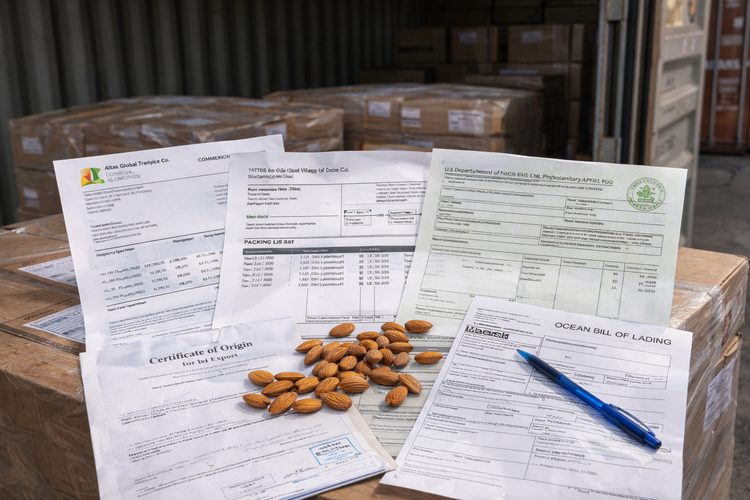
Industrial application & trade note
Export documentation for almond shipments matters because international nut trading is rarely won or lost on nominal product price alone. A shipment can be commercially sound at the quotation stage and still become costly if the paperwork file does not match the product, the shipment terms, the consignee instructions or the destination market’s practical requirements. In real buyer almond trade, documentation is part of the supply program itself. It affects customs clearance, importer planning, banking alignment, transport release, warehouse receiving, traceability and the buyer’s confidence in the exporter.
For that reason, strong almond export programs usually start by aligning product definition and shipment documentation at the same time. The exact almond format matters. Whole kernels, in-shell almonds, diced almonds, almond meal, almond flour, almond butter and almond oil do not move through the market in the same way. The document file may need to reflect different product descriptions, packaging structures, labeling statements, treatment status, lot identification and destination-side compliance expectations depending on the exact form being shipped.
The practical lesson is simple: the export file should be built from the actual commercial brief. Product format, treatment status, packaging style, destination, Incoterm, shipment method and buyer-specific document requests should be clarified before cargo moves.
Why documentation problems happen even in otherwise straightforward almond shipments
Documentation issues usually arise when commercial assumptions stay informal for too long. A buyer may assume that the exporter will issue a certain certificate as standard. The exporter may assume the buyer only needs the usual invoice and packing list. The forwarder may book a shipment based on one consignee format while the importer needs another. Labels may be approved late. Net weights may be revised after packing. Container loading may change the carton count. A destination market may ask for a specific origin statement, importer registration reference, or inspection-related document that was not identified when the quote was first discussed.
None of those problems are unusual. They are operational details. But in export trade, operational details become commercial risks very quickly. A mismatch between documents and cargo can delay release, trigger correction fees, create customs questions, complicate duty treatment, delay delivery appointments or force the buyer to spend time resolving issues that could have been prevented before dispatch.
That is why experienced almond buyers and sellers normally treat document planning as a pre-shipment workstream, not a last-minute administrative step. The stronger programs are built on a documentation checklist that is reviewed against the final order, the final packaging plan, the final destination and the final shipment mode.
Core document categories buyers usually review
Although document requirements vary by destination and program structure, most almond export shipments are reviewed across four broad categories: commercial documents, transport documents, compliance or origin-related documents, and buyer-specific support documents. A practical checklist should distinguish between those categories because each one is usually prepared by different parties and verified at different points in the shipment timeline.
Commercial documents usually form the backbone of the shipment file. These commonly include the commercial invoice and packing list. In many programs, those two documents drive downstream review because they describe the product, seller, buyer, quantities, weights, carton or pack structure and commercial terms the rest of the file must support.
Transport documents usually reflect how the cargo is moving. Depending on shipment mode, the buyer may expect a bill of lading, sea waybill, airway bill, forwarder release details or other transport-related references that match the consignee and shipment instructions exactly.
Compliance and origin-related documents often vary the most by market. These may include certificates of origin, phytosanitary paperwork, treatment-related documents, origin declarations, specification sheets, product statements or other destination-driven requirements.
Buyer-specific documents may include internal document formats, supplier declarations, testing summaries, signed statements, label copies, pallet maps, pre-alert packets or customs-broker support information requested by the importer or distributor.
Commercial invoice: more than a billing document
The commercial invoice is often treated too casually by inexperienced exporters. In practice, it is one of the most important documents in the file because it frequently anchors customs review, payment processing and internal receiving at the importer side. The invoice should align with the actual seller and buyer names, the agreed product description, the correct packaging description, the shipment term, the pricing basis and the final shipping references available at document issue stage.
For almond shipments, product description quality matters. A vague description may create confusion, especially if the buyer is importing more than one almond format or if the destination market expects the document description to reflect treatment status, kernel style or intended commercial form. The invoice should also be internally consistent with the packing list and any other supporting papers so that quantities, weights and product naming do not contradict one another.
Good commercial discipline also means deciding early whether the invoice language needs to reflect internal buyer coding, destination customs expectations, label-facing product descriptions or bank-facing commercial terminology. These choices are easier to manage before shipment than after the file has already been circulated.
Packing list: the operational map of the shipment
The packing list is where many avoidable discrepancies appear. Buyers, warehouses, customs brokers and transport partners all use it in slightly different ways. For the importer, it may function as the receiving map. For customs, it may support weight and package verification. For the warehouse, it can determine how the load is checked against arrival. That means the packing list should not simply repeat the invoice; it should clarify the packing logic of the cargo.
In almond trade, useful packing list detail often includes carton count, unit pack format, gross and net weights, pallet count where relevant, and other load-structure information the destination side needs to plan receiving. If the shipment includes more than one SKU, more than one lot or more than one packaging configuration, the value of a clean packing list increases significantly. The more complex the shipment, the more the packing list becomes an operational control document rather than a clerical attachment.
Transport documents and release coordination
Transport paperwork becomes especially important once the commercial file leaves the seller’s office and enters the logistics chain. Depending on the mode and route, the buyer may need the transport document not only for recordkeeping but also for release arrangements, customs filing, appointment booking and finance-side reconciliation. Errors in consignee names, notify party details, shipment references or routing information can cause delays even when the product file itself is correct.
One practical point buyers often overlook is that transport details should be aligned with the commercial order before shipment cutoff. If the buyer wants a certain consignee structure, customs broker notation or notify party format, that should be stated early. The same applies when the shipment is moving under specific bank, documentary or compliance instructions. The freight document must fit the agreed transaction model, not merely the default entry in a booking system.
Origin, phytosanitary and destination-specific papers
Many almond export programs also require paperwork beyond the basic invoice and packing list. The exact file depends on destination country, buyer type, importer requirements and the commercial structure of the sale. In some cases the additional document is primarily commercial, such as a certificate of origin used for customs or customer preference. In other cases it may be a phytosanitary or inspection-related document connected to how the shipment is reviewed at destination.
The practical point for buyers is not to assume that every market expects the same file. Some destinations are relatively straightforward. Others require more specific supporting papers, exact naming conventions or destination-specific statements. If the buyer knows that customs clearance or importer compliance will depend on particular documents, that requirement should be included in the inquiry, quotation review or order confirmation stage rather than after production is complete.
Destination requirements can vary widely. The safest commercial approach is to confirm the required document set with the importer, customs broker or destination compliance team before shipment finalization.
Specification sheets and product identity documents
In many almond programs, especially ingredient and industrial business, the buyer also expects a product specification sheet or another technical reference document. This may not always be a formal customs document, but it can still be commercially important. It helps the importer confirm that the shipped product matches the approved item, treatment route, packaging format and end-use expectations.
That is especially relevant when the buyer is not simply importing generic almonds for resale, but is manufacturing further. A bakery, snack, confectionery, dairy-alternative or ingredient buyer may rely on the product file to confirm that the shipment aligns with internal approval. In those cases, the specification and the shipment documents should support the same product story. If the specification says one thing and the commercial paperwork describes another, the importer may stop the shipment internally even before external authorities do anything.
Why product form changes the document logic
For almonds, document planning should always begin with the exact form being shipped. In-shell almonds are not the same as kernels. Raw almonds are not the same as roasted almonds. Almond flour, almond meal, diced almonds, almond butter and almond oil can each carry different commercial language, pack structures, user expectations and destination-side interpretations. The right document description for one product may be incomplete or commercially weak for another.
That is one reason Atlas emphasizes specification-minded quotation requests. If the buyer only asks for “almonds,” the eventual paperwork conversation may start from a weak foundation. If the buyer asks for natural kernels, pasteurized kernels, dry roasted diced almonds, extra fine almond flour, almond butter or another clearly defined format, the documentation plan becomes much easier to align with the shipment reality.
Pre-shipment checklist: what should be confirmed before cargo moves
A practical almond export checklist usually works best when it is reviewed one final time against the actual packed order. At minimum, buyers and sellers typically benefit from confirming: the exact product description, pack size and carton count, net and gross weights, seller and consignee details, Incoterm, destination address details where needed, transport routing references, document names requested by the importer, label wording expectations, and any special statements needed for customs or internal receiving.
It is also useful to confirm who is responsible for generating, checking and circulating each document. In many shipments, the exporter, forwarder, inspection body, chamber-type issuer, customs support party and importer all contribute to the final file. Problems happen when each party assumes someone else is checking the final alignment. A simple document responsibility matrix can prevent that.
Common mistakes that create avoidable delays
The most common problems in almond export documentation are rarely dramatic. They are usually mismatches. A carton count on the packing list that does not match the final load. A product description that does not match the approved label. A consignee name that differs between transport and commercial documents. Missing references requested by the buyer’s customs broker. Origin or compliance documents requested too late. Shipment timing that leaves no room for corrections before vessel cutoff or customer delivery booking.
Another common mistake is separating commercial and logistics conversations too sharply. Buyers may negotiate the product and price with one group, then hand the shipment to logistics without fully transferring the document requirements. That gap often leads to incomplete pre-alert packets or document corrections after sailing. Stronger programs avoid that by making documentation part of the commercial briefing from the beginning.
How this topic shows up in real buying decisions
For almond buyers, the quote should reflect the real format and route. Whole or kernel material is different from diced, meal, extra fine flour, butter or oil. The commercial logic also changes when the material is raw, pasteurized, dry roasted or oil roasted. Those product differences are not only manufacturing differences; they affect how documents should describe the cargo and what supporting papers may be commercially useful.
For almond programs on this website, the usable product menu may include in-shell almonds, raw almonds, pasteurized almonds, dry roasted almonds, oil roasted almonds, diced almonds, almond meal, almond flour, almond butter and almond oil. Which of those makes sense depends on the end use, whether the customer is manufacturing further, packing for retail or planning export distribution. The stronger the product brief, the easier it becomes to build a document file that supports the shipment rather than chasing the shipment after the fact.
What Atlas would ask before quoting
Atlas encourages buyers to define intended use, pack style, destination, timeline and quality expectations early. Those inputs help reduce avoidable back-and-forth and improve comparability across California supply options. When the inquiry is export-oriented, Atlas would also usually want to know whether the buyer already has a preferred document set, whether the shipment is moving to a distributor, processor or retailer, and whether the destination side has already flagged any market-specific documentation or labeling requirements.
That approach is not bureaucratic. It is commercial. The buyer who states the exact almond format, expected pack structure, monthly or trial volume, destination market and target shipment timing generally gets a more practical quotation discussion. Documentation readiness is one reason why.
Typical almond use cases on this website include bakery, confectionery, snack mixes, granola and cereal, plant-based dairy and ingredient manufacturing. The product brief should be tied to one of those concrete end uses whenever possible, because that also improves the document and packing discussion.
Commercial planning points
From a trading standpoint, the best programs are built around repeatability. That means clear documentation, agreed packaging, sensible shipment cadence and a commercial structure that supports continuity rather than one-off emergency buying. Repeating programs usually perform better because the document set, label logic, freight flow and buyer-side receiving expectations become standardized over time.
When relevant, the brief should also mention whether the program is industrial bulk, foodservice, retail-ready, private label or export-oriented. That single clarification often changes packaging, documentation and timing assumptions. A private label retail almond shipment may need very different paper coordination than an industrial flour shipment or a bulk kernel program going to a manufacturer.
Buyer planning note
Atlas Global Trading Co. uses topics like this to move conversations from broad interest to a specification-minded inquiry. Export documentation is not separate from sourcing; it is one of the areas where sourcing quality becomes visible. If you are evaluating almond supply, share the exact format, pack style, estimated volume, destination market and target timing using the floating contact form so the next step can be grounded in a real commercial need.