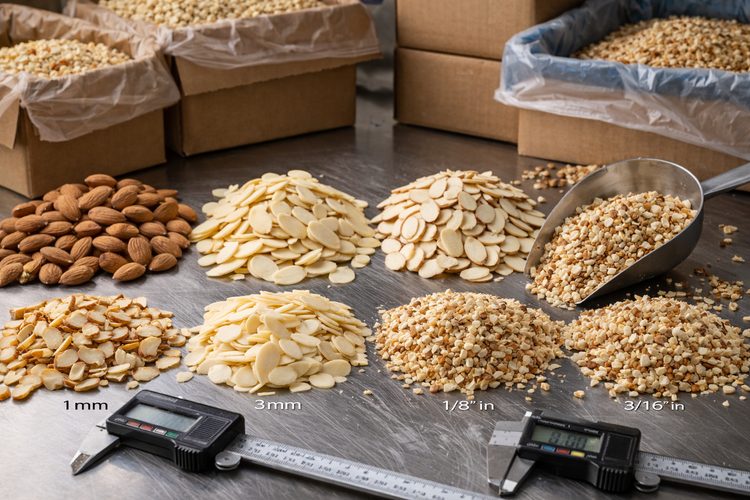
Industrial application & trade note
Specifying slice thickness and diced cut range matters because industrial nut buying is rarely only about nominal price. In real almond projects, cut geometry directly influences process performance, visual coverage, breakage behavior, finished texture, pack cleanliness and the buyer’s perception of value in use. A stronger commercial outcome usually comes from aligning specification, process route, packaging and shipment timing before the order is placed rather than treating particle size as a minor detail to be sorted out later.
For sliced and diced almonds, the cut is the product. Buyers are not simply purchasing “almonds” in a broad category sense. They are purchasing a certain behavior in production and a certain result in the finished food. Thin slices may create a broader visual spread and lighter topping effect. Heavier slices may deliver more bite and more visible nut identity. A tighter diced range may improve portion control and uniformity in bars or cereals. A more open commercial range may be acceptable where appearance is less critical and operational economics matter more.
That is why Atlas generally treats slice and dice projects as specification-led ingredient programs. A bakery topping, cereal inclusion, confectionery enrobing application, savory coating mix, dessert garnish and foodservice salad topper may all use cut almonds, but they do not necessarily need the same cut definition. The practical question is not “what almond cut is available?” but “what cut will do the job best in the buyer’s actual application?”
In sliced and diced almond programs, size is not just a descriptive feature. It influences process flow, visual presentation, texture, distribution in the finished product and how consistently the ingredient performs from trial through commercial replenishment.
How this topic shows up in real buying decisions
For almonds, the quote should reflect the real format and route. Whole or kernel material is different from sliced, slivered, diced, meal, extra fine flour, butter or oil. The commercial logic also changes when the material is raw, pasteurized, dry roasted or oil roasted. A buyer sourcing thin slices for a pastry top layer is making a different decision from a buyer sourcing diced almonds for inclusion in cereal clusters or protein bars, even if the two products originate from the same California raw material base.
In practice, buyers often arrive with a broad idea such as “sliced almonds for bakery” or “diced almonds for inclusions,” but that description is usually not yet strong enough for a precise commercial comparison. The next level of clarity often involves thickness preference, cut band, acceptable overs, acceptable unders, fines tolerance, roast state, appearance priority, pack style and whether the project is industrial bulk, foodservice, retail-ready or export-oriented.
For almond buyers, the wider usable product menu may still include in-shell almonds, raw almonds, pasteurized almonds, dry roasted almonds, oil roasted almonds and processed formats such as slices, slivers, dice, meal, flour, butter and oil. Which one makes sense depends on the end use, whether the customer is manufacturing further, packing for retail or planning export distribution. In cut projects, the challenge is usually not identifying the category but narrowing it to the right dimensional behavior.
Why slice thickness matters more than many buyers first assume
Slice thickness affects far more than visual style. Thinner slices may cover a larger visible area per unit weight, create a lighter topping impression and integrate more gently into bakery and dessert surfaces. They may also be more fragile, behave differently in transport and respond differently in roasting or secondary processing. Thicker slices may feel more premium in some applications because they deliver more obvious bite and shape definition, but they may also cover less area and change weight-per-appearance economics.
In bakery systems, slice thickness can influence surface adhesion, browning behavior, visual density and how the finished product looks after baking. In cereal and granola applications, it may influence how the almond component distributes through the blend and how much visible nut the buyer appears to be delivering. In confectionery and dessert use, slice thickness can affect both decorative appearance and eating texture. Because of that, buyers usually benefit from defining not just “sliced almonds,” but the real performance goal behind the slice requirement.
Commercially, this matters because two slice programs that look similar on a generic product sheet may create different value in use. The buyer paying attention to appearance yield, breakage risk, carton cleanliness and finished product repeatability will often reach a different decision than the buyer comparing price alone.
Why diced cut range is a process control issue
Diced almonds are often purchased because the buyer wants more controlled particulate behavior than whole kernels or broader broken pieces can provide. In bars, cookies, bakery fillings, cereals, chocolate systems, snack mixes and savory blends, a consistent cut range can help improve inclusion visibility, bite uniformity, weight consistency and plant handling. If the dice band is too wide for the application, the buyer may see excess overs, more fines, inconsistent distribution or an eating experience that feels less controlled than intended.
For many industrial users, diced cut range is really about tolerance management. A target size is important, but so are the acceptable levels of material above and below that target. Overs may interfere with depositor systems, distribution or finished appearance. Unders and fines may collect at the bottom of the bag, create dust, change blend behavior or affect perceived value when the finished product should look clean and premium.
This is why many sophisticated diced almond buyers define their needs through the application: cereal cluster inclusion, dessert topping, bar interior, bakery dough mix, confectionery layer or salad topper. The same nominal “diced almond” can be commercially acceptable in one of those systems and operationally weak in another if the cut profile is not matched to the use.
Raw, pasteurized and roasted state can change cut behavior
Slice thickness and diced cut range do not exist in isolation from process state. A raw cut almond may behave differently from a roasted cut almond in terms of fragility, aroma, color development and how it is perceived in the final system. For some applications, the buyer may want raw cut material because the product will be baked or roasted later in the process. For others, a roasted cut may be preferred because the finished product needs a ready-developed nut note or because the almond is being used as a topping or inclusion without substantial further heat treatment.
That distinction matters at quotation stage because the commercial logic changes when the material is raw, pasteurized, dry roasted or oil roasted. The physical handling, breakage expectation, appearance standards and packaging choices can all change with the process state. A good quote request therefore links the cut definition to the process route, not just to the nominal size category.
A strong cut specification usually combines three things: the target particle profile, the acceptable tolerance window and the actual end use. Without all three, buyers may receive offers that are hard to compare on a true like-for-like basis.
What buyers usually define for sliced almond projects
For sliced almonds, buyers often begin with the intended application and then work backward into thickness, coverage and tolerance expectations. Bakery and pastry users may focus on top-of-product appearance, breakage resistance and browning response. Cereal or granola users may care more about visible spread, blend distribution and weight efficiency. Foodservice buyers may prioritize attractive appearance and manageable breakage across transport and handling.
Beyond the target thickness direction itself, buyers commonly review whether slice appearance is more important than exact throughput economics, whether the application tolerates some broken material, whether the material will be roasted or baked after purchase, and how the slices will be packed and handled. Thinner or more delicate slice programs may need stronger attention to pack style and transit conditions if the buyer wants a clean presentation at the receiving end.
What buyers usually define for diced almond projects
For diced almonds, buyers often focus on target cut band, piece distribution and the acceptable balance between usable core particles and less desirable material such as fines. In many applications, visual cleanliness matters almost as much as the target size itself. A diced inclusion used in premium cereal, confectionery or visible bakery items is often judged by the cleanliness of the bag and the repeatability of the particle profile from lot to lot.
Industrial buyers may also define whether the dice is being blended into a matrix, deposited into a system, used as an external topping or mixed into a dry component. Those distinctions change what “good” looks like. A cut that performs well inside a dense bar system may not create the same result on the surface of a pastry or in a clear-sided retail snack mix.
Commercial consequences of overs, unders and fines
One reason cut projects deserve more detailed briefs is that commercial disputes often arise from expectations that were never written down. A buyer may think the core target size is enough. The supplier may interpret the order through a more open commercial range. The result is not necessarily wrong product, but it may be wrong for the application. That is especially common when overs, unders and fines were not discussed clearly at the quotation stage.
In real buyer terms, excess fines can affect pack cleanliness, consumer perception, depositor consistency, blend ratios and waste perception on the line. Excess overs can create visual inconsistency, processing issues or difficult-to-control bite. For that reason, serious buyers usually treat cut-range clarity as part of the commercial brief, not as an afterthought once samples are already in motion.
Packaging and logistics matter more for fragile cuts
For cut almonds, packaging is not only about shipping convenience. It also supports cut integrity. Sliced almonds, especially thinner profiles, may be more sensitive to handling and transit than less fragile formats. Diced almonds may accumulate more fines if the pack structure, handling discipline or shipment mode does not match the fragility of the material and the cleanliness expectation of the buyer.
That is why the same cut specification may need different packaging logic depending on whether the program is industrial bulk, foodservice, retail-ready, private label or export-oriented. A local industrial buyer with fast turnover may accept a different handling model from an exporter who needs long transit, multiple warehouse touches and cleaner presentation at destination. The packaging conversation should therefore sit inside the cut conversation, not outside it.
How this topic connects to quotation quality
Atlas encourages buyers to define intended use, pack style, destination, timeline and quality expectations early because those inputs help reduce avoidable back-and-forth and improve comparability across California supply options. For slice and dice projects, it also helps to include whether the application is visual, textural, structural or process-driven. That single clarification often changes the commercial reading of the same nominal size brief.
A stronger quote request for cut almonds will often include the exact format, target thickness or cut range direction, roast or process state, whether appearance or process flow is the leading priority, the acceptable tolerance mindset, pack style, destination market and the volume rhythm. When those points are defined together, the inquiry becomes far more useful than a generic request for “sliced almonds” or “diced almonds.”
Typical use cases for almonds on this website include bakery, confectionery, snack mixes, granola & cereal and plant-based dairy. For cut projects, the product brief should still be tied to a concrete use case such as pastry topping, cereal inclusion, chocolate decoration, bar interior, salad topper or dessert garnish.
Commercial planning points
From a trading standpoint, the best slice and dice programs are built around repeatability. That means a clear cut brief, agreed packaging, sensible shipment cadence and a commercial structure that supports continuity rather than one-off emergency buying. Cut projects often improve significantly once the buyer moves from trial language to a recurring replenishment model, because both technical expectation and logistics handling become more disciplined.
When relevant, the brief should also mention whether the program is industrial bulk, foodservice, retail-ready, private label or export-oriented. That single clarification often changes packaging, documentation and timing assumptions. It may also change how strict the buyer needs to be about visual cleanliness, case presentation and distribution resilience.
Commercially, many projects move through four stages: sample review, validation run, launch quantity and repeat replenishment. Atlas generally finds that buyers who explain where they are in that sequence get a more practical discussion around both technical suitability and commercial feasibility.
Buyer planning note
Atlas Global Trading Co. uses topics like this to move conversations from broad interest to a specification-minded inquiry. If you are evaluating almonds supply for sliced or diced applications, share the exact format, pack style, estimated volume, destination and target use using the floating contact form so the next step can be grounded in a real commercial need.